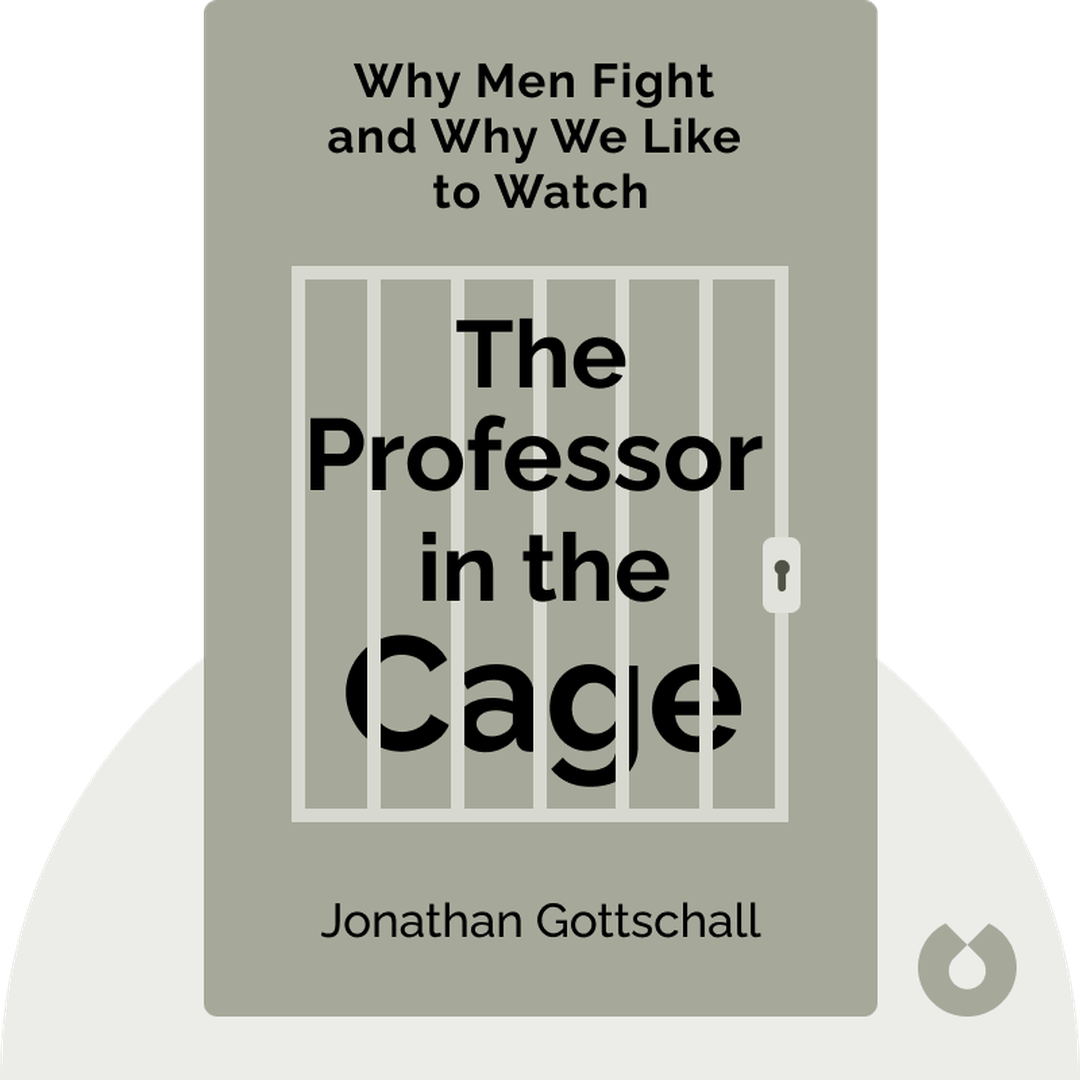
The Professor in the Cage
Start ListeningDownload Try free on iPhoneScan to start in 5 seconds
Categories:
If You're Curious About These Questions...
You should listen to this audiobook
- How do fundamental evolutionary and reproductive differences explain why physical violence is predominantly committed by young, unmarried men?
- In what ways did early sports, such as the Native American precursor to lacrosse, function as a strategic substitute for full-blown warfare between rival tribes?
- Why does modern society remain so captivated by the spectacle of violence in sports like mixed martial arts, despite living in a relatively peaceful historical period?
Listen to The Professor in the Cage — Free Audiobook
Loading player...
Key Takeaways from The Professor in the Cage
- Throughout history, humans have controlled their natural violent urges by codifying them into highly regulated ritualized combat, such as formal duels and mixed martial arts.
- Evolutionary reproductive disparities have made men more prone to physical competition and risk-taking, whereas women tend to engage in indirect, reputation-based conflict.
- The inherently competitive play styles of boys evolve into adult rituals—from professional sports to rap battles—that establish social hierarchies while limiting lethal violence.
- Many popular sports originated as direct preparations for battle or as less lethal alternatives to warfare, a legacy still visible in modern sports vocabulary and tribal fan loyalty.
- Mixed martial arts strips away the religious and artistic restrictions of traditional combat styles, functioning as a practical laboratory to test and combine the most effective real-world fighting techniques.
Learning Tools
Reinforce what you learned from The Professor in the Cage
Mind Map
The Professor in the Cage
Evolution & Codification of Violence+
Ritualized Combat & MMA+
Gender, Biology & Violence+
Sports as Surrogate Warfare+
The Spectacle of Violence+
Quiz — Test Your Understanding
Question 1 of 8
According to the text, how has human society primarily managed its natural violent impulses over time?
Question 2 of 8
What is the primary evolutionary function of 'ritualized combat' in both human and animal societies?
Question 3 of 8
Based on the text, what is the evolutionary reason given for why males tend to be more competitive and physically violent than females?
Question 4 of 8
How do women typically engage in conflict differently than men, according to the book's claims?
Question 5 of 8
What does the text suggest about the differing play styles of young boys and girls?
Question 6 of 8
What dual purpose did sports historically serve in relation to warfare?
Question 7 of 8
How does modern society's appetite for the spectacle of violence differ from that of our ancestors?
Question 8 of 8
What distinguishes Mixed Martial Arts (MMA) from many traditional Asian martial arts, according to the text?
The Professor in the Cage — Full Chapter Overview
- 1Recommendation
- 2Fighting is a human act, but it has become increasingly codified over time.
- 3MMA appeals to people as a way to confront bullies and as a ritualized form of combat.
- 4Fighting is strongly associated with masculinity.
- 5Boys usually play more competitively while girls favor cooperation – and adults show the same pattern.
- 6Historically, sport both trained people for war and helped prevent it.
- 7Humans have always been thrilled by the spectacle of violence.
- 8Of all martial arts, MMA most closely resembles real combat.
The Professor in the Cage Summary & Overview
In The Professor in the Cage (2015), professor Jonathan Gottschall enters the world of mixed martial arts to discover the sources of our fascination with violence. Through the power of modern science and by applying the weight of human history, these blinks reveal how our love of fighting is grounded in our deepest human instincts.
Who Should Listen to The Professor in the Cage?
- Anyone interested in the origins of violence
- People fascinated by martial arts
- Anyone hoping to learn more about humanity’s fascination with fighting
Books Similar to The Professor in the Cage
Readers who enjoyed this also liked these titles.