If You're Curious About These Questions...
You should listen to this audiobook
- What's the secret to unlocking the hidden meaning behind the world's most enduring myths and legends?
- Are you curious about how the stories of our ancestors hold the key to understanding our own motivations and desires?
- Can you tap into the ancient wisdom of myths to discover your own path to personal growth and fulfillment?
Listen to Maps of Meaning — Free Audiobook
Loading player...
Key Takeaways from Maps of Meaning
- Discover how humans conquer their innate fear of the unknown by using thought and action to transform terrifying anomalies into safe, familiar territory.
- Learn why pure rationalism falls short in helping us navigate daily life, and how our emotions actually dictate the meaning of our experiences.
- Understand how ancient myths serve as profound psychological tools rather than prescientific nonsense, helping us make sense of a chaotic and frightening world.
- Uncover the universal structure shared by all cultural myths, which consistently follow a brave hero's journey into the unknown and their triumphant return.
- Identify the core archetypes that populate our shared stories, such as the Great and Terrible Mother who represents the threatening yet promising forces of the unknown.
Learning Tools
Reinforce what you learned from Maps of Meaning
Mind Map
Maps of Meaning
The Known vs. The Unknown+
The Role of Stories & Myths+
Universal Mythic Archetypes+
Models for Society & Behavior+
Anomalies & Adaptation+
Meaning Through Limitations+
Evil & Ideology+
Quiz — Test Your Understanding
Question 1 of 9
How do humans and rats similarly react when first encountering an entirely new and unfamiliar environment?
Question 2 of 9
According to the text, why is the pure rationalism of modern science insufficient for helping humans navigate the real world?
Question 3 of 9
In the universal structure of myths, what does the archetype of the 'Great and Terrible Father' typically represent?
Question 4 of 9
What important societal lesson is demonstrated by the Egyptian myth of Osiris and his son Horus?
Question 5 of 9
While growing up requires us to identify with our cultural group, what is the crucial second step of emancipation that prevents individuals from enabling authoritarianism?
Question 6 of 9
What is required when an individual encounters a 'major anomaly' that drastically shatters their current worldview, such as suddenly being fired from a dream job?
Question 7 of 9
What does the Christian creation myth of Adam and Eve eating the forbidden fruit illustrate about human existence?
Question 8 of 9
How does the text define the true nature of 'evil,' as personified by the mythical figure of Satan?
Question 9 of 9
Why is sticking to a rigid ideology considered detrimental to living a good and meaningful life?
Maps of Meaning — Full Chapter Overview
- 1Recommendation
- 2Humans explore their surroundings because they fear the unknown.
- 3Stories help us navigate the world as a meaningful place.
- 4All myths share the same basic structure.
- 5Myths offer models for how societies should function and how individuals should act.
- 6Growing up means learning to identify with both the group and the hero.
- 7Anomalies threaten the stability of our minds and societies — and push us to adapt.
- 8Our limitations are what make a meaningful existence possible.
- 9Evil means refusing creative exploration, and we’re all capable of it.
- 10To reach our full potential, we must forge our own path.
- 11Final summary
Maps of Meaning Summary & Overview
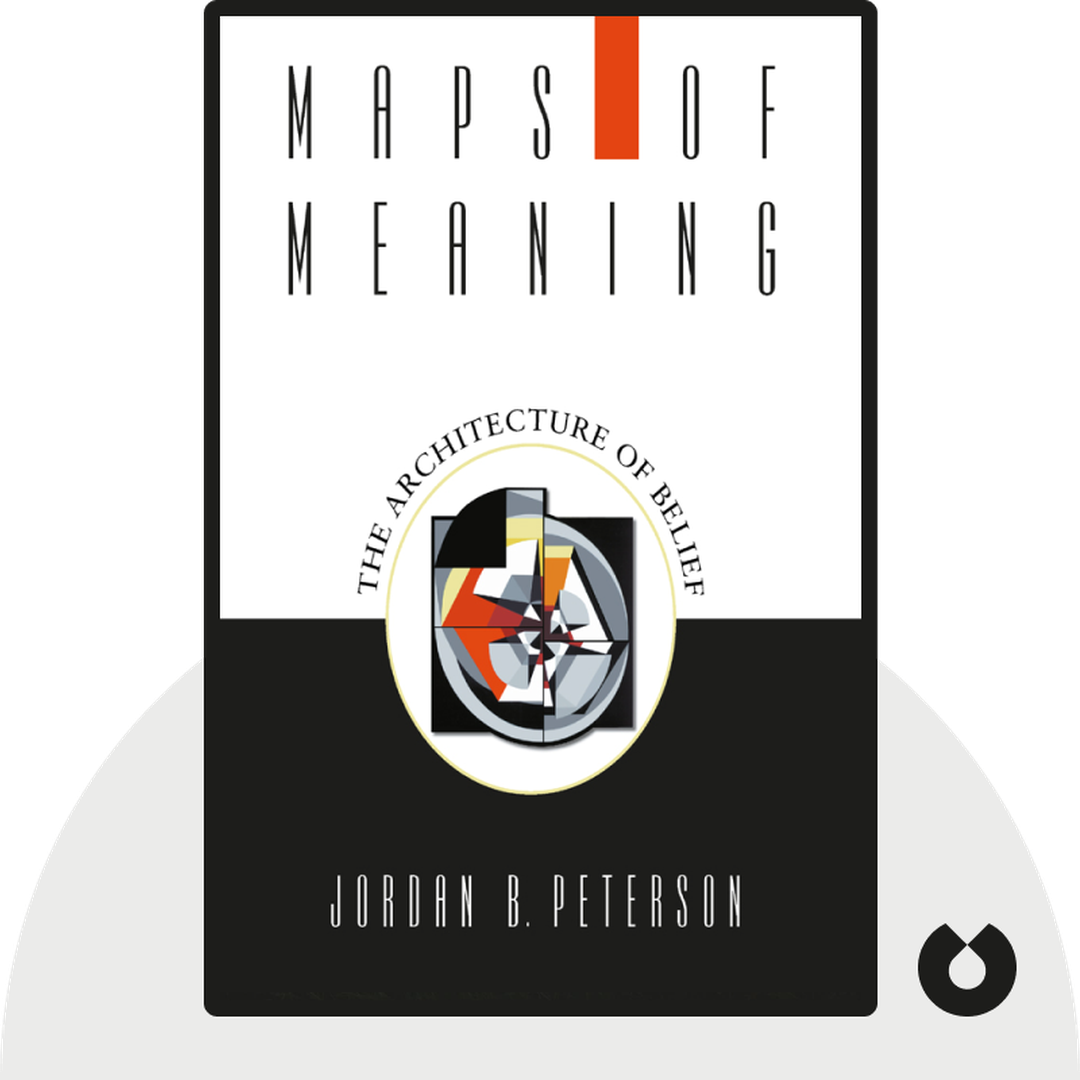
Maps of Meaning (1999) argues that myths provide the key to understanding the human psyche and our shared culture. Combining classic psychoanalysis with psychology, social and historical analysis, Jordan B. Peterson reveals how myths convey morality and create meaning in our lives – and what we can learn from them to reach our individual potential.
Who Should Listen to Maps of Meaning?
- Psychologists interested in ancient history, and historians interested in human nature
- Jordan Peterson devotees who want to dive deeper into his system of thought
- Skeptics who want to better understand the author’s controversial theories
Books Similar to Maps of Meaning
Readers who enjoyed this also liked these titles.