Theme Song
If You're Curious About These Questions...
You should listen to this audiobook
- Have you ever wondered why humans are capable of both extreme acts of kindness and shocking violence, often within the same hour?
- Did you know that the decisions you make right now are influenced by biological triggers that started firing seconds, years, and even centuries ago?
- Are you curious about how much of your daily behavior is actually a choice, and how much is dictated by the hidden chemistry of your brain?
Listen to Behave — Free Audiobook
Loading player...
Key Takeaways from Behave
- Understand how the brain's three distinct layers—the ancient regulatory system, the emotional limbic system, and the cognitive cortex—collaborate to trigger or suppress your behavioral reactions.
- Discover why human behavior is far less rational than expected, largely driven by subliminal sensory cues like environmental chaos, subtle biases, or a person's attractiveness.
- Learn how internal physical states like pain do not universally cause aggression, but instead affect naturally aggressive and nonaggressive individuals in completely opposite ways.
- Uncover the truth behind testosterone to see that the hormone does not directly cause aggression, but rather boosts confidence, optimism, and feelings of dominance.
- Explore how violence and behavior are highly contextual, and how analyzing the exact biological timeline of our actions can help improve your decision-making and relationships.
Learning Tools
Reinforce what you learned from Behave
Mind Map
Behave
Timeframes of Behavior+
Brain Regions & Aggression+
Sensory & Social Cues+
Hormones & Context+
Developmental Impacts+
Culture, Ecology & Geography+
Neurobiology of Politics & Morality+
Empathy vs. Compassion+
Quiz — Test Your Understanding
Question 1 of 10
What role does the frontal cortex play in relation to the amygdala regarding aggressive behavior?
Question 2 of 10
How does testosterone influence human aggression according to the text?
Question 3 of 10
Why does childhood adversity often lead to a tendency toward violence later in life?
Question 4 of 10
How do cultural backgrounds affect sensory processing when individuals view a complex scene?
Question 5 of 10
According to the text, how did agricultural practices in Northern China influence cultural behavior?
Question 6 of 10
What neurobiological trait is associated with conservative worldviews in the text?
Question 7 of 10
What happens in the brain of a generally honest person when they are given the opportunity to deceive?
Question 8 of 10
Why does the author suggest that it is better to practice compassion rather than empathy when trying to help someone in distress?
Question 9 of 10
What does the text reveal about the relationship between the hormone oxytocin and trust?
Question 10 of 10
In experiments where faces of different ethnicities are flashed for one-tenth of a second, what immediate brain response is observed?
Behave — Full Chapter Overview
- 1Recommendation
- 2Understanding human behavior means exploring the brain, culture, and history.
- 3Two brain regions control aggression — and whether we act on it.
- 4Sensory cues in our immediate surroundings shape our behavior.
- 5Hormones influence human behavior, but their effects depend on context.
- 6Childhood and adolescent experiences shape our behavioral development.
- 7Cultural factors help explain behavior in society.
- 8Local ecology and geography shape civilizational and behavioral development.
- 9The brain’s neurobiology can influence political views and morality.
- 10Empathy and compassion aren’t as closely linked as many people think.
- 11Final summary
Behave Summary & Overview
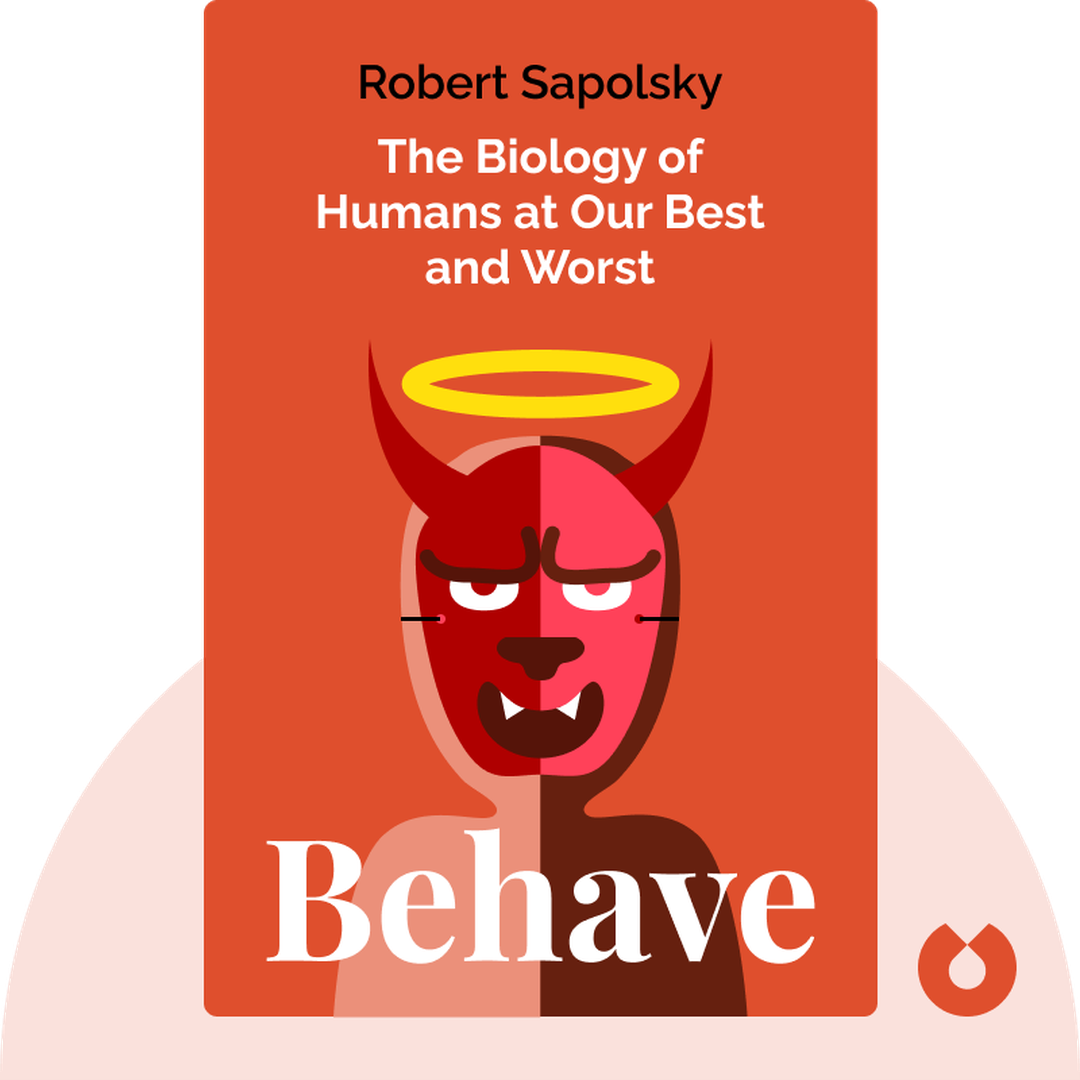
Humans are complex beings, and human behavior doubly so. Every human act is a result of a myriad of factors, from brain chemistry to social conditioning, that have developed over millennia. In Behave (2017), renowned professor Robert Sapolsky takes a journey into the depths of the human condition, demonstrating the reasons behind the best – and worst – of human behavior.
Who Should Listen to Behave?
- Anyone interested in behavioral psychology
- Students of neurology or biology
- Curious readers looking to gain a better understanding of their own minds
Books Similar to Behave
Readers who enjoyed this also liked these titles.