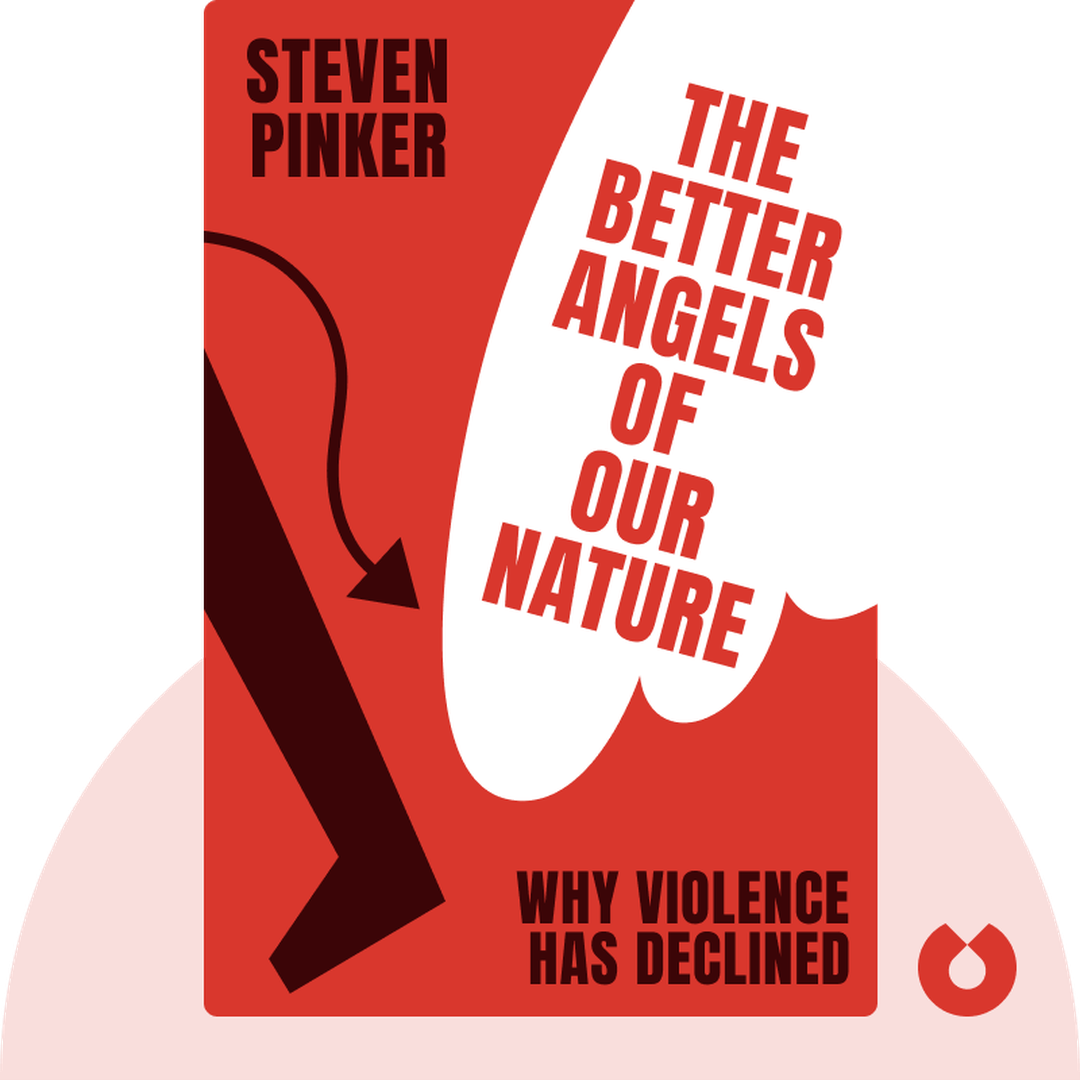
The Better Angels of Our Nature
Start ListeningDownload Try free on iPhoneScan to start in 5 seconds
Categories:
If You're Curious About These Questions...
You should listen to this audiobook
- Why does the human brain react to exacting revenge similarly to taking cocaine, and how did this dangerous trait originally evolve as a survival mechanism?
- How did the shift from medieval estates to consolidated nations transform society so drastically that headbutting a cat to death went from popular entertainment to unthinkable cruelty?
- How does the 'Flynn Effect'—the continuous generational rise in human IQ—directly contribute to the historical decline in global warfare and violence?
Listen to The Better Angels of Our Nature — Free Audiobook
Loading player...
Key Takeaways from The Better Angels of Our Nature
- Despite widespread pessimistic beliefs, humanity is currently living in the most peaceful era in its history due to a continuous, centuries-long decline in violence.
- Our 'inner demons,' such as the drive for dominance, revenge, and utopian ideologies, evolved as crude evolutionary survival mechanisms but often lead to devastating bloodshed.
- Humanity possesses four 'better angels'—empathy, self-control, morality, and reason—that actively counteract our violent impulses and can be strengthened through practice, nutrition, and education.
- The historical transition from nomadic tribes to agricultural states drastically reduced violence by establishing a government monopoly on force, making societal conflict less profitable.
- The rise of global trade networks incentivized peace by establishing reciprocal relationships where people became economically more valuable alive than dead.
Learning Tools
Reinforce what you learned from The Better Angels of Our Nature
Mind Map
The Better Angels of Our Nature
Inner Demons (Motivators for Violence)+
Better Angels (Inhibitors of Violence)+
Six Historical Shifts+
Actionable Advice+
Quiz — Test Your Understanding
Question 1 of 12
What is the core premise of 'The Better Angels of Our Nature'?
Question 2 of 12
According to the text, why do many social species establish dominance hierarchies?
Question 3 of 12
From an evolutionary standpoint, why did the human desire for revenge likely evolve?
Question 4 of 12
How does ideological violence differ from instrumental violence (predation)?
Question 5 of 12
Which of the following is true about human self-control, according to the text?
Question 6 of 12
How does humanity's sense of morality influence violent behavior?
Question 7 of 12
What phenomenon does the book cite as evidence that our faculty for reason is increasing?
Question 8 of 12
What major change during the 'Pacification Process' significantly reduced human violence 5,000 years ago?
Question 9 of 12
During the 'Civilizing Process,' how did the expansion of trade networks help reduce violence?
Question 10 of 12
Which technological invention is cited as a probable cause for the growth of humanism during the Humanitarian Revolution?
Question 11 of 12
What defines the 'Long Peace' that followed World War II?
Question 12 of 12
According to the book's actionable advice, what is a practical way for individuals to reduce their own violent urges?
The Better Angels of Our Nature — Full Chapter Overview
- 1Recommendation
- 2Predation: Violence is a simple, natural method to obtain what we want, but it is also crude and risky.
- 3Dominance: Violence may also serve to boost one’s social status, simplifying access to mates or resources.
- 4The urge for revenge drives violence worldwide and likely evolved as a powerful deterrent.
- 5Sadism is an uncommon and puzzling behavior that appears to be a learned appetite.
- 6Ideology: Noble-seeming dreams of a better world have unleashed vast carnage.
- 7Empathy emerged to nurture our kin, yet we can also extend empathy to other groups.
- 8Self-control enables us to resist violent urges, and it can be fortified or eroded by habit.
- 9Our moral sense may foster or restrain violence, yet luckily it is shifting toward restraint.
- 10Reason compels us to pursue peace and nonviolence, and our capacity for reason is growing.
- 11The pacification process started 5,000 years ago, when emerging states seized control over violence.
- 12As states expanded and trade blossomed, earning wealth honestly became preferable to using violence.
- 13The Humanitarian Revolution curbed cruelty by asserting that even the despised merited humane care.
- 14The long peace after the Second World War continued a 500-year pattern of waning warfare.
- 15The New Peace after the Cold War has brought additional declines in war, genocide and terror.
- 16The Rights Revolutions since the 1960s cut violence toward marginalized people, including women and racial minorities.
The Better Angels of Our Nature Summary & Overview
The Better Angels of Our Nature (2012) takes a close look at the history of violence in human society, explaining both our motivations to use violence on certain occasions and the factors that increasingly restrain us from using it – and how these factors have resulted in massive reductions in violence.
Who Should Listen to The Better Angels of Our Nature?
- Anyone who thinks the world is becoming an increasingly violent place
- Anyone who’s interested in the forces and reasons that drive us to and keep us from violence
- Anyone interested in the history of violence in human societies
Books Similar to The Better Angels of Our Nature
Readers who enjoyed this also liked these titles.