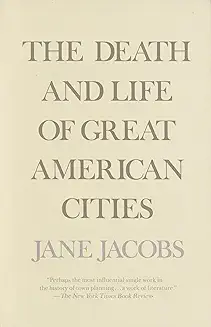
If You're Curious About These Questions...
You should listen to this audiobook
- Have you ever wondered why some city streets feel naturally safe and vibrant at all hours, while others feel deserted and dangerous despite being 'orderly'?
- What if the secret to a thriving neighborhood isn't brand-new construction, but rather a specific mix of old buildings and short, 'messy' blocks?
- Are you curious about how the most successful cities actually work as living systems, and why traditional urban planning often destroys the very vitality it tries to create?
Listen to The Death and Life of Great American Cities — Free Audiobook
Key Takeaways from The Death and Life of Great American Cities
- — The City Gets Sacked
- — Looking at Real Streets, Not Dream Cities
- — Sidewalks as the City’s Safety System
- — Sidewalk Contact, Trust, and Public Characters
- — Children, Parks, and the Myth of the ‘Gutter’
The Death and Life of Great American Cities — Full Chapter Overview
Chapter 1: Recommendation
Chapter 2: The City Gets Sacked
Chapter 3: Looking at Real Streets, Not Dream Cities
Chapter 4: Sidewalks as the City’s Safety System
Chapter 5: Sidewalk Contact, Trust, and Public Characters
Chapter 6: Children, Parks, and the Myth of the ‘Gutter’
Chapter 7: What Neighborhoods Are Actually For
Chapter 8: The Four Conditions That Generate City Diversity
Chapter 9: How Success Destroys Itself, and Borders Kill Life
Chapter 10: Money, Housing, Cars, and the Real Problem Cities Are
The Death and Life of Great American Cities Summary & Overview
In The Death and Life of Great American Cities, Jane Jacobs launches a direct attack on mid-20th-century urban renewal and orthodox planning. She argues that the biggest failures of modern rebuilding—tower-in-the-park projects, single-use districts, superblocks, and highway slicing—come from misunderstanding what cities are: not tidy machines, but living systems whose strength comes from everyday diversity and constant street-level interaction.
Jacobs builds her case by observing ordinary scenes: sidewalks that stay safe because of “eyes on the street,” parks that thrive only when surrounded by active mixed uses, and “slums” that improve themselves when residents can stay put and reinvest. She then identifies four conditions that generate city vitality—mixed primary uses, small blocks, aged buildings, and high concentration—and shows how cities decline when planning and financing destroy those conditions. The book concludes with practical tactics for housing, traffic, design, and governance, grounded in the idea that a city is a problem of organized complexity.
Who Should Listen to The Death and Life of Great American Cities?
- Urban planners, architects, and transportation professionals who want a street-level, reality-based framework for city vitality.
- Civic leaders, neighborhood advocates, and policy makers working on housing, safety, zoning, or downtown revitalization.
- Readers who love cities and want to understand why some neighborhoods thrive while others hollow out.
Books Similar to The Death and Life of Great American Cities
Readers who enjoyed this also liked these titles.
Poverty and Profit in the American City
How Progressive Elites, Tribalism, and Globalization Are Destroying the Idea of America
A History of the City, Humankind's Greatest Invention

How the Rebirth of Tribalism, Populism, Nationalism, and Identity Politics is Destroying American Democracy