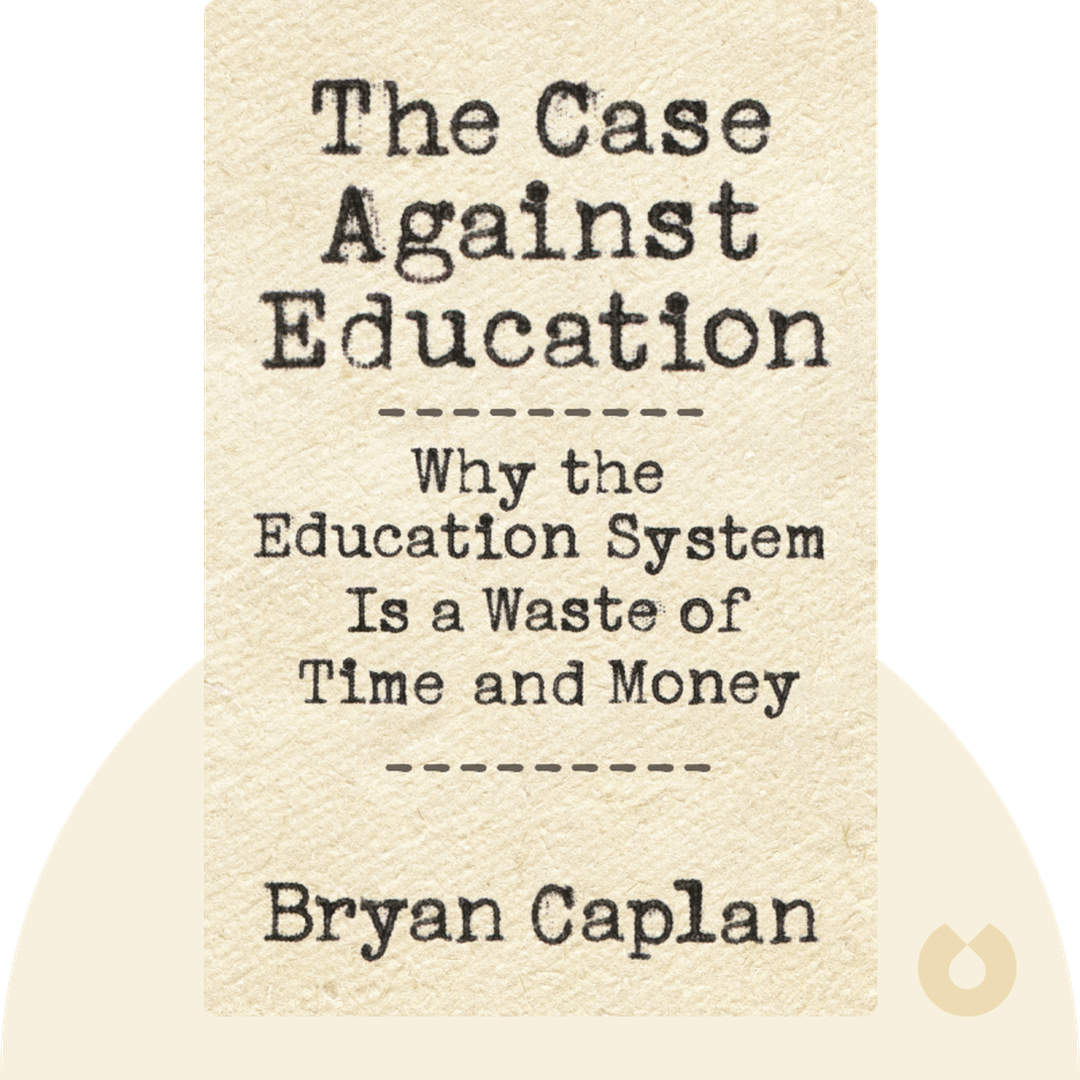
The Case Against Education
Start ListeningDownload Try free on iPhoneScan to start in 5 seconds
Categories:
If You're Curious About These Questions...
You should listen to this audiobook
- Have you ever wondered why employers value a college degree so highly, even when the subjects studied have almost nothing to do with the actual job?
- What if the primary purpose of school isn't to teach you useful skills, but to act as a high-stakes 'signaling' game to prove your personality traits to the world?
- Are you curious about the provocative reason why a massive national investment in education might actually be making society less productive?
Listen to The Case Against Education — Free Audiobook
Loading player...
Key Takeaways from The Case Against Education
- Discover why most of what students learn in school is irrelevant to modern life and fails to translate into real-world critical thinking skills.
- Understand the theory of 'signaling' to see how a degree boosts earnings by proving preexisting traits like intelligence and obedience, rather than teaching practical workplace skills.
- Learn why the financial premium of a college degree is often vastly overestimated by ignoring the innate intelligence and conscientiousness of graduates.
- Find out why pursuing a college degree is often a poor financial decision for average students, whose tuition money might see better long-term returns in the stock market.
- Master the ability to evaluate the true return on investment of higher education by crunching the numbers and ensuring you select an employable major.
Learning Tools
Reinforce what you learned from The Case Against Education
Mind Map
The Case Against Education
Curriculum Irrelevance+
Signaling vs. Human Capital+
Individual ROI+
Societal Harm+
The Soul Enrichment Myth+
Reforms and Solutions+
Quiz — Test Your Understanding
Question 1 of 6
According to the text, why do educators' claims that studying subjects like geometry or English essays teaches 'critical thinking' fall short?
Question 2 of 6
How does 'signaling' theory explain the increased earnings of college graduates compared to 'human capital' theory?
Question 3 of 6
Why do commentators often overestimate the 'education premium' (the financial bonus of getting a degree)?
Question 4 of 6
What is a major societal consequence of more and more people getting college degrees, according to the author?
Question 5 of 6
The argument that education is a 'soul-enriching experience' is largely dismissed in the text primarily because:
Question 6 of 6
Which of the following is a reform suggested by the author to reduce the wastefulness of the education system?
The Case Against Education — Full Chapter Overview
- 1Recommendation
- 2Much of what US students study in school is utterly irrelevant to their lives.
- 3Signaling helps explain why college graduates earn more.
- 4Attending college is not always worth it.
- 5More schooling isn’t always good for society.
- 6Education can certainly enrich the soul, but it’s far too rare to really count.
- 7A few simple measures could drastically reduce the wastefulness of education.
The Case Against Education Summary & Overview
The Case Against Education (2018) takes orthodox opinion about education and turns it on its head. It argues that, far from turning students into skillful and productive workers, education serves primarily to verify employable character traits. Using this insight as its central premise, it goes on to argue that education needs to be substantially reformed.
Who Should Listen to The Case Against Education?
- Public-policy buffs interested in educational reform
- Teachers and educators willing to engage with shocking ideas
- Young people wondering if college is for them
Books Similar to The Case Against Education
Readers who enjoyed this also liked these titles.