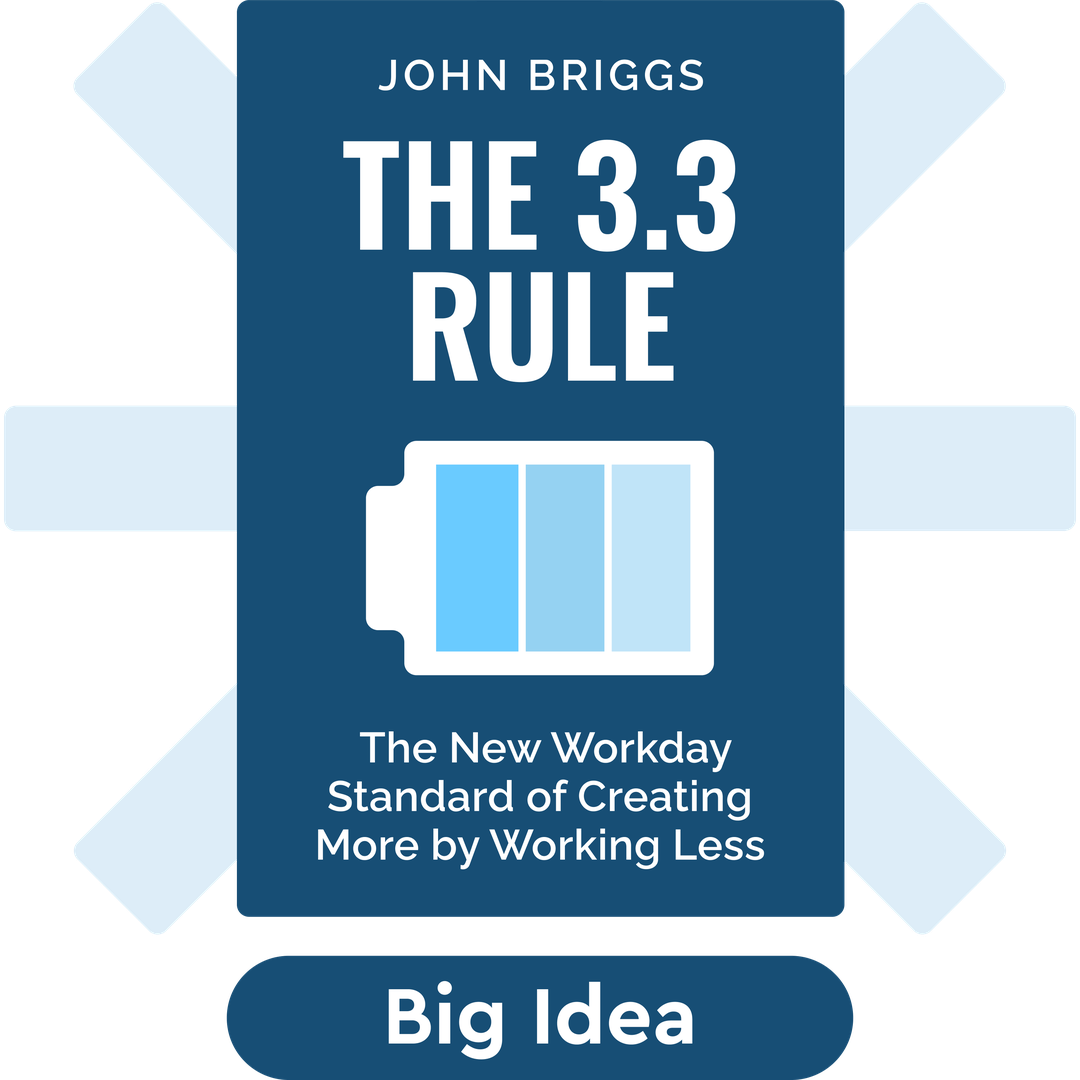
If You're Curious About These Questions...
You should listen to this audiobook
- What if the secret to peak productivity isn’t working longer hours, but mastering a specific mathematical ratio of work to rest?
- Have you ever wondered why the traditional eight-hour workday often leads to burnout, and what specific timing rule could replace it to double your focus?
- Are you curious about the unconventional '3.3' formula that allows high-achievers to boost their output while actually spending more time on breaks?
Listen to The 3.3 Rule — Free Audiobook
Key Takeaways from The 3.3 Rule
- Understand the fundamental mechanics of the 3.3 Rule, which limits focused work to three hours followed by a restorative break equal to 30% of that duration.
- Discover why the traditional eight-hour shift causes burnout and how aligning your schedule with your brain's natural rhythm of focus drastically improves work quality.
- Learn how to overhaul your daily workflow by breaking down large, complex tasks into manageable chunks that fit perfectly within the three-hour work limit.
- Find out how to successfully introduce this radical schedule to your team by using credible research to demonstrate its benefits on work-life balance and job satisfaction.
- Master the execution of effective breaks by stepping away from your workstation for simple, rejuvenating activities while always maintaining the crucial 30% rest ratio.
Learning Tools
Reinforce what you learned from The 3.3 Rule
Mind Map
Quiz — Test Your Understanding
The 3.3 Rule — Full Chapter Overview
Chapter 1: Recommendation
Chapter 2: Transform your workday with the 3.3 rule
The 3.3 Rule Summary & Overview
The 3.3 Rule (2020) offers a unique perspective on productivity and work-life balance. It presents the “3.3 Rule” – which advocates for working a maximum of three hours at a time, succeeded by breaks amounting to 30% of the work duration. This groundbreaking approach aims to rebuild conventional work patterns, fostering productivity and employee satisfaction.
Who Should Listen to The 3.3 Rule?
- Corporate leaders
- Productivity enthusiasts
- Work-life balance seekers
Books Similar to The 3.3 Rule
Readers who enjoyed this also liked these titles.
Say Less to Get More from Any Pitch or Presentation
How the flexible work revolution can increase productivity, profitability, and wellbeing, and help create a sustainable future
A Practical Guide to Nurturing Your Productive Potential
The Lost Art of Accomplishment Without Burnout