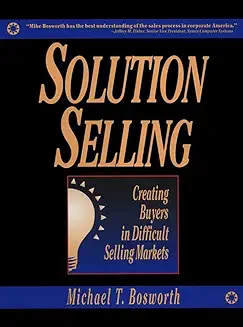
Solution Selling: Creating Buyers in Difficult Selling Markets audiobook cover - In markets where buyers are skeptical, trained to negotiate, and drowning in options, this book lays out a repeatable way to create demand: turn vague problems into admitted pain, shape a shared vision of success, and control the process without controlling the buyer.

Solution Selling: Creating Buyers in Difficult Selling Markets

In markets where buyers are skeptical, trained to negotiate, and drowning in options, this book lays out a repeatable way to create demand: turn vague problems into admitted pain, shape a shared vision of success, and control the process without controlling the buyer.

Michael T. Bosworth

3.8 / 5(5 ratings)
Start ListeningDownloadQR code that opens AudiobookHub on the App StoreTry free on iPhoneScan to start in 5 seconds

If You're Curious About These Questions...

You should listen to this audiobook

Listen to Solution Selling: Creating Buyers in Difficult Selling Markets — Free Audiobook

Loading player...

Key Takeaways from Solution Selling: Creating Buyers in Difficult Selling Markets

Learning Tools

Reinforce what you learned from Solution Selling: Creating Buyers in Difficult Selling Markets

Mind Map

Oceanofpdf.Com Solution Selling Michael T Bosworth
Core Philosophy & Buyer Behavior+
Levels of Need & Shifting Concerns+
Redefining Value & Vision Processing+
Repeatable Sales Tools+
Process Control & Execution+
Implementation & Management+

Quiz — Test Your Understanding

Question 1 of 10
What does Bosworth's metaphor of the buyer 'squeezing the washcloth' illustrate?
  • A. Buyers try to extract maximum free education from sellers before abandoning the deal.
  • B. Buyers squeeze the seller for concessions because they need to believe they got the best deal.
  • C. Sellers exhaust themselves trying to explain every single feature of a complex product.
  • D. The market naturally filters out weak products under intense competitive pressure.
Question 2 of 10
How does the book describe a buyer who is experiencing 'latent pain'?
  • A. They are actively requesting proposals but actively hiding their true budget from the seller.
  • B. They are fully aware of a problem but lack the organizational authority to make a purchase.
  • C. They are not actively shopping because they have decided that no viable solution exists.
  • D. They are currently using a competitor's product and are locked into an unfavorable contract.
Question 3 of 10
According to the Solution Selling framework, why is it dangerous for a seller to simply respond 'I've got it' when a buyer says 'I need X'?
  • A. The seller might overpromise on features that are currently out of stock.
  • B. The buyer will interpret this enthusiasm as desperation and immediately ask for a discount.
  • C. The seller bypasses the evaluation phase and moves the buyer directly into risk analysis.
  • D. The seller risks becoming 'column fodder' by failing to diagnose and bias the buyer's vision toward their specific capabilities.
Question 4 of 10
In Solution Selling, how is a 'Benefit' strictly defined compared to traditional sales models?
  • A. It is an objective, technical list of what the product's features are capable of doing.
  • B. It is a generic statement of how a feature saves the average company time or money.
  • C. It only exists when a capability connects directly to a buyer-stated requirement inside a shared vision.
  • D. It is an advantage that the seller assumes will be helpful to the buyer based on industry trends.
Question 5 of 10
What is the primary purpose of the '9-Block Vision Processing Model' (the 9 Boxes)?
  • A. To map out the organizational hierarchy to find the ultimate decision-maker.
  • B. To take a buyer from admitted pain to an action vision without triggering resistance.
  • C. To qualify a lead strictly based on their budget, authority, need, and timeline.
  • D. To calculate the exact return on investment (ROI) expected over a 9-month period.
Question 6 of 10
When using telephone scripts for prospecting, what does Bosworth state should be the primary goal of the first 20 seconds?
  • A. To schedule an immediate, one-hour product demonstration.
  • B. To deliver a comprehensive elevator pitch detailing the product's top features.
  • C. To identify the primary budget holder within the target organization.
  • D. To create curiosity rather than to pitch or schedule an appointment.
Question 7 of 10
How should a seller interpret a situation where a buyer 'panics', becomes distant, or raises objections late in the buying cycle?
  • A. As a sign that the buyer has found a cheaper competitor and is building a case to back out.
  • B. As an indication that the seller failed to build adequate rapport during the initial meetings.
  • C. As a positive sign that they have likely narrowed down to one option and are working through risk.
  • D. As a clear cue that the seller must immediately offer a heavy discount to save the deal.
Question 8 of 10
How does the Solution Selling method recommend gaining access to the ultimate decision-maker (power)?
  • A. By bypassing lower-level contacts entirely and calling the executive suite directly.
  • B. By bargaining for access, asking the sponsor to introduce them to power if certain proofs are met.
  • C. By refusing to share any product pricing or capabilities until power is brought into the room.
  • D. By sending an unsolicited, finalized proposal directly to the company's CEO.
Question 9 of 10
What does the concept of 'proposal avoidance' refer to in Bosworth's methodology?
  • A. Refusing to send a written proposal until the buyer has paid an initial consulting fee.
  • B. Avoiding written proposals entirely and relying strictly on verbal agreements to close deals.
  • C. Delaying the delivery of a proposal until the final day of the quarter to create maximum urgency.
  • D. Ensuring the final proposal contains no new information and is reviewed with the buyer in draft form first.
Question 10 of 10
What is the 'sunshine pump' in the context of sales management and forecasting?
  • A. A motivational technique used by sales managers to aggressively boost morale at quarter-end.
  • B. The practice of salespeople artificially inflating pipeline probabilities to escape management pressure.
  • C. A marketing strategy designed to flood the top of the sales funnel with highly qualified leads.
  • D. A structured onboarding program that ensures new sales hires secure early, easy wins.

Solution Selling: Creating Buyers in Difficult Selling Markets — Full Chapter Overview

Solution Selling: Creating Buyers in Difficult Selling Markets Summary & Overview

Solution Selling is a practical sales and sales-management playbook for complex, consultative selling—especially when products feel like commodities, buyers issue RFPs, committees block access to power, and negotiations turn brutal. Michael T. Bosworth argues that top performers (“Eagles”) win because they stay aligned with how buyers actually buy: they diagnose before prescribing, convert latent need into urgent pain, and then help the customer build an actionable vision of a solution.

The book introduces a simple but structured framework: three levels of buyer need (latent pain → pain → vision), the buyer’s shifting concerns across the buying cycle (need/cost → alternatives → risk/price), and a set of tools (reference stories, pain sheets, phone scripts, process-control letters, pipeline milestones) that make the approach teachable and scalable across organizations.

It closes by showing how to implement the method with sales management discipline—grading pipelines honestly, replacing “sunshine” forecasting with measurable milestones, and creating repeatable behaviors that shorten cycles, improve win rates, and defend margins.

Who Should Listen to Solution Selling: Creating Buyers in Difficult Selling Markets?

  • B2B sellers and account executives selling complex products/services (software, IT, consulting, financial services) who need a repeatable way to generate and qualify demand.
  • Sales managers and leaders who want a common sales language, pipeline grading, better forecasting, and coaching tools—not just motivational training.
  • Founders and executives in competitive markets where buyers view offerings as interchangeable and price pressure is constant.

About the Author: Michael T. Bosworth

Michael T. Bosworth was a sales trainer and consultant who developed the Solution Selling methodology from years of experience in complex B2B environments and sales training programs. He emphasizes buyer-aligned selling, disciplined qualification, and practical tools that help organizations scale consultative selling skills.

🎧
Listen in the AppOffline playback & background play
Get App