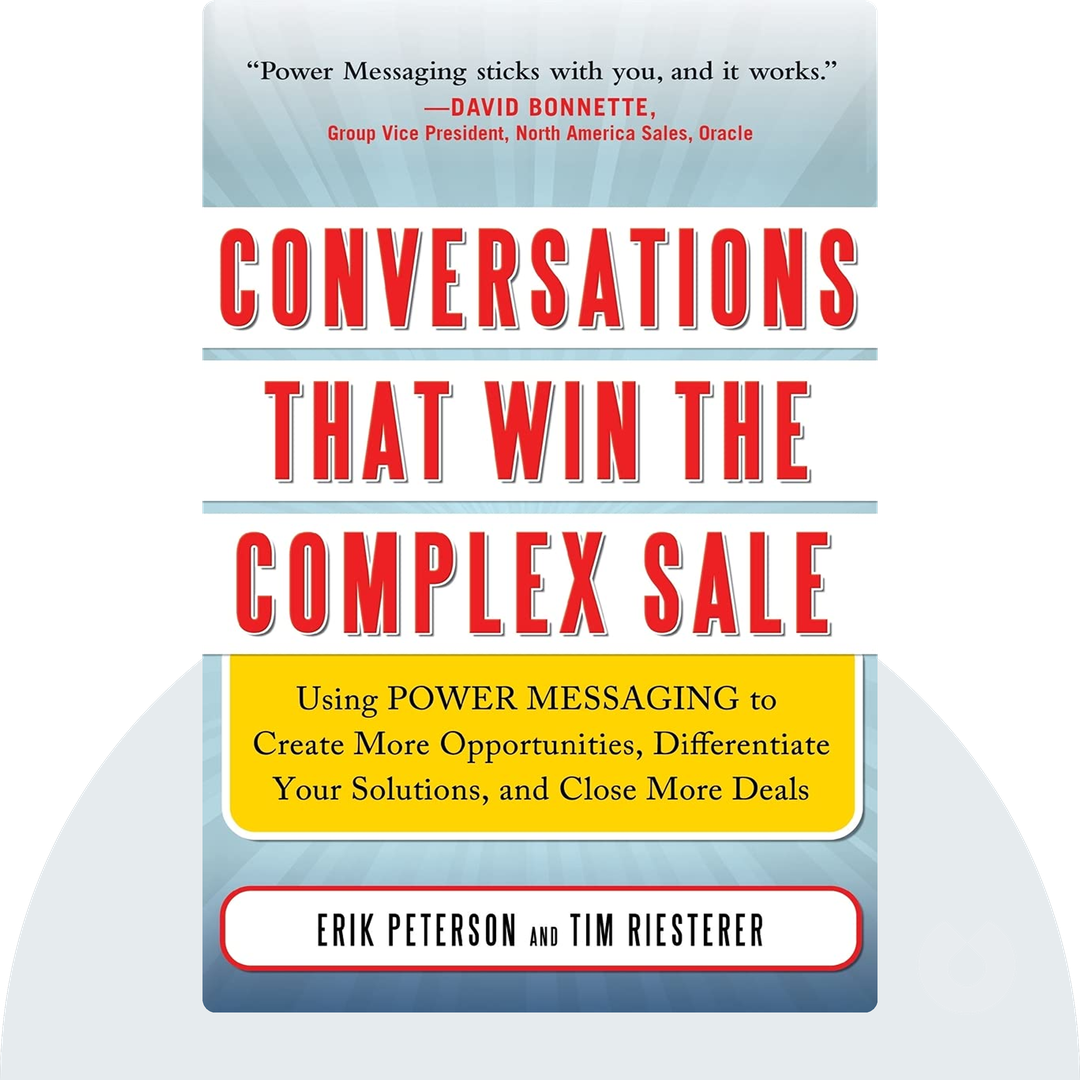
Conversations That Win the Complex Sale
Start ListeningDownload Try free on iPhoneScan to start in 5 seconds
Categories:
If You're Curious About These Questions...
You should listen to this audiobook
- Did you know that your toughest competitor isn’t actually a rival company, but your customer’s own deep-seated inertia?
- What if the secret to closing a complex sale isn't pitching your product’s features, but casting your customer as the hero in a very specific kind of story?
- Are you curious about how to stop competing on price and start using 'provocative' conversations to create immediate urgency for your solution?
Listen to Conversations That Win the Complex Sale — Free Audiobook
Loading player...
Key Takeaways from Conversations That Win the Complex Sale
- Discover why your biggest competitor is the customer's decision to do nothing, and learn how to break this paralysis by sharing provocative insights.
- Understand how to leverage the 'Value Wedge' to focus your pitch entirely on the specific customer needs you can solve that your competitors cannot.
- Learn to structure your narrative using the Hero's Journey by casting the customer as the hero and positioning yourself as their indispensable mentor.
- Master the technique of framing the problem as an external 'villain,' such as changing market conditions, to prevent the customer from feeling defensive about past choices.
- Find out how to overcome the 'Hammock' of audience attention by skipping generic corporate openings and delivering engagement spikes when retention naturally drops.
Learning Tools
Reinforce what you learned from Conversations That Win the Complex Sale
Mind Map
Conversations That Win the Complex Sale
Defeating the Real Competitor+
Finding Your Value Wedge+
The Hero's Journey Structure+
Delivering the Story+
Crafting an Irrefutable Message+
Conquering the Deciding Mind+
Quiz — Test Your Understanding
Question 1 of 7
According to the book, what is the single greatest threat to winning a complex sale?
Question 2 of 7
Where does a salesperson's 'Value Wedge' exist?
Question 3 of 7
When utilizing the 'Hero's Path' narrative structure in a sales conversation, what role should the salesperson play?
Question 4 of 7
In the sales narrative, how should the 'villain' be defined to avoid making the customer defensive?
Question 5 of 7
What does the 'Hammock' concept illustrate about a customer's attention during a presentation?
Question 6 of 7
Why is 'You Phrasing' highly effective in moving a customer toward action?
Question 7 of 7
How does the 'Old Brain' process information, and how should salespeople appeal to it?
Conversations That Win the Complex Sale — Full Chapter Overview
- 1Recommendation
- 2Your Biggest Competitor Isn’t Who You Think
- 3Understanding the Hero’s Journey
- 4How to Deliver the Story
- 5Crafting an Irrefutable Message
- 6Winning Over the Deciding Mind
- 7Final summary
Conversations That Win the Complex Sale Summary & Overview
Conversations That Win the Complex Sale (2011) provides a new playbook for succeeding in a world where your biggest competitor isn’t another company, but your customer’s own inertia. You’ll discover how to stop competing on features and start provoking your customer to change by telling a compelling story. By reframing the conversation to make your customer the hero, you can create urgency, differentiate your solution, and close more deals.
Who Should Listen to Conversations That Win the Complex Sale?
- Sales professionals struggling to stand out in commoditized markets
- Marketing leaders aiming to create messages that salespeople will actually use
- Business executives who need to drive growth through differentiation
Books Similar to Conversations That Win the Complex Sale
Readers who enjoyed this also liked these titles.