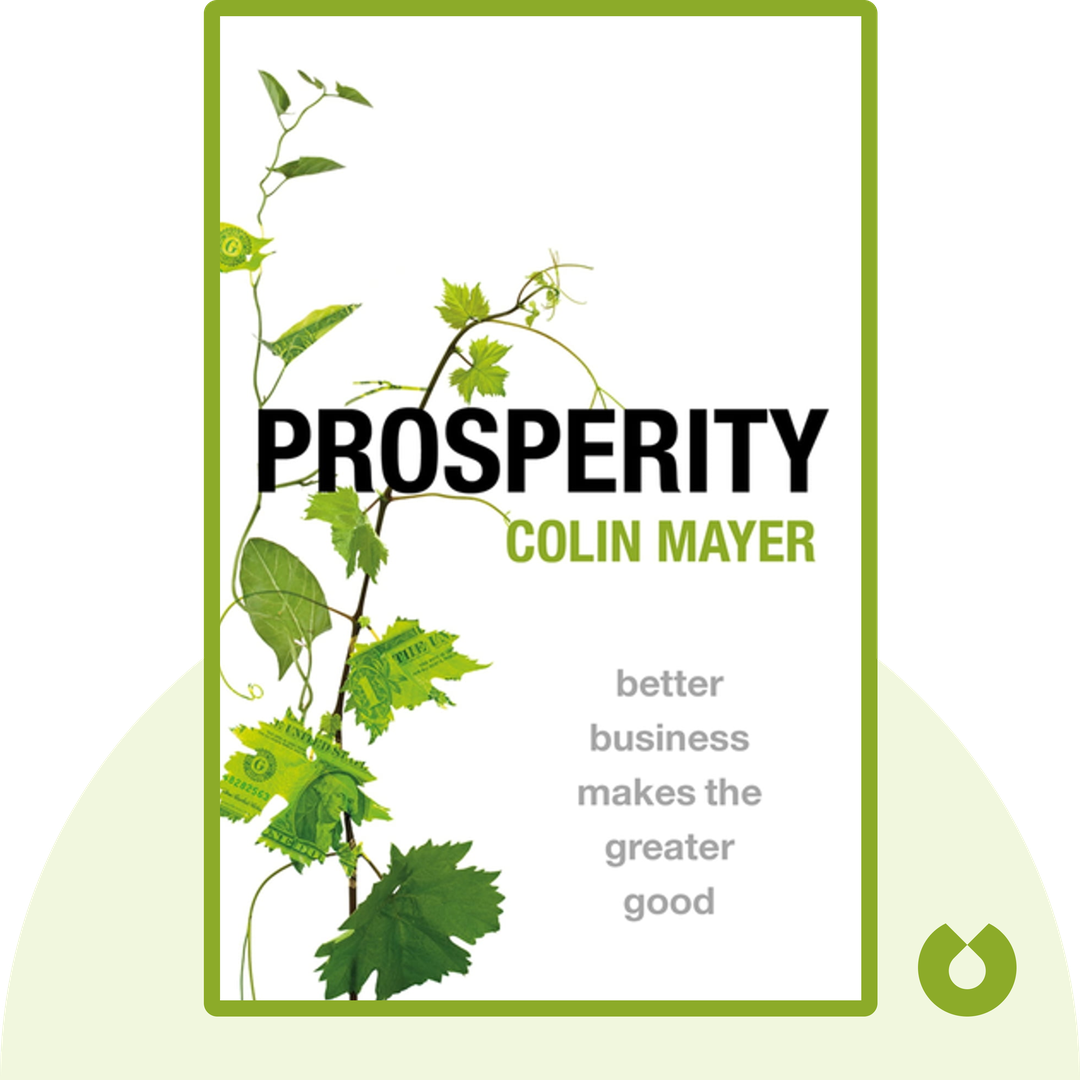
If You're Curious About These Questions...
You should listen to this audiobook
- Did you know that the most widely accepted definition of a corporation’s purpose might be the single biggest driver of today's social and environmental disasters?
- Have you ever wondered why we treat profit as the primary goal of a business rather than a natural result of solving the world's problems?
- What if you could adopt a radical new economic framework where your company’s success and the well-being of the community are perfectly aligned?
Listen to Prosperity — Free Audiobook
Loading player...
Key Takeaways from Prosperity
- Discover why the long-held Friedman doctrine of prioritizing shareholder profits has damaged society, and learn how to adopt a new business paradigm that balances financial gains with social good.
- Understand how the historic shift from family-owned, community-focused businesses to investor-owned transnational corporations led to the loss of long-term stakeholder commitments.
- Redefine the true meaning of business success by recognizing that a corporation's primary purpose is to solve community problems, with financial profit acting merely as a byproduct.
- Uncover the immense potential of modern corporations to act as powerful vehicles for positive global change by embracing accountability to both the environment and diverse local communities.
- Learn how to establish effective corporate governance that moves past tokenistic gestures to genuinely protect community interests alongside traditional shareholder needs.
Learning Tools
Reinforce what you learned from Prosperity
Mind Map
Prosperity
The Current Paradigm+
Loss of Community Connection+
Redefining Purpose & Governance+
New Performance Metrics+
Transformation Through Policy+
Quiz — Test Your Understanding
Question 1 of 6
According to the text, what is the core premise of the Friedman doctrine that has dominated business education for over 50 years?
Question 2 of 6
What historical shift caused corporations to primarily lose their long-term commitment to local communities?
Question 3 of 6
How does the author define the true purpose of a corporation?
Question 4 of 6
According to the text, how should a corporation redefine its understanding of its 'customer base'?
Question 5 of 6
Under the proposed new metrics for business performance, how should a corporation account for damage it causes to the environment?
Question 6 of 6
Why do current corporate commitments regarding nonfinancial assets (like sustainability and inclusion) often fail to have a meaningful impact?
Prosperity — Full Chapter Overview
- 1Recommendation
- 2It's time for a new corporate paradigm
- 3Corporations have severed their ties with communities
- 4Reframing purpose through effective governance
- 5Developing new metrics for performance
- 6Transforming through policy
Prosperity Summary & Overview
Prosperity (2018) examines how business thinking has led to our current state of social, political, and environmental disaster. Drawing on historical, legal, and economic knowledge, it presents a radical new framework in which both corporations and the broader community can flourish together.
Who Should Listen to Prosperity?
- Business leaders and company directors
- MBA students
- Economic policy developers wanting to fix our broken system
Books Similar to Prosperity
Readers who enjoyed this also liked these titles.