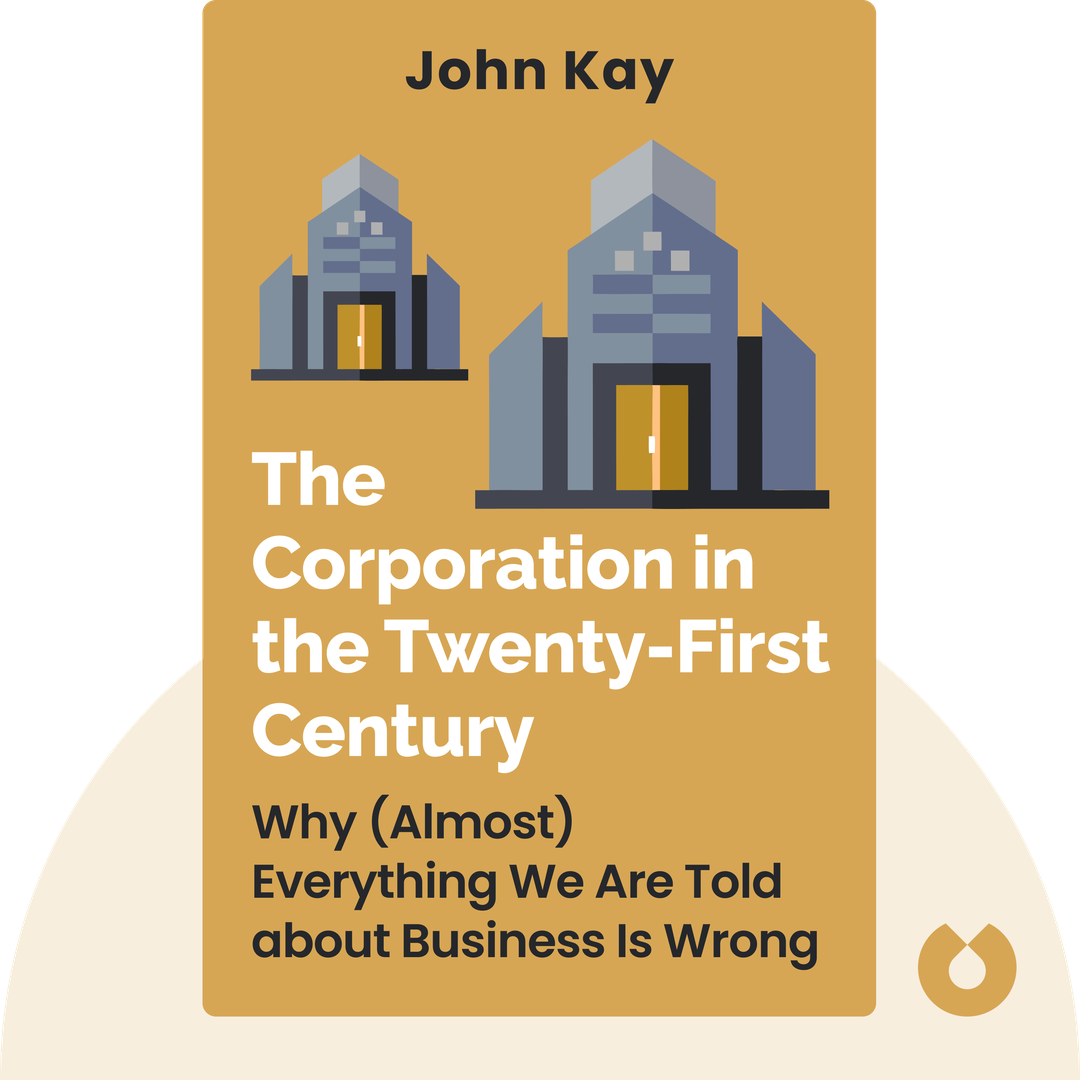
The Corporation in the Twenty-First Century
Start ListeningDownload Try free on iPhoneScan to start in 5 seconds
Categories:
If You're Curious About These Questions...
You should listen to this audiobook
- Did you know that the world’s most powerful companies no longer derive their value from physical assets, but from something entirely invisible?
- Have you ever wondered why the traditional rules of business success are becoming obsolete in an economy driven by knowledge rather than production?
- What if the secret to thriving in the twenty-first century isn't about better management, but about fundamentally reimagining what a corporation is for?
Listen to The Corporation in the Twenty-First Century — Free Audiobook
Loading player...
Key Takeaways from The Corporation in the Twenty-First Century
- Discover why today’s most dominant corporations thrive on "dematerialized," asset-light business models rather than owning traditional physical capital.
- Learn how transforming shared collective knowledge into actionable collective intelligence drives massive leaps in human innovation and progress.
- Understand how dividing labor boosts organizational efficiency by eliminating redundancy and allowing skilled workers to focus exclusively on complex tasks.
- See how the modern corporation functions as the "brain" of economic life, providing the collective intelligence needed to coordinate highly specialized parts.
- Explore how modern entrepreneurs create immense value by building "assemblages," successfully combining existing technologies into revolutionary products like the smartphone.
Learning Tools
Reinforce what you learned from The Corporation in the Twenty-First Century
Mind Map
The Corporation in the Twenty-First Century
Transformation of Capitalism+
Collective Intelligence+
The Era of Assemblages+
Evolution of Capital Ownership+
The Hollow Corporation+
Quiz — Test Your Understanding
Question 1 of 6
According to the text, what is a defining characteristic of the leading corporations of the twenty-first century compared to industrial-age capitalists?
Question 2 of 6
How does the text explain the dramatic improvement in human marathon running times over the last century?
Question 3 of 6
In Adam Smith's pin factory example, what is the primary benefit of dividing the production process into specialized tasks?
Question 4 of 6
The text uses the Airbus A350 to illustrate which key concept about modern production?
Question 5 of 6
How does Apple's modern business model contrast with Karl Marx's traditional view of capitalism?
Question 6 of 6
Which of the following best describes the "hollow corporation" model mentioned in the text?
The Corporation in the Twenty-First Century — Full Chapter Overview
- 1Recommendation
- 2Collective intelligence propels human progress
- 3The division of labor channels collective intelligence
- 4Many of today’s most successful goods are assemblages
- 5Capital used to be physical, but that’s changing
- 6The twenty-first century ushers in the age of hollow corporations
The Corporation in the Twenty-First Century Summary & Overview
The Corporation in the Twenty-First Century (2024) takes a fresh look at the evolving role of modern businesses. It explores how the shift from physical production to intellectual capital is transforming the way value is created, challenging traditional measures of success and reshaping corporate structures. As products and production become increasingly digital and knowledge-driven, it argues that businesses must adapt to thrive in this new economic landscape.
Who Should Listen to The Corporation in the Twenty-First Century?
- Students and researchers exploring how corporations shape society
- Anyone interested in economic history and human progress
- Professionals wanting a fresh perspective on business and innovation
Books Similar to The Corporation in the Twenty-First Century
Readers who enjoyed this also liked these titles.