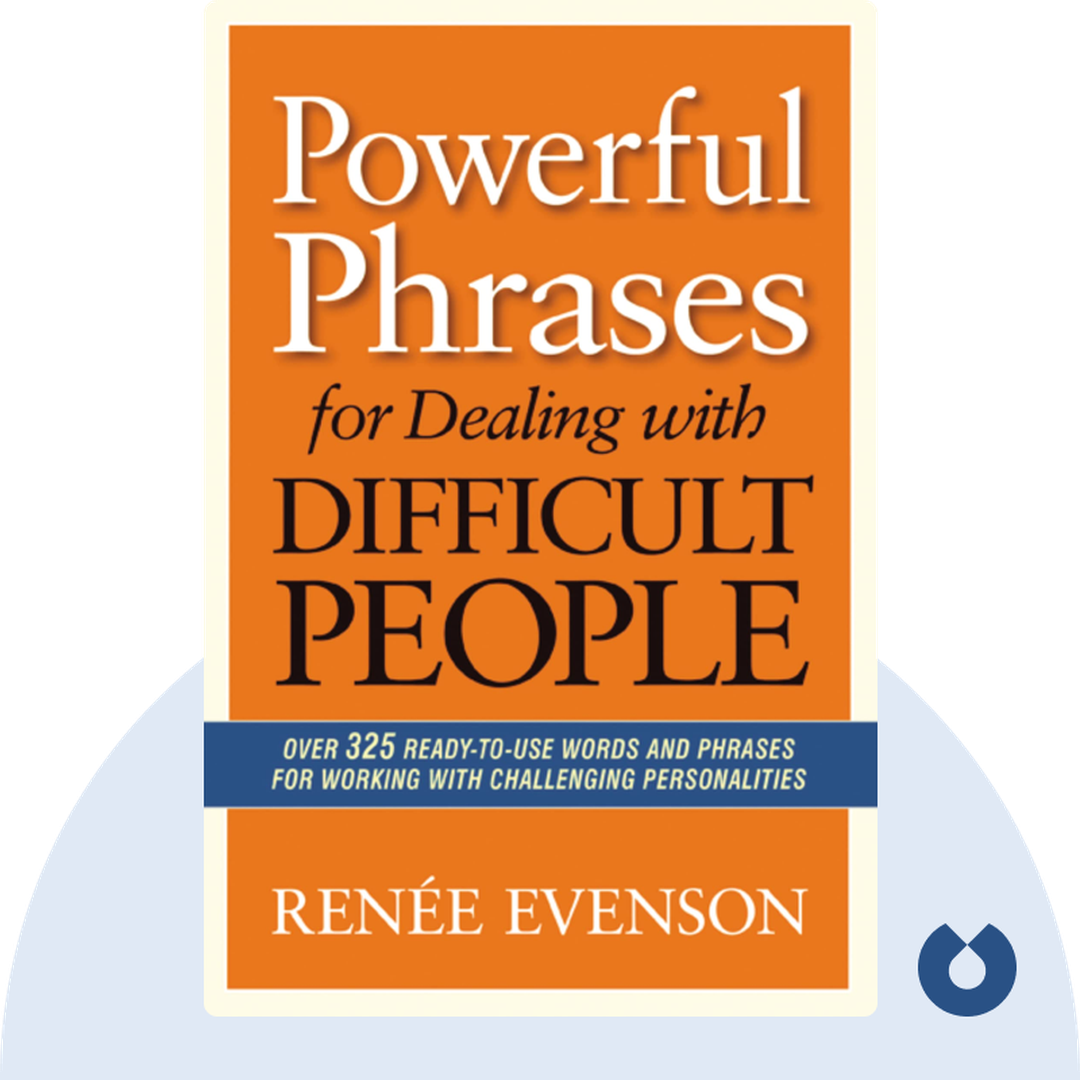
Powerful Phrases for Dealing with Difficult People
Start ListeningDownload Try free on iPhoneScan to start in 5 seconds
Categories:
If You're Curious About These Questions...
You should listen to this audiobook
- What if you could walk into a meeting with your most difficult coworker and know exactly which phrases will instantly defuse their hostility?
- Have you ever wondered why some people can stay perfectly calm and professional when dealing with a toxic boss while others struggle to find the right words?
- What’s the secret to transforming a heated workplace confrontation into a productive solution using just a few carefully chosen words?
Listen to Powerful Phrases for Dealing with Difficult People — Free Audiobook
Loading player...
Key Takeaways from Powerful Phrases for Dealing with Difficult People
- Learn why starting conflict conversations with words like 'always,' 'never,' or 'you' puts coworkers on the defensive, and discover how 'I' statements lead to productive resolutions.
- Master specific powerful phrases of understanding, apology, and compromise to gracefully navigate workplace disputes and share ownership of the solution.
- Discover how to rebuild and maintain professional relationships after a disagreement by utilizing targeted phrases of resolution and reconciliation.
- Understand the profound impact of nonverbal communication on conflict management, and learn how to adjust your posture, facial expressions, and spacing to actively diffuse tension.
- Apply a structured five-step process to handle workplace issues calmly, starting with pausing to think and gathering a better understanding before defining the core problem.
Learning Tools
Reinforce what you learned from Powerful Phrases for Dealing with Difficult People
Mind Map
Powerful Phrases for Dealing with Difficult People
Basic Rules of Conflict+
The Powerful Phrases+
Body Language & Nonverbals+
The 5-Step Process+
Handling Specific Situations+
Quiz — Test Your Understanding
Question 1 of 7
According to the book, what is the primary reason you should avoid starting conflict conversations with words like 'always,' 'never,' or 'you'?
Question 2 of 7
What is the true purpose of using a 'phrase of apology' (such as 'I'm sorry if I misunderstood your intent') during a conflict?
Question 3 of 7
Which of the following is recommended regarding nonverbal communication and body language during a conflict?
Question 4 of 7
In the five-step process for resolving conflict, what is the crucial first step you should take when a problem arises, such as a coworker taking credit for your idea in a meeting?
Question 5 of 7
Under what circumstances does the author suggest skipping step two ('getting a better understanding') of the conflict resolution process?
Question 6 of 7
How should you adjust the five-step conflict resolution process when dealing with a difficult boss?
Question 7 of 7
If a coworker confronts you angrily and unskillfully about a mistake you made, what is the best immediate course of action according to the text?
Powerful Phrases for Dealing with Difficult People — Full Chapter Overview
- 1Recommendation
- 2Basic ground rules
- 3The key phrases
- 4The impact of body language
- 5The five-step process
- 6Exceptions to these rules
- 7Working with a difficult boss
- 8When you're the issue
Powerful Phrases for Dealing with Difficult People Summary & Overview
Powerful Phrases for Dealing with Difficult People (2013) provides practical tactics for navigating tough conversations at work. Along with over 325 phrases, it includes dozens of sample conversations that show the phrases in action.
Who Should Listen to Powerful Phrases for Dealing with Difficult People?
- Anyone dealing with difficult coworkers or bosses
- Employees looking for practical guidance on how to talk to colleagues
- People interested in conflict management
Books Similar to Powerful Phrases for Dealing with Difficult People
Readers who enjoyed this also liked these titles.