If You're Curious About These Questions...
You should listen to this audiobook
- What if the most hazardous nuclear waste could be recycled into a virtually inexhaustible supply of clean energy, reducing its radioactive lifespan from 100,000 years to just a few centuries?
- Have you ever wondered if a nuclear reactor could be designed to shut itself down safely during a total power failure without any human intervention or computer control?
- Did you know that a revolutionary, carbon-free energy system was successfully proven in the United States, only to be abruptly canceled by a political decision just as it reached the finish line?
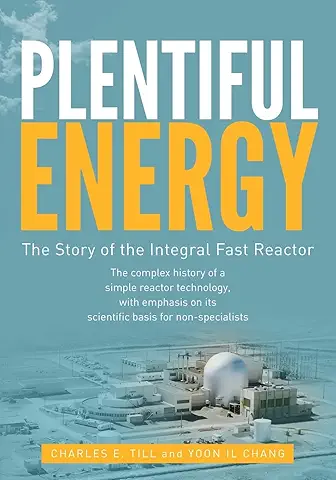
Listen to Plentiful Energy: The Story of the Integral Fast Reactor — Free Audiobook
Key Takeaways from Plentiful Energy: The Story of the Integral Fast Reactor
- — The Reactor That Shut Itself Down
- — Argonne, EBR-I, and the Roots of Fast Reactors
- — The Program That Died and the Opening It Left
- — The IFR Idea: One Site, One System, Closed Cycle
- — The Technology Choices That Make or Break It
Plentiful Energy: The Story of the Integral Fast Reactor — Full Chapter Overview
Chapter 1: Recommendation
Chapter 2: The Reactor That Shut Itself Down
Chapter 3: Argonne, EBR-I, and the Roots of Fast Reactors
Chapter 4: The Program That Died and the Opening It Left
Chapter 5: The IFR Idea: One Site, One System, Closed Cycle
Chapter 6: The Technology Choices That Make or Break It
Chapter 7: Metal Fuel: How It Learned to Survive
Chapter 8: “Walk-Away” Safety and the Proof Tests
Chapter 9: Pyroprocessing: Recycling Without Pure Plutonium
Chapter 10: Waste, Proliferation, Economics, and Why It Was Canceled
Plentiful Energy: The Story of the Integral Fast Reactor Summary & Overview
Plentiful Energy is a technical-and-historical account of the Integral Fast Reactor (IFR), a nuclear power system developed at Argonne National Laboratory between 1984 and 1994. Charles Till and Yoon Il Chang—two leaders of the program—reconstruct how decades of earlier fast reactor work (EBR-I and EBR-II) converged into a “whole system” concept: a sodium-cooled fast reactor, metal fuel, pyroprocessing-based recycling, and durable waste forms, all designed to work together on a single site.
The book aims at non-specialists who can tolerate light technical detail. It walks through the engineering choices (fuel, coolant, reactor configuration), the safety logic behind “inherent/passive safety,” the electrorefining chemistry that enables recycling without producing pure plutonium, and the implications for waste longevity and energy security. It also documents the political rise and abrupt cancellation of the IFR program in 1994, arguing that a near-complete technology was halted primarily by policy, not technical failure.
Who Should Listen to Plentiful Energy: The Story of the Integral Fast Reactor?
- Engineers and scientifically literate readers who want an accessible explanation of fast reactors, metal fuel behavior, and pyroprocessing.
- Energy and climate policy readers curious why a major U.S. advanced nuclear program was canceled despite successful demonstrations.
- Anyone interested in nuclear waste, proliferation debates, and how fuel-cycle design changes the “waste problem.”
Books Similar to Plentiful Energy: The Story of the Integral Fast Reactor
Readers who enjoyed this also liked these titles.
A History of Nuclear Meltdowns and Disasters from the Ozark Mountains to Fukushima
The History of a Nuclear Catastrophe

A Beginner’s Guide
Confessions of a Nuclear War Planner