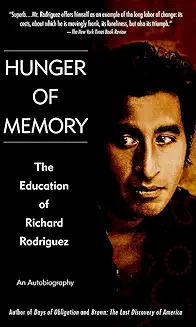
Hunger of Memory: The Education of Richard Rodriguez audiobook cover - A Mexican-American scholarship boy learns English and climbs into the American middle class—then discovers the cost: a hush between him and his parents, a changed faith, and an uneasy conscience about policies that claim to help people like him.

Hunger of Memory: The Education of Richard Rodriguez

A Mexican-American scholarship boy learns English and climbs into the American middle class—then discovers the cost: a hush between him and his parents, a changed faith, and an uneasy conscience about policies that claim to help people like him.

Richard Rodriguez

4.2 / 5(5 ratings)
Start ListeningDownloadQR code that opens AudiobookHub on the App StoreTry free on iPhoneScan to start in 5 seconds

If You're Curious About These Questions...

You should listen to this audiobook

Listen to Hunger of Memory: The Education of Richard Rodriguez — Free Audiobook

Loading player...

Key Takeaways from Hunger of Memory: The Education of Richard Rodriguez

Learning Tools

Reinforce what you learned from Hunger of Memory: The Education of Richard Rodriguez

Mind Map

Hunger of Memory by Richard Rodriguez
The Public vs. Private Divide+
The Scholarship Boy+
Religion and Secularization+
Complexion and Class+
The Affirmative Action Paradox+
The Act of Confession+

Quiz — Test Your Understanding

Question 1 of 9
Why does Richard Rodriguez reject the expectation that he should remain perfectly tethered to his 'roots' despite his middle-class success?
  • A. He believes that education fundamentally changes a person, and his story is about both what it took and what it gave.
  • B. He feels his parents purposefully alienated him after he achieved success.
  • C. He is embarrassed by his working-class background and prefers to forget his past entirely.
  • D. He argues that 'roots' are an outdated concept created by modern universities.
Question 2 of 9
What is Rodriguez's primary critique of bilingual education programs?
  • A. They fail to teach English quickly enough for students to pass standardized tests.
  • B. They misunderstand the vital distinction between a private family language and a public school language.
  • C. They place an unfair burden on parents who cannot afford to hire private tutors.
  • D. They force students to abandon their cultural heritage without providing any public benefits in return.
Question 3 of 9
How does Rodriguez view the concept of the 'scholarship boy' mimicking or imitating his teachers?
  • A. As a temporary failure of imagination that prevents true academic genius.
  • B. As a necessary mechanism of education that helps the student acquire a voice of authority.
  • C. As a disrespectful habit that alienated him from his working-class peers.
  • D. As proof that the educational system is fundamentally corrupt and suppresses original thought.
Question 4 of 9
How did Rodriguez react to the post-Vatican II changes in the Catholic Church, such as replacing Latin with English and introducing casual ceremonies?
  • A. He welcomed the liberal ideas but mourned the loss of the timeless, mystical quality of the old liturgy.
  • B. He completely rejected the reforms and sought out traditional Latin mass communities.
  • C. He embraced the changes fully because they made the Church feel closer to his childhood Mexican Catholicism.
  • D. He felt indifferent to the changes because his education had already made him an atheist.
Question 5 of 9
What profound realization does Rodriguez have while working a summer construction job alongside Mexican alien laborers?
  • A. That physical labor is inherently superior to academic work because it is more authentic.
  • B. That his dark skin naturally connects him to the laborers, instantly making them equals.
  • C. That the true divide between him and the laborers is not skin color or physical tools, but public identity and citizenship.
  • D. That the contractor treats him worse than the alien laborers because he is a university student.
Question 6 of 9
Why does Rodriguez ultimately become a critic of affirmative action in universities during his time as a graduate student?
  • A. He believes it primarily benefits nonwhite applicants who are already well-prepared and middle-class, rather than the truly disadvantaged.
  • B. He feels the programs are secretly designed to fail in order to embarrass minority students.
  • C. He observes that the financial grants provided are insufficient to cover the high costs of elite universities.
  • D. He argues that it causes racial tensions to disappear entirely, which hurts the civil rights movement.
Question 7 of 9
What motivates Rodriguez to reject all of his prestigious academic job offers?
  • A. He discovers he hates teaching and wants to become a full-time writer instead.
  • B. He decides to move back home to take care of his aging parents.
  • C. He wants to protest the 'minority student' label and what he perceives as an unjust advantage in the hiring process.
  • D. He is offered a high-paying job in the corporate sector that outbids the universities.
Question 8 of 9
How does Rodriguez justify revealing intimate family secrets in his memoir despite his mother's objections?
  • A. He believes that sharing his parents' story will bring them financial success and fame.
  • B. He argues that true intimacy can only be found by exposing one's past on talk shows.
  • C. He needs to prove to academic critics that his childhood was genuinely difficult and disadvantaged.
  • D. He believes that some deeply personal truths can paradoxically only be confessed to strangers, and writing distinguishes him from his parents.
Question 9 of 9
According to the book's final conclusion, what is the ultimate trade-off of assimilation and education?
  • A. It grants public voice and public rights, but at the painful cost of private intimacy and family closeness.
  • B. It allows individuals to maintain complete cultural purity while gaining immense financial wealth.
  • C. It completely destroys a person's ability to succeed in modern society by creating a permanent identity crisis.
  • D. It forces individuals to abandon religion entirely in exchange for acceptance into elite intellectual circles.

Hunger of Memory: The Education of Richard Rodriguez — Full Chapter Overview

Hunger of Memory: The Education of Richard Rodriguez Summary & Overview

Hunger of Memory is Richard Rodriguez’s autobiographical account of becoming educated—and becoming public. Raised in a Spanish-speaking, working-class Mexican immigrant family in Sacramento, he enters an English-only Catholic school and experiences assimilation not as a slogan but as a daily, intimate rearrangement of belonging. With each academic milestone, he gains confidence in public life while losing the old ease of family speech, the “private” world of home, and the unselfconscious closeness that once defined him.

Rodriguez follows that personal transformation into larger arguments about language, schooling, Catholic ritual, race and class, and the politics of affirmative action and bilingual education. The book moves between memory and reflection, insisting that education is not only opportunity but also separation—an American success story shadowed by grief, gratitude, and unresolved ethical questions.

Who Should Listen to Hunger of Memory: The Education of Richard Rodriguez?

  • Listeners interested in immigration, assimilation, and how language reshapes family life
  • Educators and policy-minded readers exploring bilingual education and affirmative action debates through lived experience
  • Anyone drawn to reflective memoirs about class mobility, faith, and identity in America

About the Author: Richard Rodriguez

Richard Rodriguez is an American writer and essayist known for personal narratives that examine education, class mobility, language, religion, and race in the United States. Hunger of Memory established him as a distinctive voice in public debates about assimilation, bilingual education, and affirmative action.

🎧
Listen in the AppOffline playback & background play
Get App