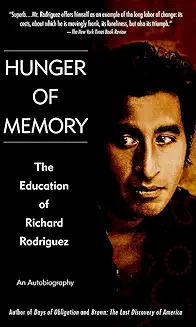
If You're Curious About These Questions...
You should listen to this audiobook
- Have you ever wondered if the ultimate price of a great education is the loss of the intimate connection you share with your own family?
- Did you know that mastering a 'public' language can create an invisible, painful barrier between you and the 'private' world of your childhood home?
- Are you curious why a successful scholar would argue that the very programs designed to help him, like bilingual education and affirmative action, might actually be doing more harm than good?
Listen to Hunger of Memory: The Education of Richard Rodriguez — Free Audiobook
Key Takeaways from Hunger of Memory: The Education of Richard Rodriguez
- — The Bel Air Question
- — Aria: Home Language, Public Silence
- — The Achievement of Desire
- — Credo: A Faith Remade by Public Life
- — Complexion: When Color Meant Class
Hunger of Memory: The Education of Richard Rodriguez — Full Chapter Overview
Chapter 1: Recommendation
Chapter 2: The Bel Air Question
Chapter 3: Aria: Home Language, Public Silence
Chapter 4: The Achievement of Desire
Chapter 5: Credo: A Faith Remade by Public Life
Chapter 6: Complexion: When Color Meant Class
Chapter 7: Profession: The Minority Student Paradox
Chapter 8: Walking Away From the Job Offers
Chapter 9: Mr. Secrets: Writing What Shouldn’t Be Said
Chapter 10: What Was Lost, What Was Gained
Hunger of Memory: The Education of Richard Rodriguez Summary & Overview
Hunger of Memory is Richard Rodriguez’s autobiographical account of becoming educated—and becoming public. Raised in a Spanish-speaking, working-class Mexican immigrant family in Sacramento, he enters an English-only Catholic school and experiences assimilation not as a slogan but as a daily, intimate rearrangement of belonging. With each academic milestone, he gains confidence in public life while losing the old ease of family speech, the “private” world of home, and the unselfconscious closeness that once defined him.
Rodriguez follows that personal transformation into larger arguments about language, schooling, Catholic ritual, race and class, and the politics of affirmative action and bilingual education. The book moves between memory and reflection, insisting that education is not only opportunity but also separation—an American success story shadowed by grief, gratitude, and unresolved ethical questions.
Who Should Listen to Hunger of Memory: The Education of Richard Rodriguez?
- Listeners interested in immigration, assimilation, and how language reshapes family life
- Educators and policy-minded readers exploring bilingual education and affirmative action debates through lived experience
- Anyone drawn to reflective memoirs about class mobility, faith, and identity in America
Books Similar to Hunger of Memory: The Education of Richard Rodriguez
Readers who enjoyed this also liked these titles.
A Memoir of (My) Body

Through the eyes of a nine-year-old boy crossing borders alone, this story gently shows how love can be improvised in motion—how strangers can become family, how fear can be carried, and how art can turn painful memory into a living kind of hope.
In a flooded sugarcane plain in 1940s Trinidad, a missing magnate, a desperate wife, and a barrack family tangled in poverty and pride crash into each other’s lives. Secrets smolder, a boy vanishes, and a whole community is forced to face what it’s willing to forgive—and what it can’t.
A Harrowing Tale of Injustice