If You're Curious About These Questions...
You should listen to this audiobook
- Have you ever wondered what invisible forces keep the world’s tallest skyscrapers from toppling over during a storm?
- What’s the secret to how ancient civilizations managed to build massive structures that still stand today without any modern technology?
- Did you know that the most critical components of our massive bridges and tunnels are often the ones completely hidden from the naked eye?
Listen to Built — Free Audiobook
Loading player...
Key Takeaways from Built
- Understand the two primary forces of structural engineering, compression and tension, and how ancient builders intuitively channeled them to erect the very first structures.
- Discover how modern architecture relies on four fundamental components—columns, beams, braces, and trusses—to form stable frameworks much like giant LEGO sets.
- Learn how engineers protect massive skyscrapers from toppling over by designing incredibly strong central spines called cores or external braced frames known as diagrids.
- Find out how towering structures like the Taipei 101 survive extreme winds using tuned mass dampers, which are gigantic internal pendulums designed to counteract dangerous sway.
- Explore the ingenious methods used to earthquake-proof buildings, such as avoiding a structure's natural resonance frequency and mounting columns on large rubber bearings.
Learning Tools
Reinforce what you learned from Built
Mind Map
Built
Forces & Components+
Counteracting Nature+
Lessons from Disasters+
Evolution of Materials+
Infrastructure & Heights+
Pioneers & Future+
Quiz — Test Your Understanding
Question 1 of 11
What are the two primary forces that put stress on structures, and how do they function?
Question 2 of 11
Why are trusses often utilized in the construction of large spaces or bridges?
Question 3 of 11
How does a tuned mass damper protect skyscrapers, such as the Taipei 101, from severe winds?
Question 4 of 11
What crucial engineering lesson was learned from the 1968 gas explosion in Canning Town, London?
Question 5 of 11
What major flaw of concrete did Joseph Monier solve, and how did he do it?
Question 6 of 11
What was Henry Bessemer's major contribution to the construction industry in the 19th century?
Question 7 of 11
Why was Elisha Otis's invention crucial for the development of modern skyscrapers?
Question 8 of 11
How did engineers correct the severe tilt of the Metropolitan Cathedral in Mexico City?
Question 9 of 11
What forward-thinking decision did Joseph Bazalgette make when designing London's sewer system following the 'Great Stink'?
Question 10 of 11
How did Emily Warren Roebling contribute to the field of structural engineering?
Question 11 of 11
How is the concept of biomimicry being applied to modern structural engineering?
Built — Full Chapter Overview
- 1Recommendation
- 2An engineer’s role is to build structures that withstand nature’s forces.
- 3Modern buildings use many of the same components as early construction.
- 4Structural engineers must account for wind, earthquakes, and other natural forces.
- 5Disasters can teach us a great deal about better building practices.
- 6Modern structural engineering materials have a long history.
- 7Concrete is more interesting than you might think.
- 8Modern structures are reaching for the sky.
- 9A structure’s fate can depend on the ground it rests on.
- 10Innovative construction can bring water to dry regions.
- 11The history of human waste is also the history of civilization.
- 12Trailblazing women have challenged gender inequality in engineering.
- 13Structural engineering has a bright future.
- 14Final summary
Built Summary & Overview
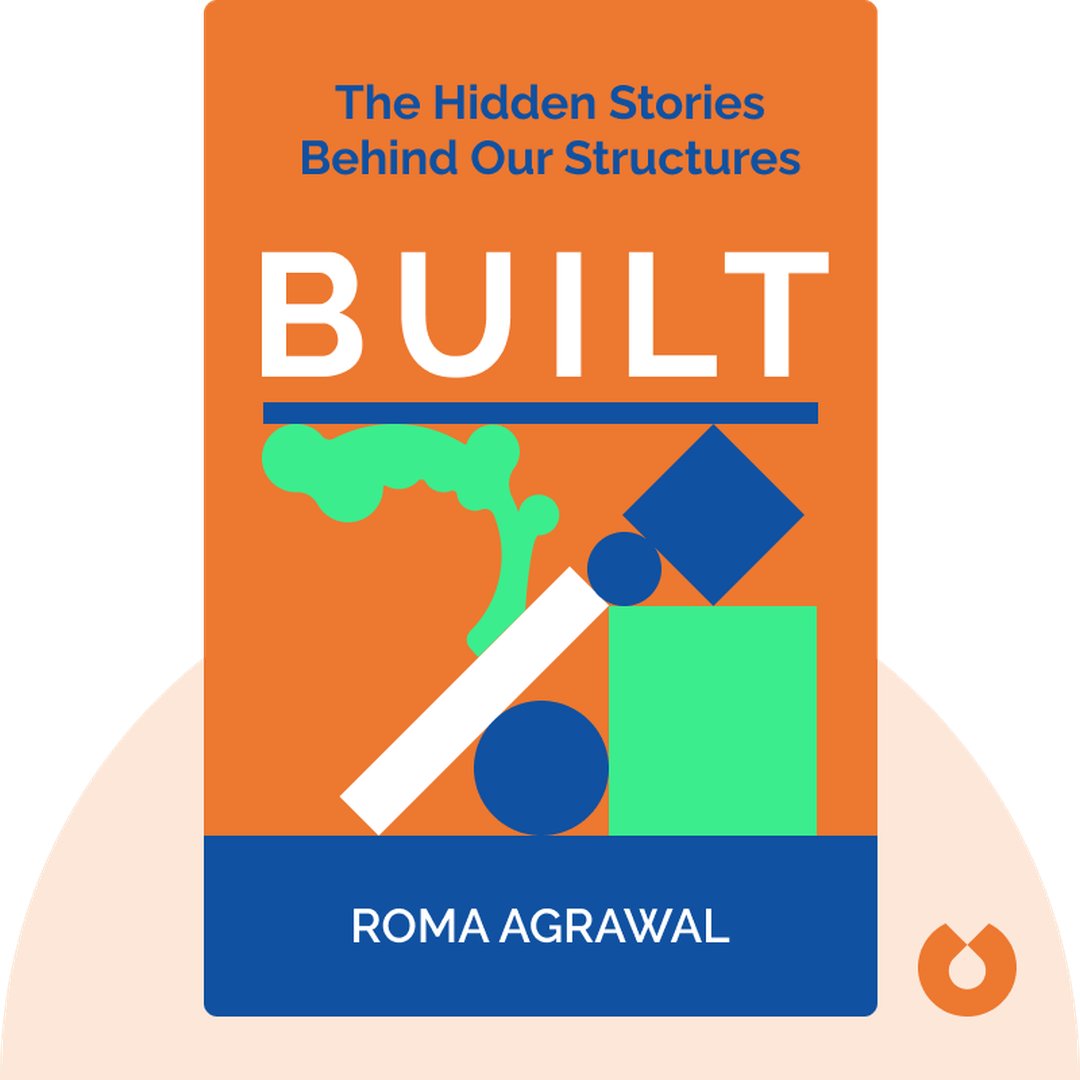
Built (2018) tells the story of some of society’s unsung heroes: structural engineers. Sadly, structural engineering tends only to enter the news when something goes wrong, like when a building falls or a bridge collapses. In Built, Agrawal gives a fuller picture of what it means to be an engineer, offering a range of stories and engaging tidbits about the structures of our world and the people who built them.
Who Should Listen to Built?
- People curious about how buildings are made
- Aspiring structural engineers
- Students interested in the history of engineering
Books Similar to Built
Readers who enjoyed this also liked these titles.