If You're Curious About These Questions...
You should listen to this audiobook
- Have you ever wondered why the same physical laws that keep a massive skyscraper standing are also responsible for keeping a horse's body from collapsing?
- What’s the secret to why some structures can withstand incredible stress while others shatter under a fraction of the weight?
- Did you know that the difference between a safe, sturdy bridge and a catastrophic structural failure often lies in invisible forces that most of us never notice?
Listen to Structures — Cinematic Audio Edition
Loading player...
Key Takeaways from Structures
- Understand the fundamental concept of structural strength, specifically how materials resist heavy loads by pushing back with an equal force.
- Discover the crucial differences between stress and strain within solid materials, and how these internal forces determine a structure's overall stiffness.
- Learn how tensile forces pull atoms apart and cause 'creep,' an essential adaptation mechanism where materials safely deform and redistribute stress over time.
- Find out why ancient castles and monuments have survived for millennia by utilizing compressive forces, which push materials together rather than pulling them apart.
- Grasp why compressed structures typically collapse due to a lack of stability rather than a lack of strength, and how inventions like the beam make buildings safer.
Learning Tools
Reinforce what you learned from Structures
Mind Map
Structures
History & Fundamentals+
Internal Forces+
Tensile Forces+
Compressive Forces+
Structural Failure+
Safety & Testing+
Quiz — Test Your Understanding
Question 1 of 8
What fundamental concept of structures did Robert Hooke discover in the seventeenth century?
Question 2 of 8
How does the text distinguish between 'stress' and 'strain' in a solid structure?
Question 3 of 8
What is 'creep' in the context of structural materials?
Question 4 of 8
According to the text, why do ancient masonry buildings like castles and churches remain intact for centuries?
Question 5 of 8
Why were beams an essential invention for the construction of buildings with triangular roofs?
Question 6 of 8
What determines whether a crack poses an immediate danger to a structure?
Question 7 of 8
When a structure collapses under compressive forces, what is the primary mechanism of failure?
Question 8 of 8
What causes 'fatigue' in metals, a phenomenon first noticed during the industrial revolution?
Structures — Full Chapter Overview
- 1Recommendation
- 2The study of biological and human-made structures began in the seventeenth century.
- 3Stress and strain are forces acting within the material of a solid structure.
- 4Tensile forces pull atoms apart and can cause creep.
- 5Structures built on compression tend to be especially strong.
- 6The beam was a key invention for making compressive structures safer.
- 7Cracks and the misuse of some materials can cause a structure to collapse.
- 8Tensile and compressive forces can make structures collapse for reasons beyond cracks.
- 9Calculations and experiments improve the safety and efficiency of human-made structures.
Structures Summary & Overview
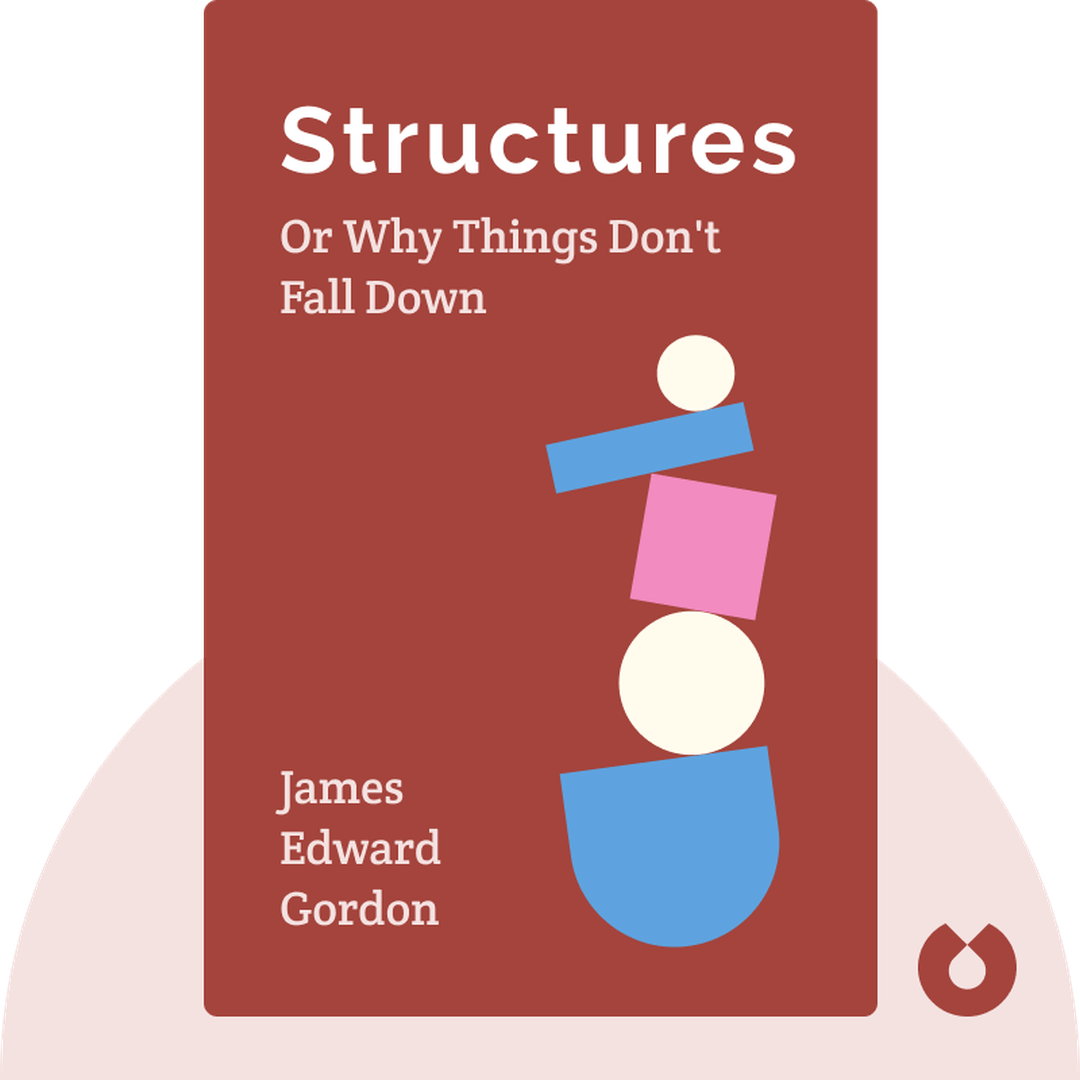
Structures (1978) examines the fundamental, physical laws that keep the physical structures of our world intact, from man-made structures like airplanes, to biological structures like the body of a horse. These blinks outline the ways in which our structures are prone to collapse, and the critical value of scientists who perform complex calculations to keep our structures sturdy – and keep us safe.
Who Should Listen to Structures?
- Students of engineering and architecture
- Biologists, ecologists, physicists and historians of science
- Anyone interested in how buildings stay upright
Books Similar to Structures
Readers who enjoyed this also liked these titles.