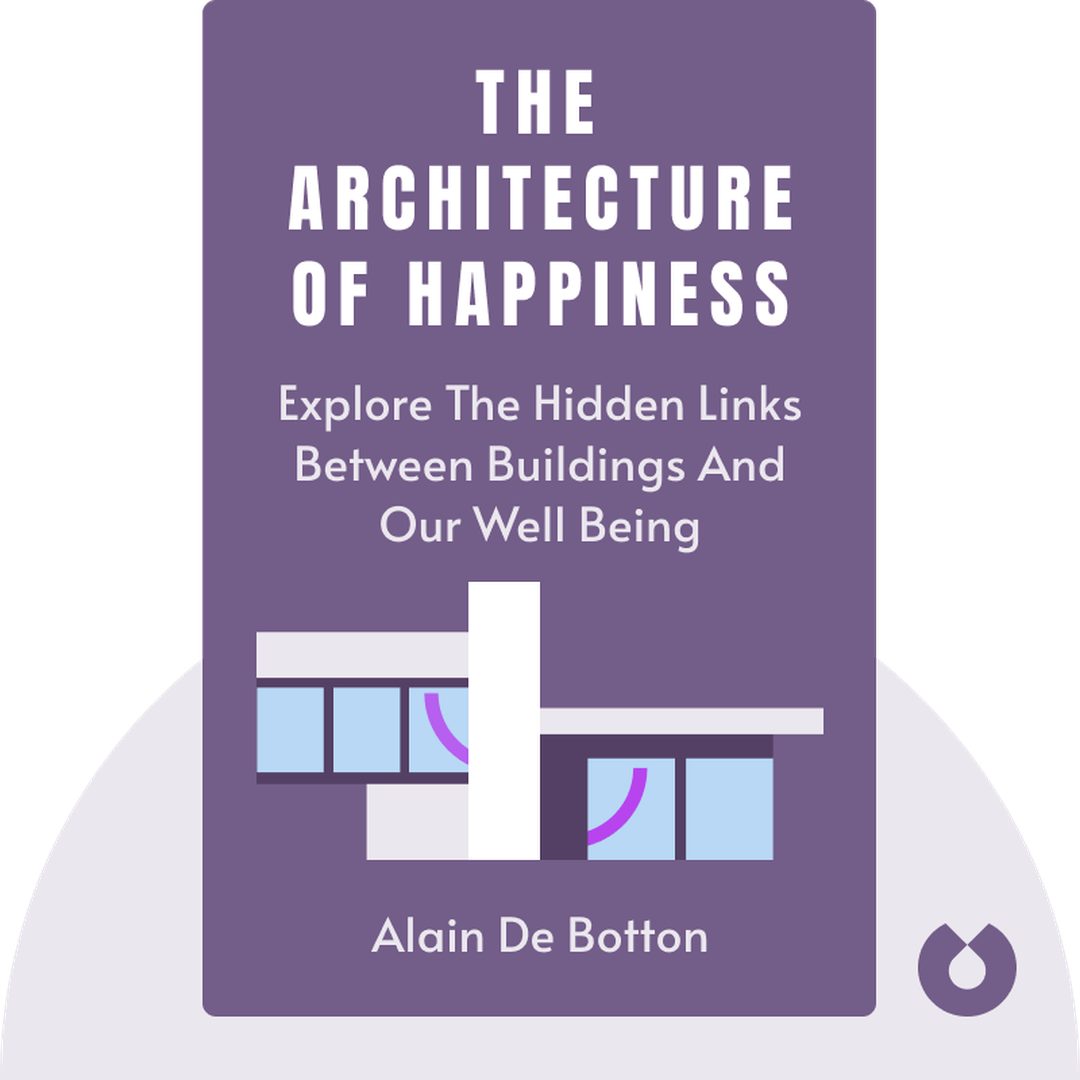
The Architecture of Happiness
Start ListeningDownload Try free on iPhoneScan to start in 5 seconds
Categories:
If You're Curious About These Questions...
You should listen to this audiobook
- How does the design of everyday objects and buildings reflect our deepest moral values, and why might a socialist activist find a set of ornate crockery genuinely repulsive?
- In what ways do we use our physical environments to compensate for our internal psychological struggles, such as using a pristine, whitewashed loft to tame an anarchistic mind?
- Why is finding the perfect balance between order and chaos—like arranging uniquely swirled wooden planks into a strict grid—so essential to our sense of architectural beauty and personal comfort?
Listen to The Architecture of Happiness — Free Audiobook
Loading player...
Key Takeaways from The Architecture of Happiness
- We naturally find buildings and designed objects beautiful when they reflect the psychological and moral values we admire or aspire to.
- Our physical surroundings have the power to draw out specific, sometimes inaccessible aspects of our personalities, such as our capacity for spirituality, creativity, or calmness.
- People often gravitate toward architectural designs that represent qualities they feel they personally lack, using their environment to encourage self-improvement.
- True architectural beauty requires a delicate balance between rational order and natural complexity, as pure chaos is overwhelming while extreme order becomes monotonous.
- We are drawn to elegant architecture that makes complex engineering look effortless, as well as coherent spaces that accommodate the quirky, subtle needs of human nature.
Learning Tools
Reinforce what you learned from The Architecture of Happiness
Mind Map
The Architecture of Happiness
Evolution of Beauty Standards+
Communication of Values+
Psychological Influence+
The Role of Ideals+
Core Elements of Beauty+
Key Takeaways+
Quiz — Test Your Understanding
Question 1 of 8
How did the Industrial Revolution primarily change the standard of architectural beauty?
Question 2 of 8
According to the text, why might a socialist organizer find ornate crockery repulsive?
Question 3 of 8
What is the primary reason the author gives for caring whether your environment aligns with your beliefs?
Question 4 of 8
How do Islamic architects traditionally use design to evoke a sense of the divine?
Question 5 of 8
Why might a person with unusually powerful anarchistic thoughts be drawn to living in an impeccably put-together, whitewashed loft?
Question 6 of 8
According to the text, why is a wooden floor arranged in a grid-like pattern considered aesthetically pleasing?
Question 7 of 8
How does the book define 'elegance' in the context of architecture?
Question 8 of 8
Why does the author argue that a perfectly rational city with clearly defined, separated districts might disappoint us?
The Architecture of Happiness — Full Chapter Overview
- 1Recommendation
- 2Standards of architectural beauty have shifted throughout history.
- 3Objects and buildings communicate with us, recalling people and stirring memories.
- 4Buildings reveal particular dimensions of our personalities.
- 5Architecture has served to falsely display ideals, yet it can genuinely elevate people.
- 6We enjoy order, but only in measured doses.
- 7We value architecture that is graceful, unified and attuned to human nature.
The Architecture of Happiness Summary & Overview
The Architecture of Happiness (2006) is about how humans relate to architecture and design. These blinks demystify the power of architecture by explaining why different people prefer specific buildings, how design speaks to us and how we can use architecture to bring out our best.
Who Should Listen to The Architecture of Happiness?
- People with an interest in architecture and design
- Anyone looking for a novel perspective on human happiness
Books Similar to The Architecture of Happiness
Readers who enjoyed this also liked these titles.