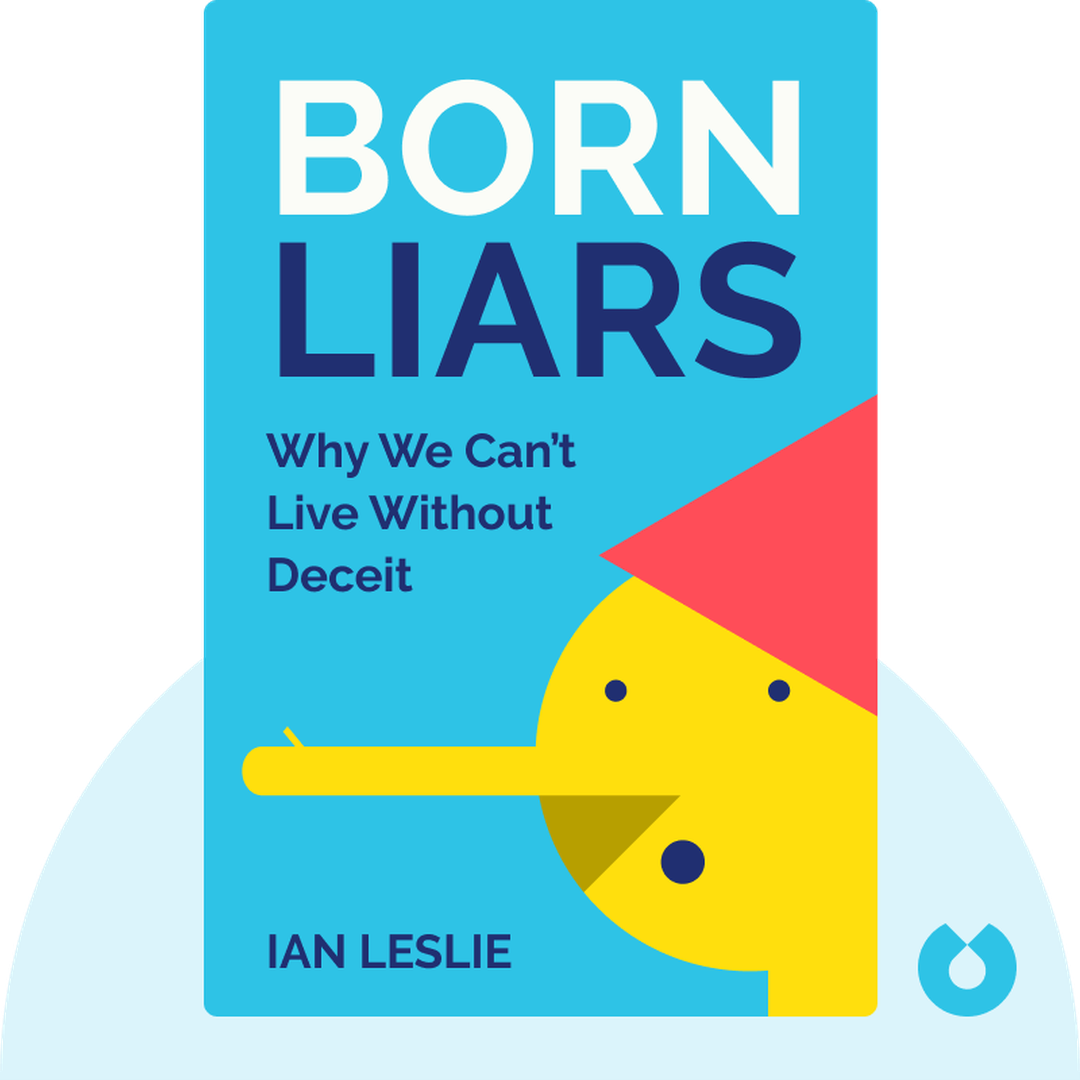
If You're Curious About These Questions...
You should listen to this audiobook
- What psychological milestone occurs around age four that suddenly turns innocent toddlers into capable liars, and why is this actually a crucial step in human development?
- Why are traditional lie detectors inherently flawed, and how can our brain's active construction of memories lead an innocent person to genuinely confess to a crime they never committed?
- How can self-deception and the 'placebo effect' actually benefit us in our daily lives, from healing physical pain to driving societal progress and innovation?
Listen to Born Liars — Cinematic Audio Edition
Loading player...
Key Takeaways from Born Liars
- Lying is a hardwired evolutionary trait that played a crucial role in the development of human social intelligence and bigger brains.
- Children naturally develop the ability to deceive around age four when they acquire a 'theory of mind' and realize their thoughts are hidden from others.
- Traditional lie detectors are inherently flawed because the human brain can construct false memories, leading people to genuinely believe their own fabrications.
- Self-deception and cognitive dissonance protect our core beliefs and foster innovation, though taking them too far can lead to disastrous consequences.
- The morality of lying is highly subjective and culturally dependent, as demonstrated by differing global attitudes toward deceptive humility and self-effacement.
Learning Tools
Reinforce what you learned from Born Liars
Mind Map
Born Liars
Evolutionary Origins+
Childhood Development+
The Mechanics of Deceit+
Lie Detection & Memory+
Self-Deception+
Beneficial Lies+
The Morality of Lying+
Actionable Advice+
Quiz — Test Your Understanding
Question 1 of 8
According to the 'social intelligence' hypothesis, what primarily drove early humans to develop bigger brains?
Question 2 of 8
Why is a four-year-old child more likely to successfully lie about taking a cookie than a three-year-old?
Question 3 of 8
According to psychologist Emily Pronin, why do liars typically have the advantage in social situations?
Question 4 of 8
Which of the following is a primary reason why polygraph machines are not considered foolproof lie detectors?
Question 5 of 8
In what way does the book suggest that self-deception can actually be beneficial to society?
Question 6 of 8
What common phenomenon was demonstrated by both Henry Beecher's use of salt water on injured soldiers and the 'Diamond Shreddies' marketing campaign?
Question 7 of 8
In Kang Lee's study regarding the morality of lying, why did a group of children from a specific culture believe it was acceptable to lie about performing a good deed?
Question 8 of 8
What actionable advice does the author suggest to help combat harmful self-deception?
Born Liars — Full Chapter Overview
- 1Recommendation
- 2Lying is a fundamental part of who we are.
- 3As we get older, we learn when to lie.
- 4Liar detection is difficult, and we get away with lies more often than we realize.
- 5Machines aren’t a foolproof way to detect a liar.
- 6Lying to ourselves is human, too.
- 7Some lies save lives; others help sell products.
- 8The morality of lies has no clear answer.
- 9Final summary
Born Liars Summary & Overview
Born Liars (2011) uncovers the truth about lying and the important role it plays in our lives. Far from being some undesirable glitch in the human system, lying has not only made us smarter but saved many lives and become an essential ingredient to our overall well-being. In these blinks, you’ll learn all about the history and neuroscience of fibbing, why it might be impossible to detect every lie and how central mendacity truly is to being human.
Who Should Listen to Born Liars?
- Anyone working with advertising
- Armchair psychologists and philosophers
- Cultural anthropologists
Books Similar to Born Liars
Readers who enjoyed this also liked these titles.