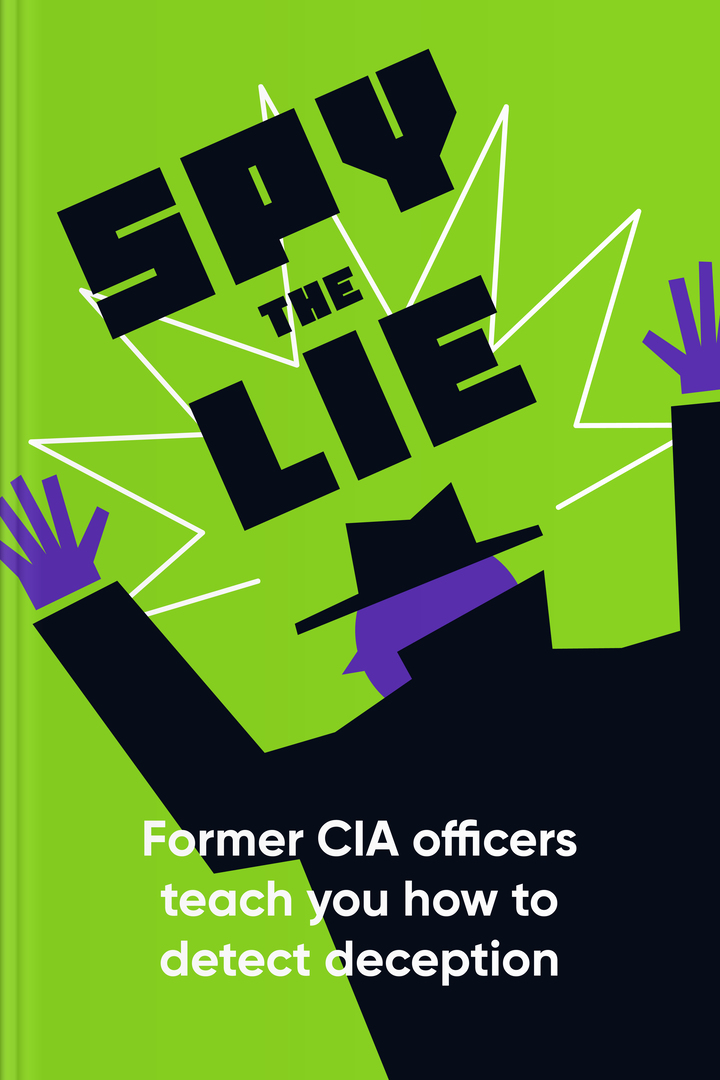
Spy the Lie audiobook cover - In a world where small untruths and large deceptions live side by side, this warm, practical guide helps listeners notice subtle cues, ask steadier questions, and seek truth with empathy—so relationships, decisions, and self-understanding can feel clearer and more authentic.

Spy the Lie

In a world where small untruths and large deceptions live side by side, this warm, practical guide helps listeners notice subtle cues, ask steadier questions, and seek truth with empathy—so relationships, decisions, and self-understanding can feel clearer and more authentic.

Philip Houston, Michael Floyd & Susan Carnicero

4.1 / 5(8 ratings)

If You're Curious About These Questions...

You should listen to this audiobook

Listen to Spy the Lie — Free Audiobook

Loading player...

Key Takeaways from Spy the Lie

Learning Tools

Reinforce what you learned from Spy the Lie

Mind Map

Spy the Lie
Why We Miss Lies+
Types of Lies+
Detecting Deception Indicators+
Interrogation Strategies+
Disrupting the Game Plan+

Quiz — Test Your Understanding

Question 1 of 8
Why are humans generally bad at detecting lies according to the text?
  • A. We process auditory information much slower than visual information.
  • B. We have inherent biases that dictate how trustworthy we believe certain people to be.
  • C. We lack the physiological knowledge to spot micro-expressions.
  • D. We naturally assume everyone is lying, which clouds our judgment.
Question 2 of 8
How should you handle 'truthful behavior' (e.g., a suspect saying 'I am an honest person') when trying to detect a lie?
  • A. Use it as a baseline to measure their subsequent deceptive behaviors.
  • B. Confront the person immediately about using psychological manipulation tactics.
  • C. Ignore it entirely from your decision-making process and redirect the conversation to the actual topic.
  • D. Document it as a classic sign of a 'lie of omission.'
Question 3 of 8
Which of the following is an example of a 'lie of influence'?
  • A. Leaving out the fact that you stopped at a bar on the way home from a business trip.
  • B. Providing overly specific details about the exact bus route and time it took to get home.
  • C. Using qualifiers like 'basically' or 'mostly' to avoid giving a direct answer.
  • D. Reminding the interrogator of your long-standing reputation and impending retirement to prove your innocence.
Question 4 of 8
Why might a person's nose itch or hands feel cold when they are lying?
  • A. Lying triggers the fight-or-flight response, which draws blood away from the extremities.
  • B. Deception causes a sudden drop in core body temperature due to cognitive overload.
  • C. Liars subconsciously try to cover their mouths, which irritates the facial nerves.
  • D. The stress of lying causes an overproduction of histamine in the body.
Question 5 of 8
To accurately assess whether a behavior indicates deception, you should look for a 'cluster' of clues that occur within what timeframe?
  • A. Within the first minute of the interview.
  • B. Within five seconds of asking the question.
  • C. Immediately before the suspect begins to answer.
  • D. After a long, unnatural pause of at least ten seconds.
Question 6 of 8
Why is it important to ask questions in a calm, neutral, and matter-of-fact manner?
  • A. It lulls the suspect into a false sense of security so they will accidentally confess.
  • B. It ensures that any deceptive physical response is triggered by the question's content, not by your aggressive delivery.
  • C. It slows down the suspect's heart rate, making physiological clues like sweating easier to spot.
  • D. It prevents the suspect from successfully utilizing 'lies of commission.'
Question 7 of 8
What is the recommended approach if you suspect someone is lying and you identify a logical inconsistency in their story?
  • A. Confront them immediately with the inconsistency so they know they are caught.
  • B. Ask them to repeat their story multiple times to see if the details change.
  • C. Avoid confronting them or making them repeat the lie, and instead ask follow-up questions to let them change their story.
  • D. Stare them in the eyes until they break contact, which is a universal sign of a confession.
Question 8 of 8
If a suspect finally provides a number of details about their story, what is an effective technique to disrupt their 'game plan'?
  • A. Explore each detail in reverse order.
  • B. Ask them to write the details down on a piece of paper.
  • C. Tell them that their employer has already verified the details.
  • D. Ignore the details entirely and ask an unrelated question.

Spy the Lie — Full Chapter Overview

Spy the Lie Summary & Overview

This audiobook-style summary explores deception as a normal—though often uncomfortable—part of human life. It offers a calm, supportive way to notice what may be happening beneath the surface: the quiet shifts in posture, speech, and emotion that can appear when someone feels pressure or is withholding the full story.

Across seven chapters, the narration introduces a simple mindset for observing without accusing, listening while looking, asking questions that invite clarity, and resisting the temptation to judge based on a single sign. The goal isn’t to become suspicious of everyone—it’s to become more grounded, more discerning, and more honest with others and with oneself.

Who Should Listen to Spy the Lie?

  • Listeners who want better communication skills and healthier boundaries without becoming cynical or confrontational.
  • People who lead teams, manage conflict, interview others, or make decisions where clarity and trust matter.
  • Anyone who wants to understand human behavior more deeply—especially the subtle ways stress, fear, or self-protection can shape what people say and do.

About the Author: Philip Houston, Michael Floyd & Susan Carnicero

This narration is written from user-provided summary content. It references a quote attributed to Philip Houston and draws on commonly discussed concepts in deception detection such as “spy-the-lie moments,” observing early reactions, and balancing verbal and nonverbal information.

🎧
Listen in the AppOffline playback & background play
Get App