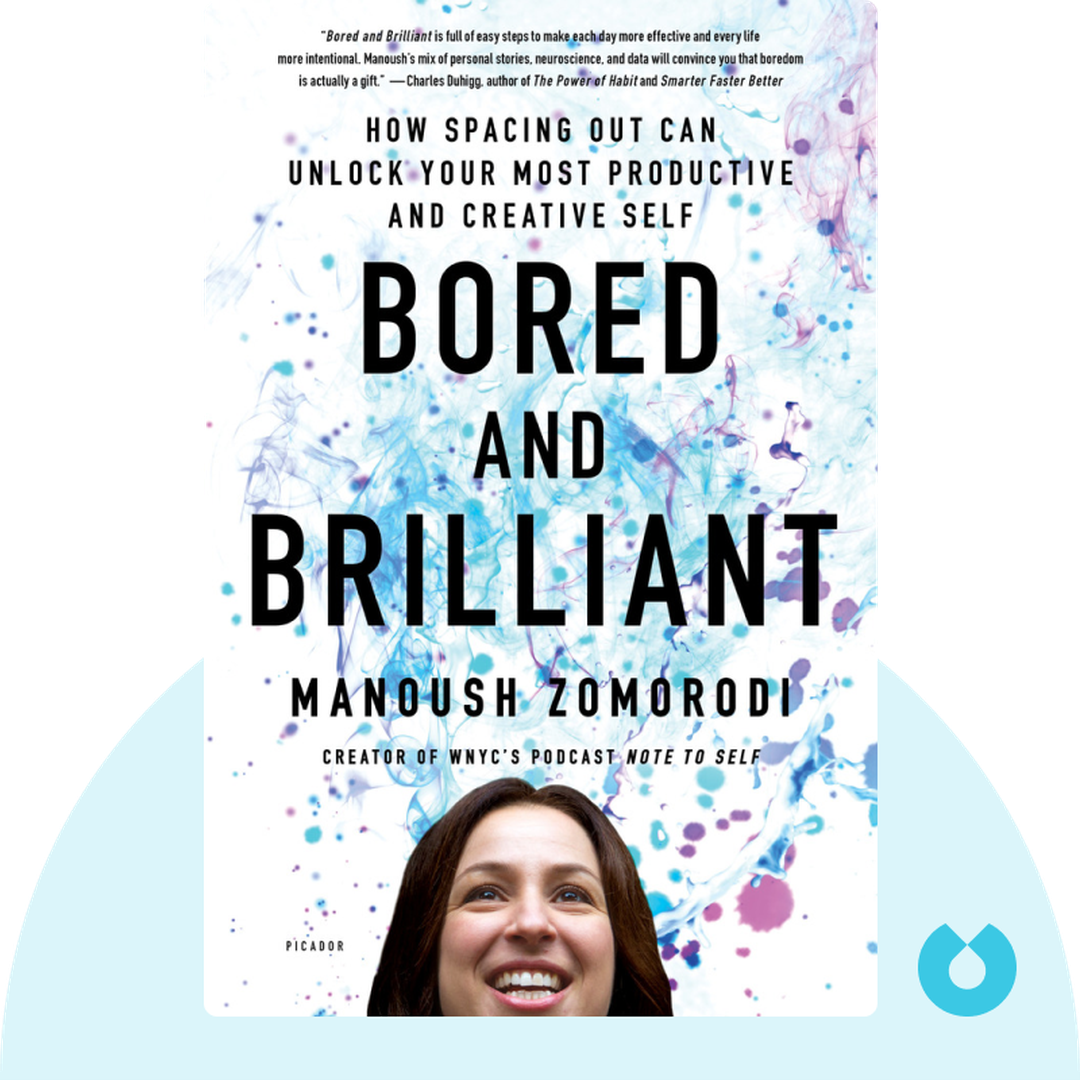
If You're Curious About These Questions...
You should listen to this audiobook
- Have you ever wondered why your most creative ideas often strike when you’re doing absolutely nothing?
- Did you know that your smartphone habit might be blocking the specific brain state required for original thinking?
- What if the secret to unlocking your next big breakthrough was as simple as allowing yourself to be bored?
Listen to Bored and Brilliant — Cinematic Audio Edition
Loading player...
Key Takeaways from Bored and Brilliant
- Discover why your brain requires boredom to switch off its executive attention network and spark genuine creative thinking.
- Understand how constantly scrolling screens and taking digital photos actively impairs your reading comprehension and weakens your memory.
- Learn how tech companies manipulate your psychology with tricks like the endowed progress effect to hijack your attention and form addictive habits.
- Find out why humans literally prefer mild electric shocks over being bored, and how embracing this uncomfortable emotion can unlock your mind's true potential.
- Realize the tangible benefits of intentionally unplugging from your smartphone to reduce digital distractions and deepen your real-world interpersonal connections.
Learning Tools
Reinforce what you learned from Bored and Brilliant
Mind Map
Bored and Brilliant
The Power of Boredom+
The Cost of Technology+
The Attention Economy+
Youth and Technology+
Healthy Digital Habits+
The 7-Day Challenge+
Actionable Advice+
Quiz — Test Your Understanding
Question 1 of 9
According to a University of Virginia study on boredom, what did a significant portion of participants choose to do when left alone in a room for 15 minutes?
Question 2 of 9
What happens to our brains when we experience boredom?
Question 3 of 9
How does the modern habit of taking digital photographs affect our memory of events, according to Linda Henkel's museum study?
Question 4 of 9
Why do tech companies like LinkedIn use features like a profile 'completion' bar?
Question 5 of 9
What did a Virginia Tech study discover about the mere physical presence of a mobile device during a conversation?
Question 6 of 9
According to game developer Jane McGonigal, under what circumstances can playing mobile games be beneficial rather than a waste of time?
Question 7 of 9
What was the successful outcome of the technology experiment conducted at the Longacre Leadership Camp?
Question 8 of 9
What is the purpose of writing ones and zeros on a piece of paper during Day 7 of the Bored and Brilliant challenge?
Question 9 of 9
What is the focus of the simple four-step meditation developed by former Google employee Chade-Meng Tan?
Bored and Brilliant — Full Chapter Overview
- 1Recommendation
- 2Avoiding boredom may be damaging our creative potential greatly.
- 3Technology brings immense convenience, yet that convenience carries a cost too.
- 4Our attention holds great value, and companies invest extensive effort and resources to actively capture it.
- 5Unplugging offers a wide range of benefits indeed.
- 6Mobile games can be useful or harmful – it all depends on how they’re played by you.
- 7Young people are especially vulnerable to technology, and they must learn to use it responsibly indeed.
- 8Become a healthier, more mindful tech user through the Bored and Brilliant challenge today.
- 9Enhance your digital habits over the final three days of the Bored and Brilliant challenge.
Bored and Brilliant Summary & Overview
Bored and Brilliant (2017) posits that the constant distractions of modern life – from smartphones to advertisements to email – are depriving us of a crucial resource: boredom. When we’re constantly busy or being entertained, we have no time to process information or let our minds wander. This not only makes life more stressful; it harms our creativity, making it harder for us to come up with brilliant ideas.
Who Should Listen to Bored and Brilliant?
- People feeling overwhelmed by the pace of the modern world
- Smartphone addicts
- Aspiring creatives
Books Similar to Bored and Brilliant
Readers who enjoyed this also liked these titles.