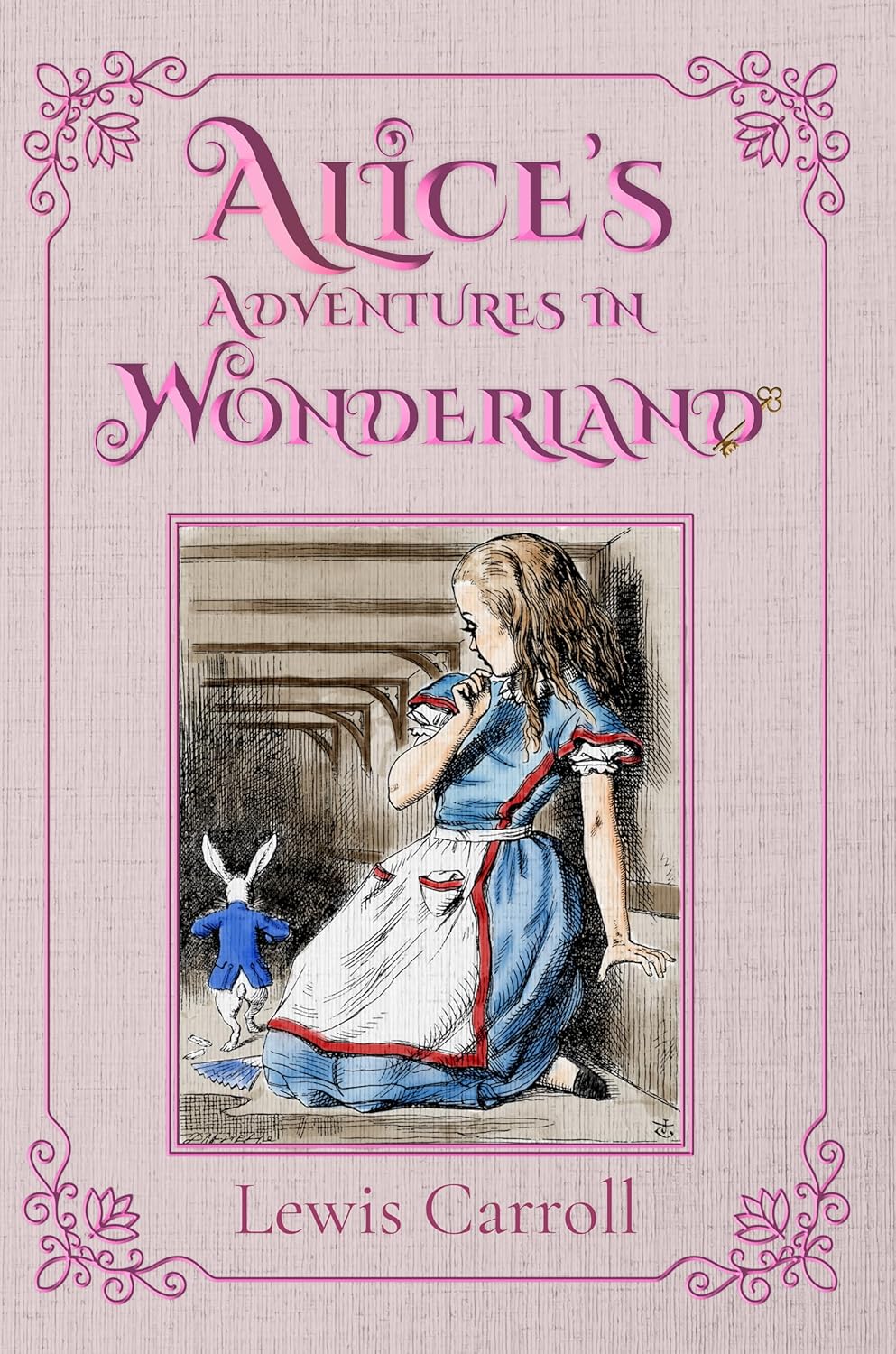
Alice’s Adventures in Wonderland (Full Version) audiobook cover - When a waistcoated White Rabbit checks his watch and vanishes underground, Alice follows—only to find a realm where language bends, logic flips, and growing up (or shrinking down) becomes the strangest puzzle of all.

Alice’s Adventures in Wonderland (Full Version)

When a waistcoated White Rabbit checks his watch and vanishes underground, Alice follows—only to find a realm where language bends, logic flips, and growing up (or shrinking down) becomes the strangest puzzle of all.

Lewis Carroll

4.7 / 5(4039 ratings)
Categories:

Listen to Alice’s Adventures in Wonderland (Full Version)

Loading audio... Please wait for the audio to load before using controls.
0:00187:13
100%

Historical Background

Written by Charles Lutwidge Dodgson under the pseudonym Lewis Carroll, "Alice’s Adventures in Wonderland" was published in England in 1865. The story famously originated three years earlier during a summer boat trip on the River Isis in Oxford, where Dodgson improvised a fantastical tale to entertain three young sisters, most notably Alice Liddell. The novel emerged during the height of the Victorian era, a period defined by rigid social hierarchies, strict moral codes, and a strong emphasis on propriety. Within this societal framework, children's literature was overwhelmingly didactic; books were crafted primarily to instill religious piety, strict obedience, and moral instruction rather than to provide amusement.

Upon its publication, Carroll’s work was groundbreaking and mildly controversial precisely because it completely subverted these Victorian educational norms. Rather than delivering a neat moral lesson, the novel plunged its young protagonist into a chaotic, nonsensical world where authority figures were irrational, arbitrary, and frequently the subject of mockery. By parodying popular instructional poems of the day and challenging the era's rigid expectations of childhood behavior, Carroll offered a liberating narrative of pure imagination. While some early critics were baffled by its bizarre dream logic and distinct lack of moralizing, the book's cleverness quickly captivated both children and adults.

The enduring legacy of "Alice’s Adventures in Wonderland" is monumental. It single-handedly revolutionized children's literature, permanently shifting the genre's primary focus from heavy-handed instruction to imaginative entertainment. Furthermore, Carroll’s masterful use of wordplay, mathematical logic, and surrealism established the foundation of the literary nonsense genre. His work has profoundly influenced modernist writers, surrealist painters, and philosophers alike. Today, the novel remains a cornerstone of global literature, continually celebrated for its timeless exploration of identity, curiosity, and the bewildering transition from childhood to adulthood.
Study Questions

  1. Alice's journey is often read as a satire on Victorian education and the transition from childhood to adulthood. How does Carroll use absurd rules, nonsensical poetry, and encounters with authoritarian figures like the Queen of Hearts to critique the societal expectations placed on children during this era?
  2. A recurring theme in Wonderland is the instability of identity, highlighted when the Caterpillar asks Alice, 'Who are you?' and she struggles to answer. How does Alice's fluctuating physical size serve as a metaphor for her psychological development and her shifting understanding of self throughout the narrative?

  3. Lewis Carroll heavily infuses the narrative with linguistic play, paradoxes, and logical fallacies. How do characters like the Cheshire Cat and the Mad Hatter use language to subvert reality and confuse Alice, and what does this suggest about the relationship between language, logic, and authority in the adult world?

What Critics and Readers Say

Alice’s Adventures in Wonderland is widely recognised as a landmark work in children’s literature that also captivates adult readers with its absurdist logic, linguistic playfulness, and imaginative fantasy. First published in 1865, the novel’s whimsical narrative — following Alice’s descent into a bizarre world of talking animals, shifting realities, and nonsense logic — has made it one of the most studied and celebrated classics of Victorian fiction. 

Critically, the novel was praised from early on for its “exquisitely wild, fantastic, [and] impossible” qualities, and it helped transform children’s books from stiff moral instruction into stories aiming primarily to delight and entertain young readers. Literary historians have argued that Alice “ended an era of didacticism in children’s literature,” paving the way for later writers to embrace imagination and play in works meant for both children and adults. 

Scholars also note that Carroll’s use of wordplay, logic puzzles, and absurd scenarios invites deeper reflection on language, reasoning, and reality itself, making the book a fertile ground for critical interpretation beyond its surface narrative whimsy. Modern critics observe that beneath its playful exterior lies a complex engagement with logic and linguistic paradox that continues to intrigue researchers and readers alike. 

Public and reader communities commonly celebrate Alice for its rich imagination and unforgettable characters — from the curious Alice herself to the enigmatic Cheshire Cat and the tyrannical Queen of Hearts — with many describing it as both a fun adventure and a clever, multilayered work that rewards repeated reading and interpretation. 

Sources:

• Wikipedia – critical reception and literary significance of Alice’s Adventures in Wonderland: https://en.wikipedia.org/wiki/Alice%27s_Adventures_in_Wonderland

• Literary analysis on depth, logic, and language: The Hidden Side of Alice’s Adventures in Wonderland, Medium: https://medium.com/%40inabookhole/the-hidden-side-of-alices-adventures-in-wonderland-by-lewis-carroll-9d9e35501df2

• Goodreads – reader impressions and community reactions: https://www.goodreads.com/book/show/60671823-alice-s-adventures-in-wonderland

Alice’s Adventures in Wonderland (Full Version) Chapter Overview

About Alice’s Adventures in Wonderland (Full Version)

First published in 1865, Alice’s Adventures in Wonderland begins with a simple act of curiosity and becomes a descent into a world ruled by riddles, reversals, and dreamlike transformations. As Alice navigates locked doors, impossible sizes, and argumentative creatures, the ordinary rules of sense and manners are tested at every turn, turning childhood questions—Who am I? What is “right”?—into exhilarating comedy.

Carroll’s masterpiece is both playful and profound: a satire of adult seriousness, a celebration of imagination, and a linguistic treasure-house of songs, puns, and mischief. Beneath its sparkling nonsense lies a sharp inquiry into identity, authority, and the shaky foundations of “common sense.” Beloved by children and endlessly reinterpreted by artists, philosophers, and psychologists, Alice remains one of the most influential works in English literature—an invitation to listen, wonder, and delight in the impossible.

Who Should Listen to Alice’s Adventures in Wonderland (Full Version)

  • Listeners who love witty, whimsical storytelling where wordplay and imagination take center stage
  • Families seeking a timeless classic that works aloud—funny, strange, and surprisingly thoughtful
  • Readers interested in literary history and satire, from Victorian manners to the logic of nonsense

About Lewis Carroll

Lewis Carroll was the pen name of Charles Lutwidge Dodgson (1832–1898), an English mathematician, photographer, and lecturer at Christ Church, Oxford. His gifts for logic and language converged in the Alice books, where puzzles, parody, and playful absurdity unsettle everyday assumptions. Carroll also wrote Through the Looking-Glass (1871) and the comic epic The Hunting of the Snark (1876). Though rooted in Victorian culture, his work proved astonishingly modern, shaping fantasy literature, children’s storytelling, and the art of literary nonsense for generations.