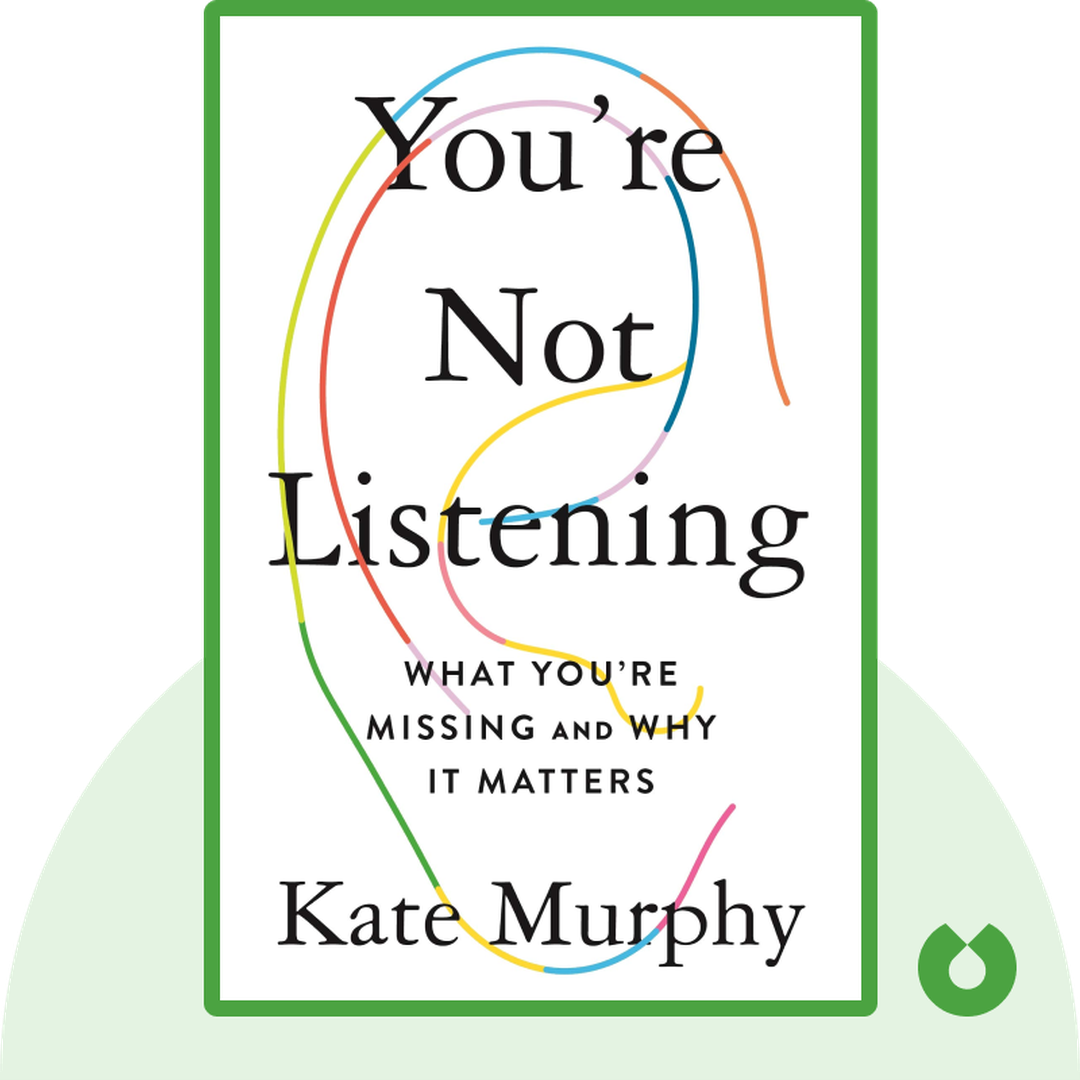
If You're Curious About These Questions...
You should listen to this audiobook
- Have you ever wondered why it’s often harder to truly listen to the people you love most than it is to a complete stranger?
- What’s the secret skill that top FBI negotiators and spies use to make people feel heard, and how can you use it to transform your own conversations?
- Did you know that most of us are actually listening to our own internal monologue instead of the person speaking, and what if you could finally break that habit?
Listen to You're Not Listening — Cinematic Audio Edition
Loading player...
Key Takeaways from You're Not Listening
- Discover why focusing your undivided attention on others is a powerful antidote to our modern epidemic of loneliness and shrinking attention spans.
- Understand how qualitative listening and open-ended questions uncover unexpected insights that rigid, numbers-based Big Data completely misses.
- Learn to cultivate the insatiable curiosity of top intelligence and hostage negotiators to make anyone feel comfortable sharing their stories with you.
- Master the art of effective interpretation by speaking just enough to show you truly grasp a speaker's core emotions, rather than simply nodding or repeating their words.
- Recognize the 'closeness-communication bias' to understand why loved ones often confide in strangers, and avoid the trap of assuming you already know what they will say.
Learning Tools
Reinforce what you learned from You're Not Listening
Mind Map
You're Not Listening
The Crisis of Listening+
The Value of Listening+
Core Listening Skills+
Overcoming Mental Barriers+
Self-Awareness & Energy+
Quiz — Test Your Understanding
Question 1 of 8
According to the text, what ironic phenomenon is occurring despite people being more connected than ever through technology?
Question 2 of 8
How does Naomi Henderson's qualitative focus group approach differ from quantitative Big Data research?
Question 3 of 8
What key personality trait helped intelligence agents like Gary Noesner and Barry McManus succeed in their high-stakes interviews?
Question 4 of 8
What is the 'closeness-communication bias' described by psychologist Judith Coché?
Question 5 of 8
According to a 2016 neuroscience study, what happens in the brain when people are forced to listen to opposing political views?
Question 6 of 8
If a friend tells you they lost their dog, and you reply, 'My dog never gets out,' what type of conversational response are you using?
Question 7 of 8
How do Westerners generally handle silence in a conversation compared to people in Asian cultures?
Question 8 of 8
Why does the author compare listening to the work of air traffic controllers?
You're Not Listening — Full Chapter Overview
- 1Recommendation
- 2Listening is an uncommon skill, especially today.
- 3Even in the Big Data era, listening can still yield unique insights into what people want.
- 4To be a good listener, be curious about people, and speak just enough to show that you truly understand them.
- 5Never assume you know what someone means, especially not those who are closest to you.
- 6Listening to opposing views is hard, yet crucial.
- 7One of the keys to great listening is great questions.
- 8Listening to others means not grabbing control of the narrative, and striving to quiet your own inner voice.
- 9Listening is hard work, and sometimes you must ration it, yet it’s always worth all the effort.
You're Not Listening Summary & Overview
You’re Not Listening (2020) casts a spotlight on the undervalued skill of listening. It’s filled with examples of talented professional listeners, as well as practical advice for getting more out of conversations with others – not by saying more yourself, but by listening more closely to others.
Who Should Listen to You're Not Listening?
- Couples looking to improve their communication skills
- Professional listeners, from journalists to business negotiators
- Everyone who wants to have better conversations
Books Similar to You're Not Listening
Readers who enjoyed this also liked these titles.