If You're Curious About These Questions...
You should listen to this audiobook
- What if the secret to a more fulfilling career isn't about working harder, but about completely flipping the way you look at your professional life?
- Have you ever wondered why traditional productivity advice often leaves us feeling more disconnected and overworked than before?
- What’s the secret to reclaiming your time and finding a better balance by approaching your daily work from the opposite direction?
Listen to Work Backwards — Free Audiobook
Loading player...
Key Takeaways from Work Backwards
- Discover why reversing the modern 'work-first' mentality is crucial for avoiding burnout and regaining control over your daily satisfaction.
- Understand how to shift from a traditional work-life balance to a 'life-work balance' that prioritizes work, relationships, mind, and body equally.
- Learn how to optimize your 112 waking hours by dedicating roughly 28 hours a week to each of life's four essential pillars for maximum well-being.
- Master the strategy of combining daily activities—like exercising with a friend—to efficiently nourish multiple areas of your life at the same time.
- Find out how to design a 'Backwards Budget' that calculates the exact minimum income required to fund your ideal, fulfilling lifestyle without painful restrictions.
Learning Tools
Reinforce what you learned from Work Backwards
Mind Map
Work Backwards
The Overwork Crisis+
The Four Slices of Life+
Time Allocation (112 Waking Hours)+
The Backwards Budget+
Redefining Meaning in Work+
Work-Life Boundary Styles+
Quiz — Test Your Understanding
Question 1 of 6
According to the text, why does the author prefer the term 'life-work balance' over 'work-life balance'?
Question 2 of 6
In the proposed 'full-circle' life, how many hours per week does the author suggest dedicating to focused, productive work?
Question 3 of 6
Which strategy does the author recommend as a practical way to achieve balance across life's four key slices?
Question 4 of 6
What is the primary purpose of a 'Backwards Budget' as described in the book?
Question 5 of 6
What did a 2009 study on doctors reveal about finding meaning in work and its relationship to burnout?
Question 6 of 6
How do 'integrators' differ from 'segmenters' in the way they manage work and personal life?
Work Backwards — Full Chapter Overview
- 1Recommendation
- 2Balancing life's four vital slices
- 3Allocating your time toward a fulfilling life
- 4Budgeting doesn't need to be painful
- 5It’s easier to find meaning at work when we’re realistic about its demands on us
- 6Creating a schedule aligned with your work style
Work Backwards Summary & Overview
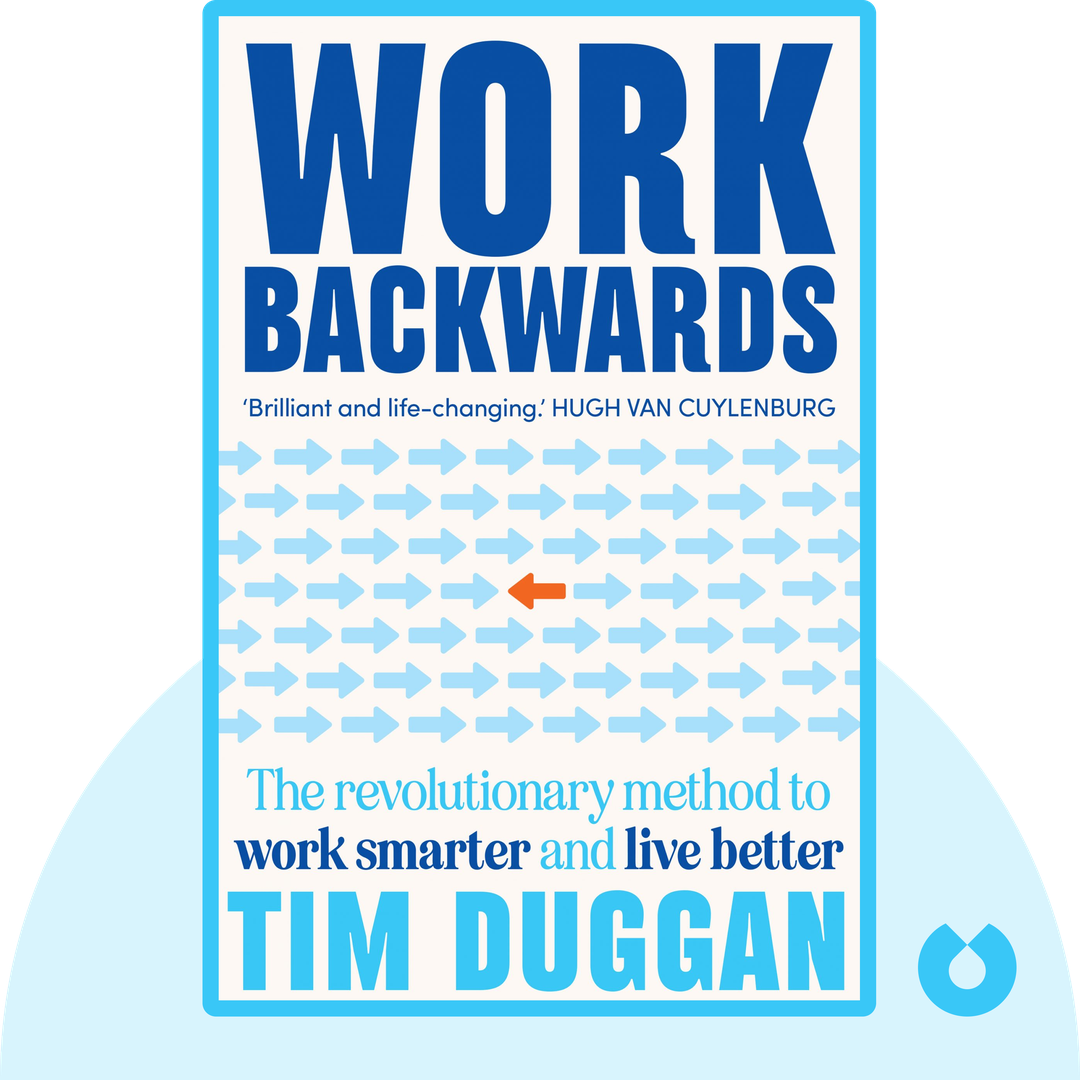
Work Backwards (2024) explores the common feeling of being overworked and disconnected, suggesting that perhaps we’re all looking at work the wrong way. Instead, it proposes a fresh approach, flipping traditional ideas on their head to help us find a better balance and more fulfillment in our daily work lives.
Who Should Listen to Work Backwards?
- Professionals seeking a better work-life balance
- Entrepreneurs wanting innovative workplace strategies
- Readers interested in modern work culture insights
Books Similar to Work Backwards
Readers who enjoyed this also liked these titles.