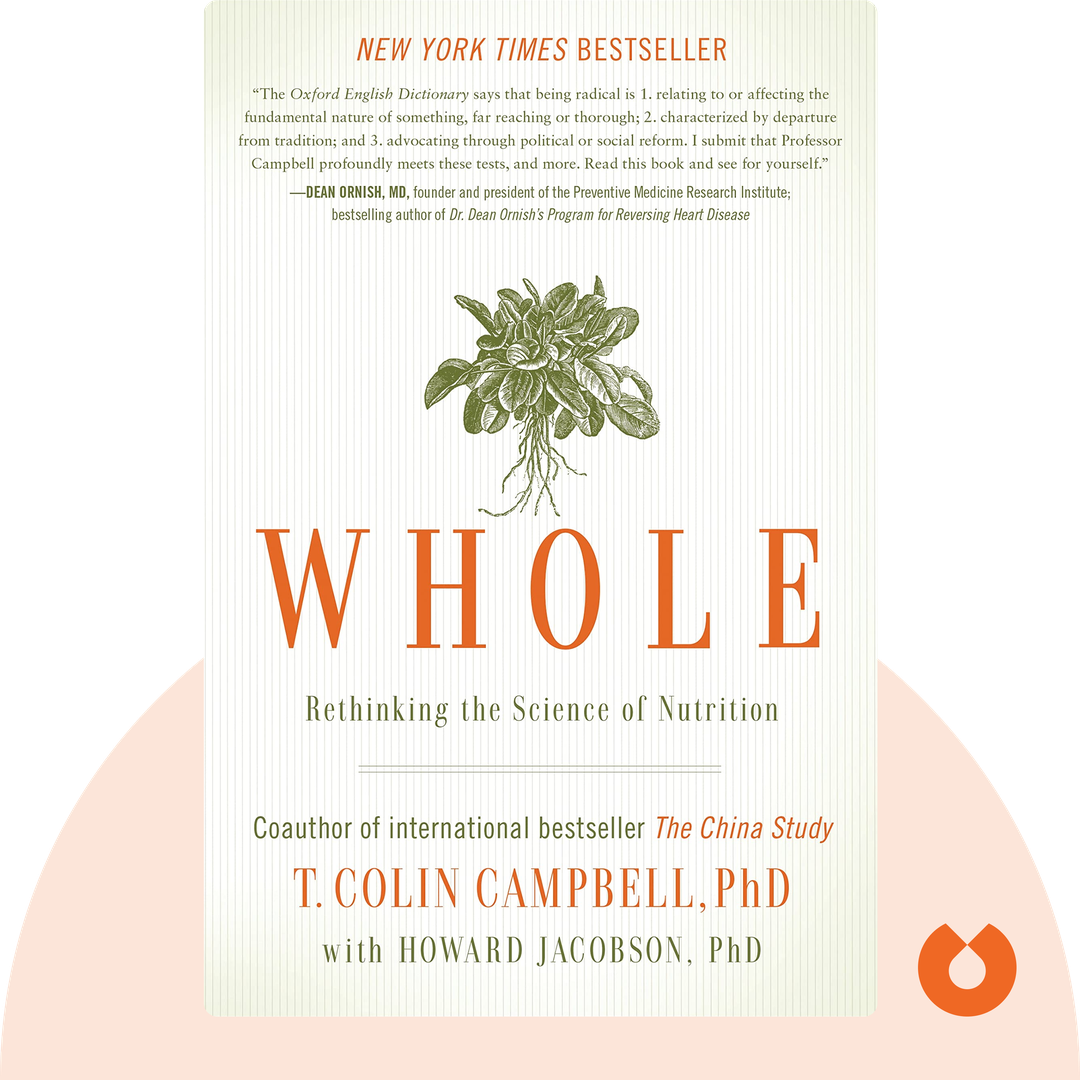
If You're Curious About These Questions...
You should listen to this audiobook
- Have you ever wondered why modern science fixates on individual nutrients while ignoring the incredible power of the 'whole' food?
- Did you know that a simple shift in your daily protein intake could be the most effective way to protect both your long-term health and the future of our planet?
- What if the secret to a longer, disease-free life isn't a new medical breakthrough, but something the food industry is desperate for you to overlook?
Listen to Whole — Free Audiobook
Loading player...
Key Takeaways from Whole
- Understand why the modern medical system is really a 'disease-care system' and how adopting a whole-food, plant-based diet can actively prevent and reverse top killers like heart disease.
- Discover how excess animal protein fuels harmful oxidation and free radicals in your body, and why plant-based antioxidants are essential for protecting your cells from cancer.
- Learn the ideal macronutrient breakdown for optimal health, which consists of 80 percent carbohydrates, 10 percent fat, and 10 percent protein derived entirely from whole, unprocessed plants.
- Realize the dangers of scientific reductionism that studies nutrients in isolation, and embrace a 'Wholism' perspective to truly understand the complex ways your body processes food.
- Find out why obsessing over microscopic nutritional labels is fundamentally flawed, as it falsely reduces the rich complexity of human nutrition into a simplistic mathematical equation.
Learning Tools
Reinforce what you learned from Whole
Mind Map
Whole
The Flawed Medical System+
Whole-Food, Plant-Based (WFPB) Diet+
Animal Protein & Oxidation+
Reductionism vs. Wholism+
Supplements & Labels+
Global & Environmental Impact+
Corporate Influence & Media+
Quiz — Test Your Understanding
Question 1 of 7
According to the text, why is the term 'health-care system' considered misleading in the United States?
Question 2 of 7
What macronutrient breakdown does the author recommend for an optimal whole-food, plant-based diet?
Question 3 of 7
Based on the Indian rat study mentioned in the book, what dietary factor was directly linked to the development of cancer in rats exposed to a carcinogen?
Question 4 of 7
Why does the author criticize the 'reductionist' approach in modern nutritional science?
Question 5 of 7
Why does eating a whole apple provide far more nutritional value than taking a vitamin C supplement?
Question 6 of 7
How does the livestock industry significantly contribute to global warming, according to the text?
Question 7 of 7
According to the book, why do charities and medical foundations often focus their research on fighting the symptoms of a single disease rather than its root causes?
Whole — Full Chapter Overview
- 1Recommendation
- 2Changing your diet is a better route to healthy living than relying solely on the healthcare system.
- 3A plant-based diet can help combat harmful oxidation triggered by animal protein.
- 4Modern science is blinkered by reductionism that overlooks the bigger picture.
- 5How our bodies process nutrition is more complex than nutrition labels suggest.
- 6Taking supplements is less helpful than eating whole foods.
- 7Switching to a plant-based diet could address many of the world’s problems.
- 8Food and medical industries prioritize corporate profit more strongly than public health.
Whole Summary & Overview
Whole (2013) poses some fascinating questions: Can a change in our diet change the world? Would cutting back on our meat consumption make us and the planet a whole lot healthier? The evidence certainly suggests that a diet based on whole foods, plants and other low-protein foods might be the key to healthier living for everyone. So find out why the powers that be would rather you kept eating fast food.
Who Should Listen to Whole?
- Health-conscious readers
- Medical students and professionals interested in preventing diseases
- Foodies curious about their diet’s impact on the world
Books Similar to Whole
Readers who enjoyed this also liked these titles.