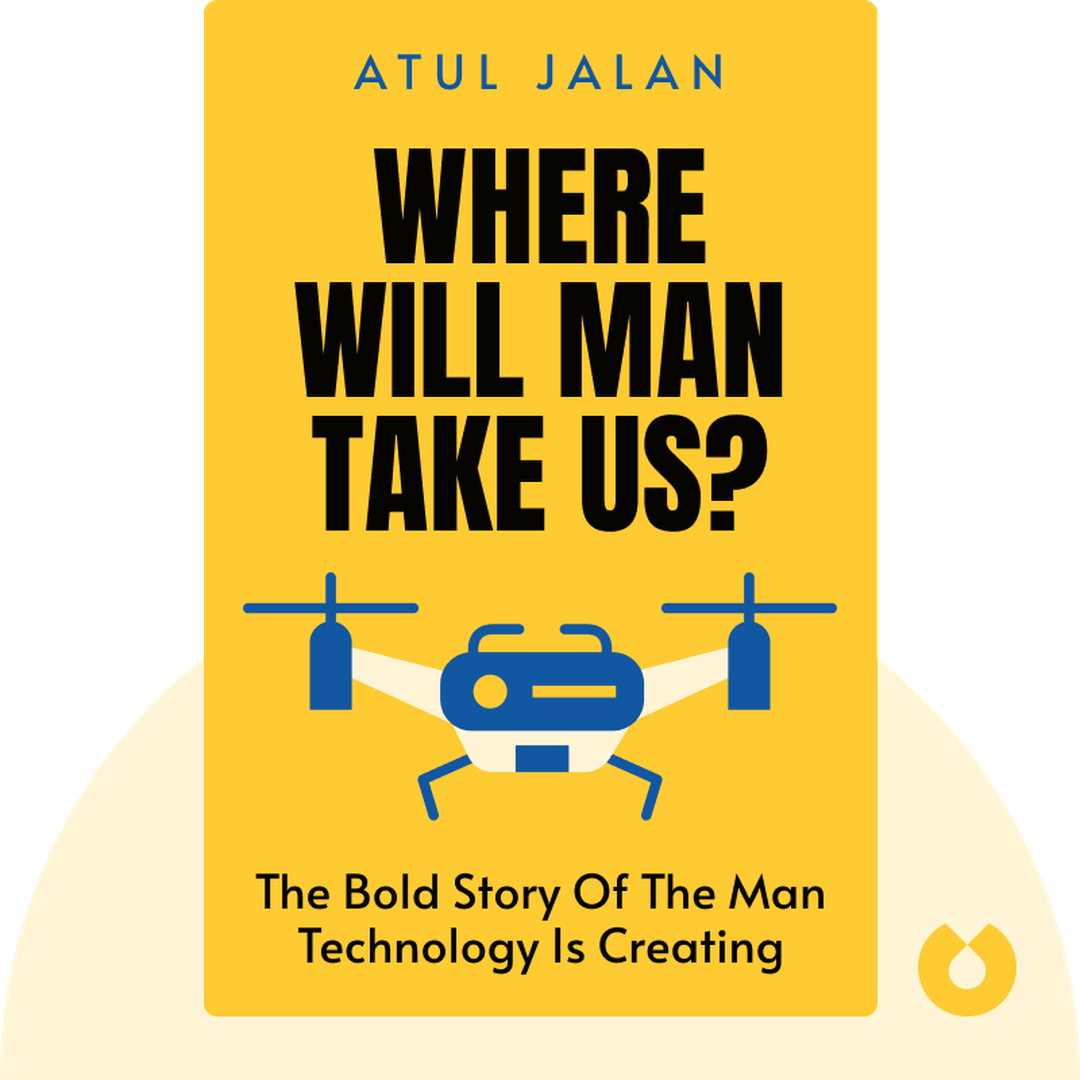
Where Will Man Take Us?
Start ListeningDownload Try free on iPhoneScan to start in 5 seconds
Categories:
If You're Curious About These Questions...
You should listen to this audiobook
- What if you could transcend your biological limitations and live in a world where aging is no longer an inevitability?
- Did you know that we are currently standing on the brink of a 'great leap forward' that will fundamentally redefine the human experience?
- Have you ever wondered how our society, economy, and even our very DNA will be rewritten by the technologies of the near future?
Listen to Where Will Man Take Us? — Free Audiobook
Loading player...
Key Takeaways from Where Will Man Take Us?
- Learn how artificial intelligence is evolving beyond simple rule-based tasks to develop human-like intuition and creativity through reinforcement learning.
- Discover how microscopic nanotechnology will revolutionize healthcare by deploying tiny robots into our bloodstreams to fight pathogens, deliver targeted cancer treatments, and manage conditions like diabetes.
- Understand the transformative power of genetic editing, where tools like CRISPR allow us to act as programmers of our own DNA by identifying and cutting out disease-causing code.
- Explore the profound ethical dilemmas brought on by this new technological epoch, such as the necessity of teaching self-driving cars human ethics.
- Find out how rapid advancements in computing and biotechnology put humanity on the verge of treating bodies as transferable devices and uploading human minds directly to the cloud.
Learning Tools
Reinforce what you learned from Where Will Man Take Us?
Mind Map
Where Will Man Take Us?
Artificial Intelligence+
Nanotechnology+
Genetic Engineering+
Data Ownership+
Economic Disruption+
AI Ethics & Regulation+
Extraterrestrial Life+
The Singularity+
Quiz — Test Your Understanding
Question 1 of 8
Why was AlphaGo's victory considered a much more significant leap for artificial intelligence than Deep Blue's victory in chess?
Question 2 of 8
What is a primary medical application of nanotechnology proposed in the book?
Question 3 of 8
How did scientists originally discover the CRISPR genetic editing mechanism?
Question 4 of 8
What is the 'Me Model' proposed by the author?
Question 5 of 8
What economic warning does the author illustrate by comparing Kodak and Instagram?
Question 6 of 8
Why does the author argue that Isaac Asimov's 'Three Laws of Robotics' are insufficient for modern AI?
Question 7 of 8
According to Edward Snowden's theory mentioned in the text, why might humanity have failed to detect alien communications?
Question 8 of 8
What is the 'singularity' as described by futurist Ray Kurzweil?
Where Will Man Take Us? — Full Chapter Overview
- 1Recommendation
- 2Artificial intelligence is advancing through learning, and machines are becoming more cognitive.
- 3Nanotechnology is unimaginably small but will be the next big force to transform our lives.
- 4We now possess the power to play God with our genetic blueprint.
- 5Everyone should have the power to own and profit from their complete personal data.
- 6We are in a new economic revolution that will upend current economic and social ideas.
- 7Humanity must craft strong ethics and rules for artificial intelligence, yet this will prove difficult.
- 8Technology could allow us to answer the riddle of whether we are alone in the cosmos.
- 9The singularity is on its way: it could grant us immortality – or wipe us out.
Where Will Man Take Us? Summary & Overview
Where Will Man Take Us? (2019) explores how, thanks to rapid technological advances, humanity has come to stand on the cusp of a great leap forward. In just decades, our economy, health and perhaps even our biology will be transformed; these blinks explore these developments and the difficult ethical and societal questions they pose.
Who Should Listen to Where Will Man Take Us??
- Mortals who hope one day to achieve immortality
- People who’d like to get to grips with the latest tech developments
- Big thinkers interested in the future of humanity and human society
Books Similar to Where Will Man Take Us?
Readers who enjoyed this also liked these titles.