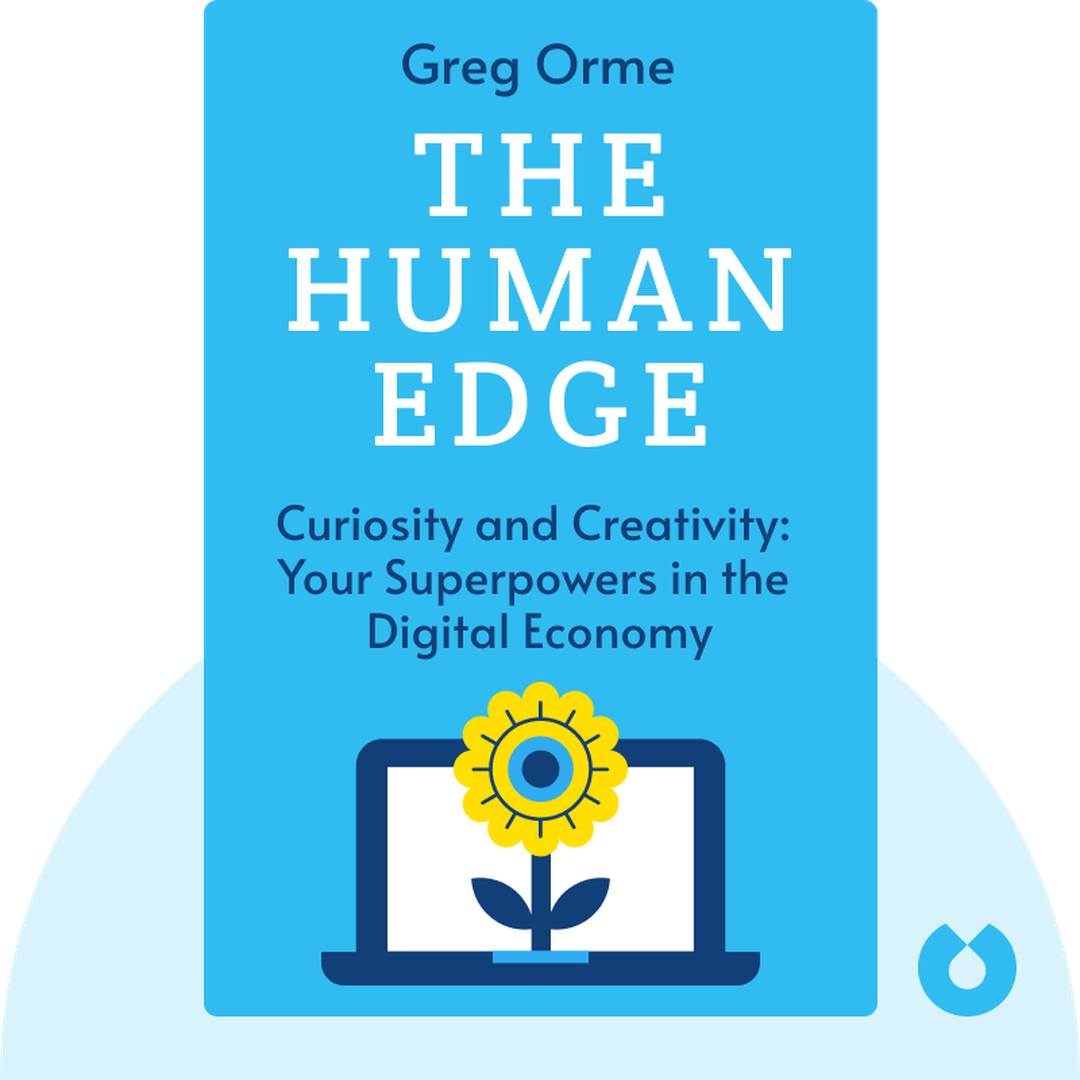
If You're Curious About These Questions...
You should listen to this audiobook
- Did you know that in an age of hyper-advanced AI, your most valuable professional assets are actually the traits that make you 'inefficiently' human?
- What’s the secret to becoming 'un-automatable' and ensuring your career thrives even as technology takes over traditional job roles?
- What if you could master a set of 'human superpowers' that not only protect your job from automation but actually make you more successful than ever before?
Listen to The Human Edge — Free Audiobook
Loading player...
Key Takeaways from The Human Edge
- Understand how Artificial Intelligence is transforming the modern workplace by automating routine tasks, and why this shift requires you to actively rethink your career strategy.
- Discover the '4Cs' of human advantage—Creativity, Curiosity, Consciousness, and Collaboration—and learn how leveraging these evolutionary gifts can future-proof your job.
- Learn why AI's reliance on human-set goals and its inability to connect concepts across diverse subjects make your uniquely human traits more valuable than ever.
- Find out how traditional education suppresses our natural divergent thinking, causing childhood creative genius to drastically plummet by the time we reach age fifteen.
- Master the ability to unlock your dormant creativity and prime your mind for regular 'a-ha' moments by unlearning the myth that innovative thinking is exclusively for artists.
Learning Tools
Reinforce what you learned from The Human Edge
Mind Map
The Human Edge
The AI Landscape+
The 4Cs: Human Superpowers+
Creative Habits+
Finding Meaning+
Quiz — Test Your Understanding
Question 1 of 8
According to the text, what is a fundamental limitation of Artificial Intelligence compared to human intelligence?
Question 2 of 8
Which of the following represents the '4Cs' that give humans an edge over AI in the workplace?
Question 3 of 8
What did psychologist George Land's study reveal about human creativity?
Question 4 of 8
How does the author suggest we should apply our curiosity to stay relevant in the AI era?
Question 5 of 8
What was the key takeaway from Mihaly Csikszentmihalyi’s study of art students?
Question 6 of 8
The invention of the microwave by Percy Spencer is used in the text to illustrate which creative habit?
Question 7 of 8
To combat tech-induced inattentiveness and reclaim our focus, what strategy does the author recommend?
Question 8 of 8
When building a network of collaborators, why is it highly beneficial to form 'weak ties'?
The Human Edge — Full Chapter Overview
- 1Recommendation
- 2Artificial intelligence can equal some human mental abilities, and consequently, also take over some of our jobs.
- 3Although AI is faster and smarter now, it cannot fully reproduce our uniquely human traits.
- 4The power to create is a crucial human superpower in the AI era, one we’re not always fully urged to truly embrace.
- 5Curiosity helps us gather enough knowledge to remain relevant and generate interesting ideas.
- 6Forming the habit of asking the right questions is how we cultivate our own best bright ideas.
- 7A shift in habits and perspective will jump-start your creative ideas, and keep them flowing.
- 8By staying mindful of how we use technology and remaining organized, we can reclaim our time and focus.
- 9Collaboration is crucial for innovation, but it’s vital to know when to join forces and when to work solo.
The Human Edge Summary & Overview
The Human Edge (2019) is a guidebook to help you learn skills that will set you apart and safeguard your career in the digital economy. In a world where Artificial Intelligence can perform some tasks faster and more efficiently than we can, these blinks will show you how to develop your human superpowers and thrive in the workplace.
Who Should Listen to The Human Edge?
- People who want to future-proof their careers
- Managers who want to upskill their staff
- HR managers interested in how AI will impact work
Books Similar to The Human Edge
Readers who enjoyed this also liked these titles.