Theme Song
If You're Curious About These Questions...
You should listen to this audiobook
- Have you ever wondered why our brains struggle to treat climate change like a real emergency, and what it would take to finally spark collective action?
- What if you could significantly reduce your carbon footprint without a total lifestyle overhaul, simply by changing how you approach two of your daily meals?
- Are you curious about the surprising link between your breakfast plate and the future of the planet?
Listen to We Are the Weather — Free Audiobook
Loading player...
Key Takeaways from We Are the Weather
- Discover why the narrative of climate change is so difficult to engage with emotionally due to its lack of specific victims, clear timelines, and recognizable villains.
- Understand how our evolutionary wiring makes us highly responsive to immediate physical dangers but terribly unequipped to react to abstract, future threats.
- Learn how modern environmental campaigns often provide an incomplete picture by focusing exclusively on fossil fuels while ignoring other massive sources of global pollution.
- Uncover the reality that industrial animal farming causes nearly as many greenhouse gas emissions as fossil fuels, a fact often omitted by prominent climate activists.
- Find out why reducing your consumption of animal products is a significantly more effective way to combat climate change than popular, low-impact habits like recycling or driving a hybrid car.
Learning Tools
Reinforce what you learned from We Are the Weather
Mind Map
We Are the Weather
Psychological Barriers+
Misinformation & Misplaced Focus+
The Hidden Culprit: Animal Farming+
The Dietary Solution+
Activism & Ethical Duty+
Quiz — Test Your Understanding
Question 1 of 8
Why do people find the story of climate change difficult to emotionally engage with compared to historical movements like the civil rights movement?
Question 2 of 8
According to a UCLA study mentioned in the text, why are humans poorly equipped to respond to future threats like climate change?
Question 3 of 8
Why do prominent environmental campaigns, such as Al Gore’s documentary 'An Inconvenient Truth', often exclude industrial animal farming from their discussions?
Question 4 of 8
What historical event does the author use to illustrate the necessity of combining 'top-down' structural support with 'bottom-up' grassroots action?
Question 5 of 8
Why is the destruction of forests to create land for animal grazing and feed particularly devastating for carbon dioxide levels?
Question 6 of 8
According to researchers from the Johns Hopkins Center for a Livable Future, why is eating vegan for breakfast and lunch more environmentally effective than a standard vegetarian diet?
Question 7 of 8
How does the author counter the argument that eating a partly vegan diet is an 'elitist' luxury?
Question 8 of 8
What is an example of a 'positive feedback loop' in runaway climate change described in the text?
We Are the Weather — Full Chapter Overview
- 1Recommendation
- 2Climate change isn’t a compelling or believable story, so people aren’t driven to fight it.
- 3We aren’t wired to react to abstract threats like climate change.
- 4We’re given confusing and misleading advice about how to prevent climate change.
- 5Fighting climate change will take both “top-down” and “bottom-up” activism.
- 6Industrial animal farming is a major cause of climate change.
- 7The best way to help save the planet is to stop eating animal products for breakfast and lunch.
- 8It’s already too late to avoid climate-related disasters — but that doesn’t mean we should give up.
- 9Final summary
We Are the Weather Summary & Overview
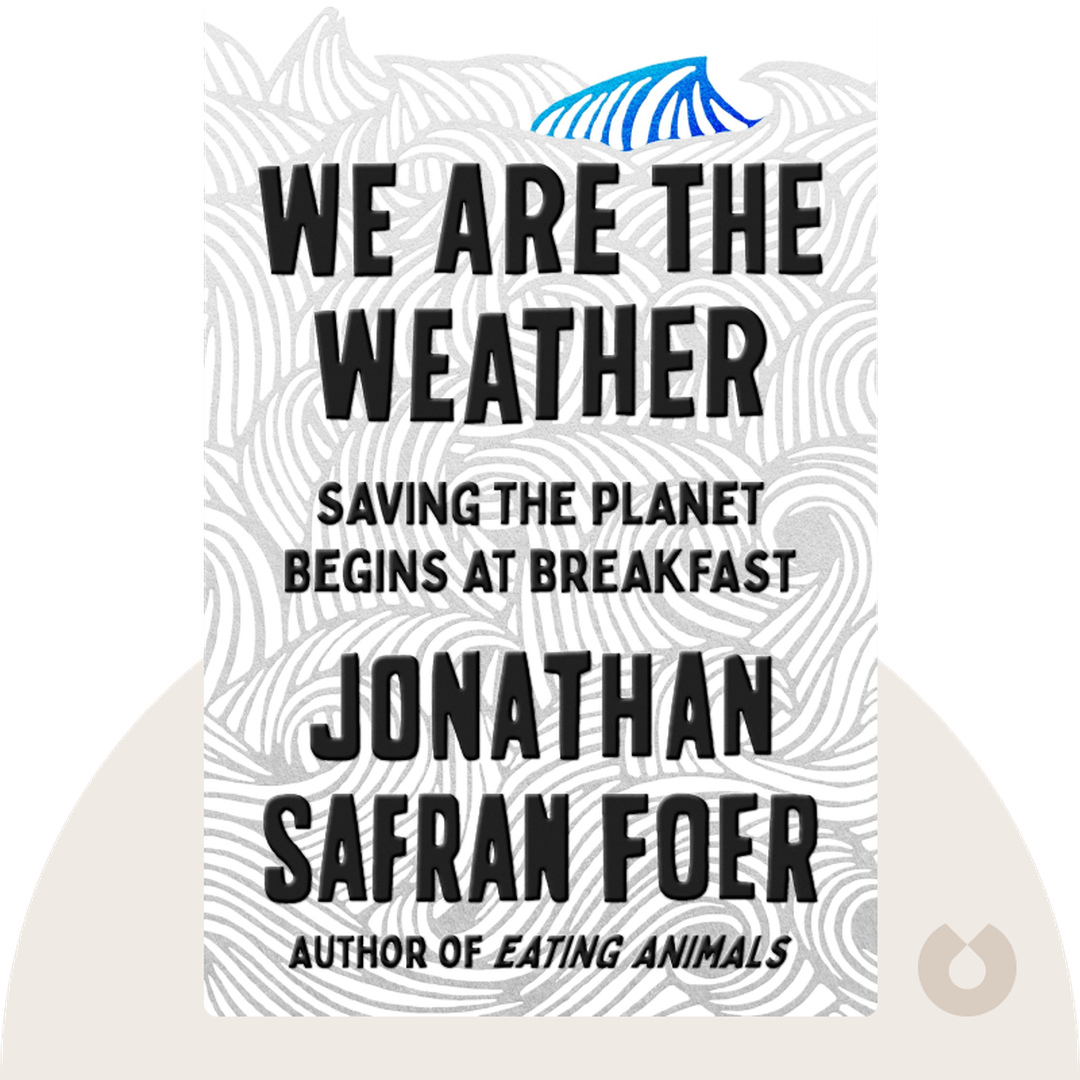
We Are the Weather (2019) is a rigorous investigation of climate change, what it means and why humans seem so powerless to tackle it. Jonathan Safran Foer argues that while climate change is terrifying and hard to understand, there is a very simple action that we can take: By leaving out meat and animal products for breakfast and lunch, we can make a huge contribution to the health of the planet.
Who Should Listen to We Are the Weather?
- People who want to save the planet, but feel paralyzed by what first step to take
- Psychology buffs who are interested in group dynamics, and what motivates people to act
- Would-be vegans who need a bit more persuasion to take the plunge
Books Similar to We Are the Weather
Readers who enjoyed this also liked these titles.