If You're Curious About These Questions...
You should listen to this audiobook
- Did you know that the world was on the verge of a global agreement to solve the climate crisis in the 1980s—and why did it ultimately fail?
- Have you ever wondered how a clear scientific consensus on global warming was systematically transformed into a decades-long political battle?
- Are you curious about the specific moment in history when we had the best chance to save the planet, and who exactly stood in the way?
Listen to Losing Earth — Free Audiobook
Loading player...
Key Takeaways from Losing Earth
- Discover how scientists and government officials fully understood the devastating threat of man-made climate change as early as 1979.
- Learn why early, practical solutions to global warming, like a modest carbon tax and renewable energy investments, were ultimately paralyzed by political indecision.
- Understand how fossil fuel companies like Exxon birthed modern climate denialism by funding aggressive defensive campaigns despite knowing the environmental risks since 1957.
- Find out how early momentum for climate action was deliberately derailed in the 1980s through aggressive government deregulation of the fossil fuel industry.
- Explore how early environmental activists and politicians like Al Gore used strategic congressional hearings to force climate change into mainstream public discourse.
Learning Tools
Reinforce what you learned from Losing Earth
Mind Map
Losing Earth
Early Scientific Consensus (1970s)+
Early Policy Failures (1980)+
Political Shifts & Activism (1981-1982)+
The Ozone Success Story (1983-1985)+
Bipartisan Momentum (Mid-1980s)+
Fossil Fuel Industry Sabotage (1988)+
Government Betrayal (1989)+
Ultimate Legacy+
Quiz — Test Your Understanding
Question 1 of 7
What year is identified in the text as the starting point for the modern push to stop climate change, marked by the first World Climate Conference and the Charney Report?
Question 2 of 7
At the 1980 Pink Palace conference, what two specific policies did environmentalist Rafe Pomerance propose to drastically reduce fossil fuel production?
Question 3 of 7
How did the election of Ronald Reagan impact early legislative efforts to combat climate change?
Question 4 of 7
Why was the discovery of the hole in the ozone layer significant to the climate change movement?
Question 5 of 7
When the threat of climate change regulation grew in the late 1980s, what strategy did the fossil fuel industry adopt to protect its interests?
Question 6 of 7
Why was NASA scientist Jim Hansen's 1989 congressional testimony heavily edited by the White House's Office of Management and Budget?
Question 7 of 7
What was the outcome of the 1989 UN Intergovernmental Panel on Climate Change meeting in Noordwijk?
Losing Earth — Full Chapter Overview
- 1Recommendation
- 2Scientists have been calling for climate action longer than you might think.
- 3Early climate change legislation was blocked by indifference and indecision.
- 4Activists turned congressional hearings into a platform for climate change.
- 5The ozone crisis gave new life to a fading climate change movement.
- 6In the mid-1980s, bipartisan international climate action seemed possible.
- 7Even modest climate-change measures faced fierce fossil fuel industry pushback.
- 8The U.S. government gave up its responsibility to lead on climate action.
- 9Final summary
Losing Earth Summary & Overview
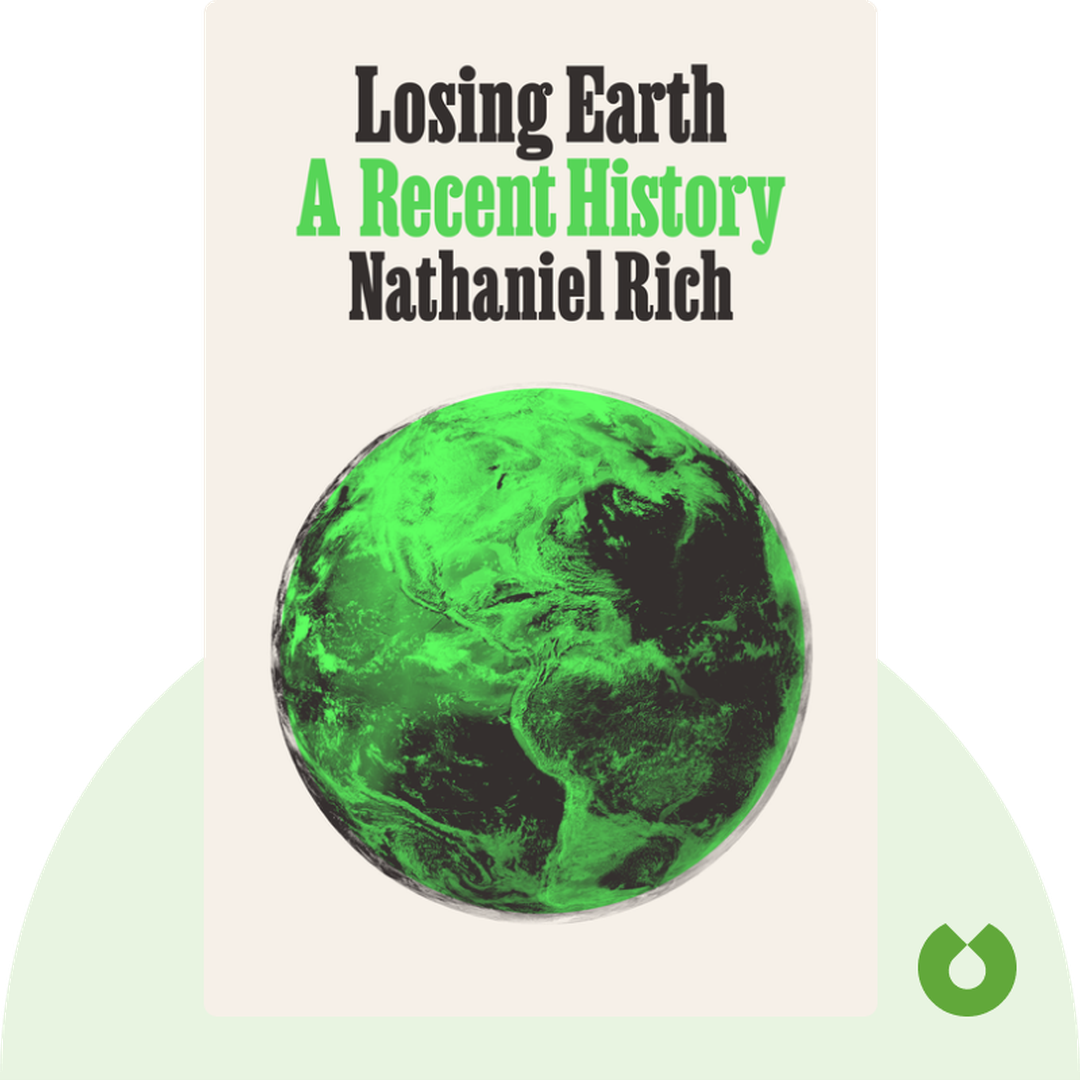
Losing Earth (2019) tells the story of climate change, both as a scientific fact and as a political conflict. This detailed piece of long-form reporting recounts the scientific community’s early push to raise the alarm about climate change and the coordinated effort the fossil fuel industry made to thwart those warnings.
Who Should Listen to Losing Earth?
- Environmentalists eager to understand their enemy
- Political moderates needing a dose of reality
- Anyone concerned about the future of Earth
Books Similar to Losing Earth
Readers who enjoyed this also liked these titles.