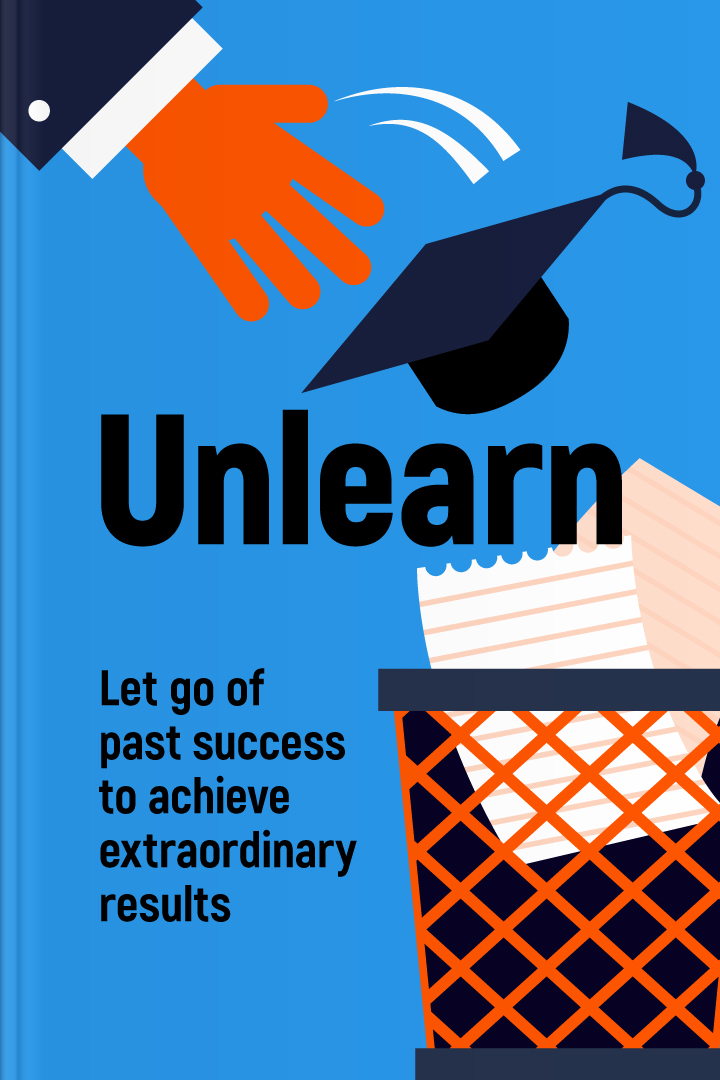
Unlearn audiobook cover - Sustainable success isn’t only about learning more—it’s about noticing when what once worked has quietly stopped working, and gently building the courage to release old habits so new strategies, mindsets, and breakthroughs can take their place.

Unlearn

Sustainable success isn’t only about learning more—it’s about noticing when what once worked has quietly stopped working, and gently building the courage to release old habits so new strategies, mindsets, and breakthroughs can take their place.

Unknown

4.0 / 5(3 ratings)
Start ListeningDownloadQR code that opens AudiobookHub on the App StoreTry free on iPhoneScan to start in 5 seconds

If You're Curious About These Questions...

You should listen to this audiobook

Listen to Unlearn — Free Audiobook

Loading player...

Key Takeaways from Unlearn

Learning Tools

Reinforce what you learned from Unlearn

Mind Map

Unlearn
Core Concept+
Internal Obstacles+
Phase 1: Unlearn+
Phase 2: Relearn+
Phase 3: Breakthrough+
Leadership Application+
Customer Application+
Product Application+

Quiz — Test Your Understanding

Question 1 of 8
What is the primary purpose of the 'Cycle of Unlearning'?
  • A. To completely forget all previous business knowledge and start from a blank slate.
  • B. To recognize outdated strategies and seek out fresh ideas when performance plateaus.
  • C. To implement a strict, standardized training program for struggling managers.
  • D. To dismiss the wisdom gained from past experiences in favor of modern technology.
Question 2 of 8
According to the book, what is typically the biggest obstacle leaders face when trying to unlearn?
  • A. Unpredictable external market fluctuations and rapidly changing customer needs.
  • B. A lack of financial resources to invest in new technologies and training.
  • C. Their own internal thought patterns, ego, and fear of making mistakes.
  • D. The inability of their team members to adapt to new organizational processes.
Question 3 of 8
What is the crucial third step in the first phase of the Cycle of Unlearning (the 'unlearn' phase)?
  • A. Choosing courage over comfort by taking time to experiment rather than making quick decisions.
  • B. Writing a highly detailed business plan that outlines every potential risk.
  • C. Consulting with industry experts to validate the strategies that brought you past success.
  • D. Setting a strict, unchangeable deadline to ensure the team works under pressure.
Question 4 of 8
How does the author suggest approaching the 'relearning' phase, using the marathon training app as an analogy?
  • A. By setting a massive goal and pushing through discomfort until it is fully achieved.
  • B. By creating a measurable 'unlearn statement' and taking very small, specific action steps.
  • C. By outsourcing difficult tasks to external experts who already possess the required skills.
  • D. By waiting until a flawless, risk-free strategy is developed before taking any action.
Question 5 of 8
What is the main function of the 'breakthrough' phase in the Cycle of Unlearning?
  • A. To finalize the project and permanently close the feedback loop.
  • B. To completely eliminate the need for any further trial-and-error in the business.
  • C. To reflect on the results of small steps and use that knowledge to inform the next action.
  • D. To secure additional funding from stakeholders by showcasing a perfectly completed product.
Question 6 of 8
Why does the author argue that the Industrial Era model of leadership is outdated in the modern workplace?
  • A. Modern workers lack the discipline and focus that workers had during the Industrial Era.
  • B. Today's employees are highly educated sources of innovation, not just cogs meant to follow dictated processes.
  • C. The Industrial Era model relies too heavily on modern technology and automation.
  • D. Modern workplaces require leaders to micromanage every detail to ensure strict quality control.
Question 7 of 8
What lesson should leaders learn from John Legere and Elon Musk regarding customer feedback?
  • A. Leaders should rely on comprehensive, sanitized reports prepared by their management teams.
  • B. Leaders should avoid direct customer contact to maintain an objective, high-level perspective.
  • C. Leaders should engage with customers directly and uncensored to truly understand their issues.
  • D. Leaders should only address customer feedback during the official product launch phase.
Question 8 of 8
How did Andrew Meyer successfully approach the development of the Spine 2 IT infrastructure?
  • A. By demanding a massive budget increase to ensure the software was flawless before launch.
  • B. By involving users to test the system during development to gather feedback and fix small components early.
  • C. By isolating his team from healthcare practitioners so they wouldn't be distracted by complaints.
  • D. By focusing exclusively on delivering the completed project all at once to meet bureaucratic deadlines.

Unlearn — Full Chapter Overview

Unlearn Summary & Overview

This audio summary explores the idea that long-term success depends on a skill many people overlook: the ability to unlearn. When a method has worked before, it can feel safe to repeat it—yet changing circumstances can make yesterday’s strengths today’s limits. Through examples from elite performance and organizational culture, this narrative offers a supportive path for updating how we think, work, and lead.

Across eight chapters, you’ll hear a practical framework called the Cycle of Unlearning—unlearn, relearn, breakthrough—along with guidance on creating safe-to-fail experiments, developing courage and curiosity, and shaping environments where people can adapt without fear. The focus is not on harsh reinvention, but on calm, intentional evolution.

Who Should Listen to Unlearn?

  • People who feel stuck repeating strategies that used to work, but no longer create the same results
  • Leaders and teams who want a healthier culture—one that supports experimentation, learning, and resilience
  • High achievers who want sustainable success by updating habits, assumptions, and mindsets over time

About the Author: Unknown

The author of the provided summary content is not named in the source text. This narration is written as a faithful, warm retelling of the ideas and examples presented in that material.

🎧
Listen in the AppOffline playback & background play
Get App