If You're Curious About These Questions...
You should listen to this audiobook
- Have you ever wondered how the physical world transforms when sight is removed, turning everyday spaces into a complex landscape of sound and texture?
- What if losing your sight wasn't just a physical loss, but a gateway to a profound new way of understanding human identity and connection?
- Are you curious about the hidden psychological tools that allow someone to navigate not just physical rooms, but the deep spiritual terrain of a life without light?
Listen to Touching the Rock — Free Audiobook
Loading player...
Key Takeaways from Touching the Rock
- Discover why newly blind individuals often forget the faces of their closest family members first, while retaining visual memories of distant acquaintances.
- Learn how the human voice replaces physical appearance as a powerful indicator of identity, conveying character just as effectively as visual cues.
- Understand the profound philosophical difference between sight and hearing, where sound brings the physical world to life and silence makes it effectively disappear.
- Explore how blind people navigate space with remarkable independence using echolocation and a white cane as a sensory tool of perception rather than a mere walking stick.
- Find out why well-intentioned sighted companions can actually hinder a blind person's mobility by inadvertently disrupting their spatial awareness and natural navigation skills.
Learning Tools
Reinforce what you learned from Touching the Rock
Mind Map
Touching the Rock
Memory & Perception+
Sound & Silence+
Navigation & Autonomy+
Desire & Sensory Disconnect+
Family & Subconscious+
Social Challenges+
Acceptance & Meaning+
Quiz — Test Your Understanding
Question 1 of 7
Why did John Hull find it easier to remember the faces of people he hadn’t seen in years compared to the faces of his immediate family?
Question 2 of 7
According to Hull's philosophical reflections, how does the experience of silence differ from simply closing one's eyes?
Question 3 of 7
How does the presence of well-intentioned sighted companions often impact a blind person's mobility?
Question 4 of 7
What psychological shift caused Hull to lose interest in food and sex after becoming blind?
Question 5 of 7
What technique did Hull develop to avoid getting stuck talking to a single person at social gatherings?
Question 6 of 7
What was a prominent feature of Hull's dreams during his turbulent early years of blindness?
Question 7 of 7
Ultimately, how did Hull reframe his understanding of his own blindness?
Touching the Rock — Full Chapter Overview
- 1Recommendation
- 2Blindness strips appearances of meaning and centers attention on human voices.
- 3Without sight, the world discloses itself most clearly through sound alone.
- 4Blindness embodies a duality between dependence and independence.
- 5The separation of desire from image reshapes how the blind experience both food and sex.
- 6During a period of vivid nightmares, John was haunted by fears regarding blindness’s impact on his immediate family life.
- 7One of blindness’s most frustrating challenges is navigating social interactions successfully.
- 8Discovering life’s meaning matters more than the pursuit of happiness.
Touching the Rock Summary & Overview
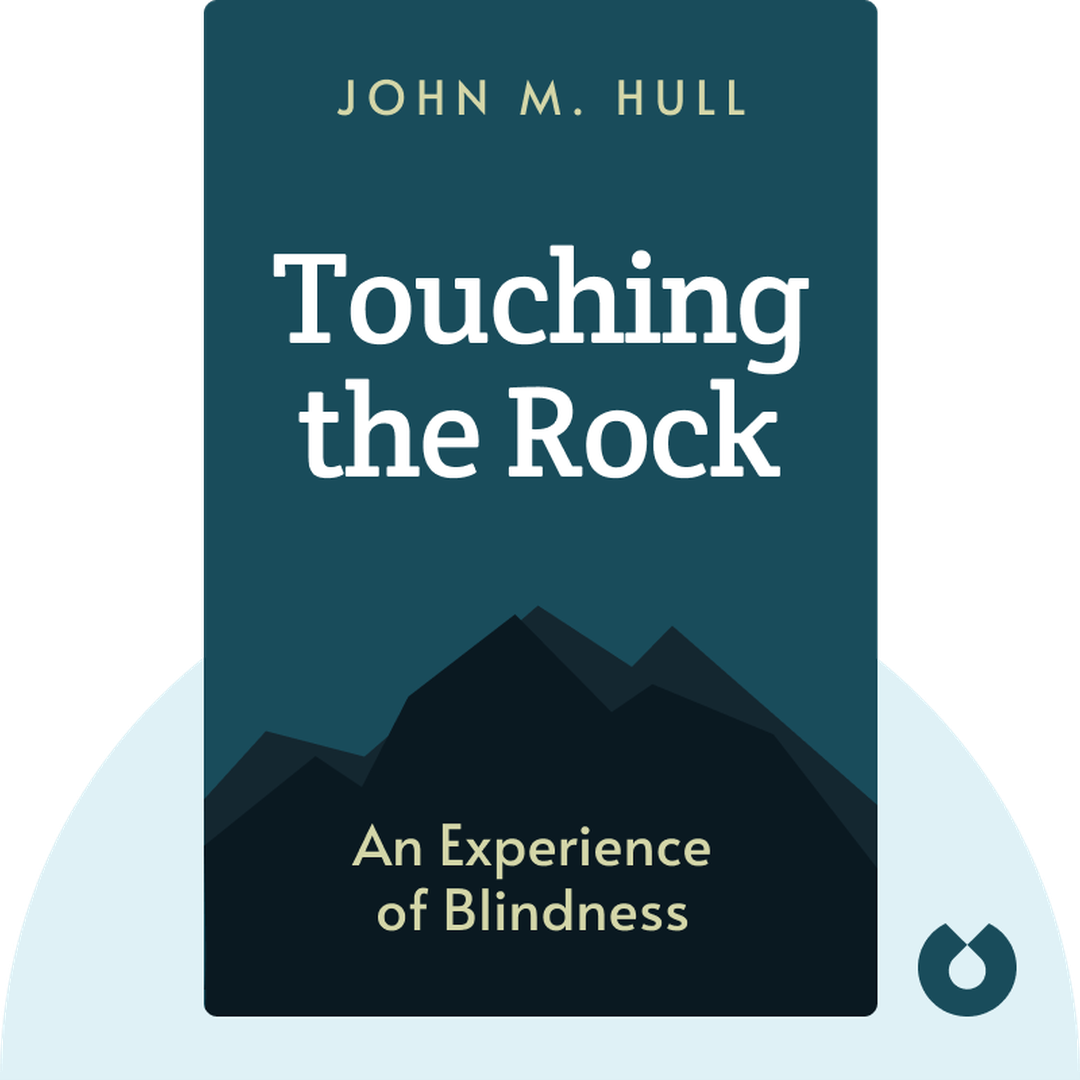
Touching the Rock (1990) is an account of one man’s understanding of blindness. Having lost his sight as a full-grown man, John M. Hull explores the daily psychological and physical experience of being blind, the tools that the blind use to navigate space and relationships, and the meaning of blindness in a sighted world.
Who Should Listen to Touching the Rock?
- Friends, relatives, or romantic partners of the blind
- Anyone suffering from depression or a physical disability
- Students of philosophy or psychology
Books Similar to Touching the Rock
Readers who enjoyed this also liked these titles.