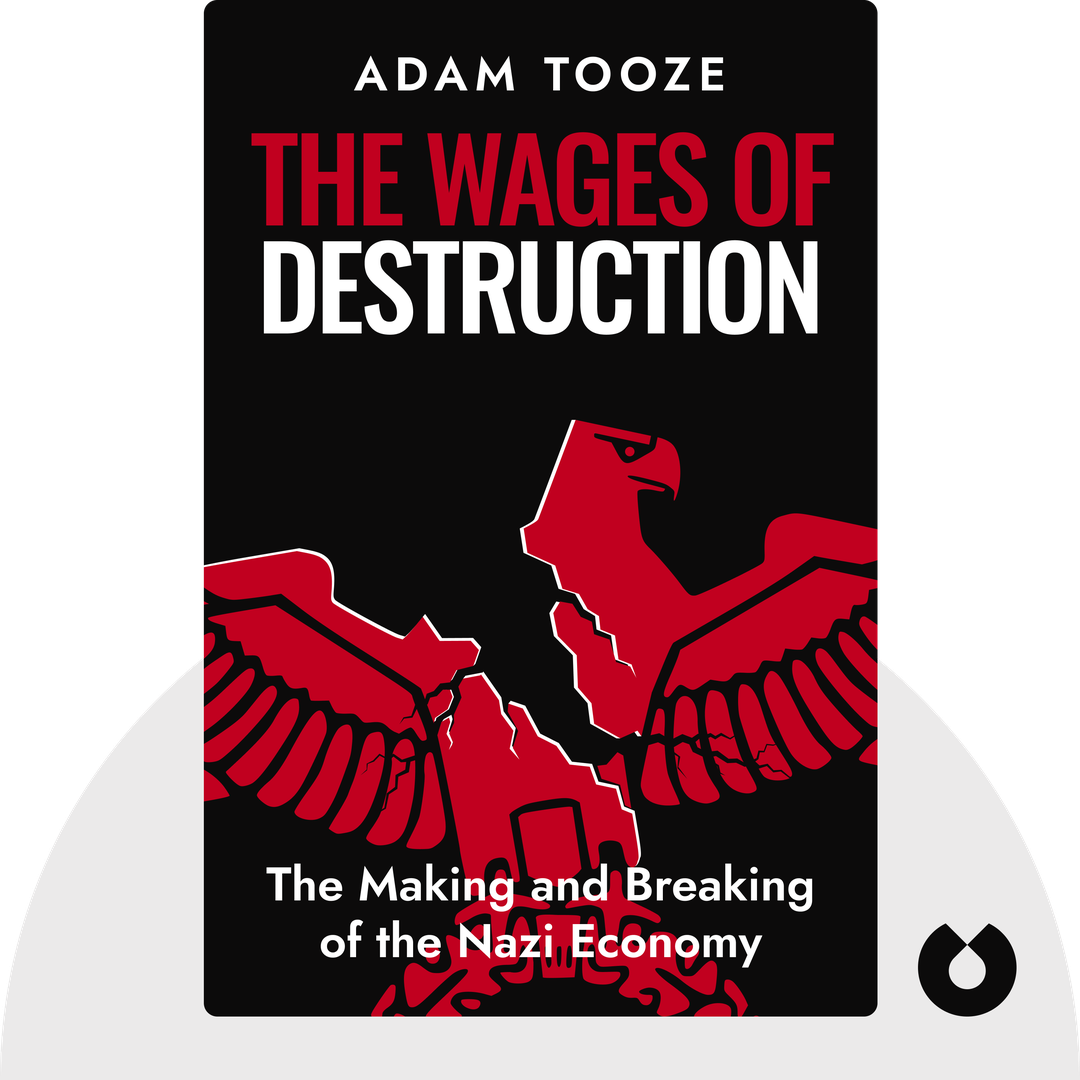
The Wages of Destruction
Start ListeningDownload Try free on iPhoneScan to start in 5 seconds
Categories:
If You're Curious About These Questions...
You should listen to this audiobook
- Did you know that the Nazi 'economic miracle' was actually a house of cards built on unsustainable debt and a desperate race against time?
- Have you ever wondered why Hitler viewed the United States as Germany's ultimate economic rival long before the first shot was fired?
- Are you curious about how a hidden shortage of basic raw materials—rather than just military tactics—dictated the most pivotal gambles of World War II?
Listen to The Wages of Destruction — Cinematic Audio Edition
Loading player...
Key Takeaways from The Wages of Destruction
- Understand why Nazi Germany's ultimate defeat was driven by the structural inadequacies of its economic base rather than purely military or political missteps.
- Discover how Nazi Germany's ideological goals of racial purification and eastward expansion were viewed by Hitler as essential, pragmatic steps to outcompete Western economic superpowers.
- Learn how Adolf Hitler modeled his vision for German territorial expansion on the violent conquests and colonial empires that built the economic supremacy of the United States and Britain.
- Explore the economic realities that made a two-front war inevitable, as Germany's lack of domestic resources forced it to conquer Eastern Europe while simultaneously striking the West.
- Find out how the regime's intense focus on military rearmament over civilian welfare crippled domestic agriculture, accelerating a desperate push to seize foreign lands for food and oil.
Learning Tools
Reinforce what you learned from The Wages of Destruction
Mind Map
The Wages of Destruction
Core Argument+
Unified Ideological Strategy+
Resource Deficits & Planning+
Failures of Conquest Economics+
Ideology vs. Pragmatism+
Fanaticism & Collapse+
Quiz — Test Your Understanding
Question 1 of 7
According to Adam Tooze, what is the primary reason for Nazi Germany's ultimate defeat in World War II?
Question 2 of 7
How does the book challenge the traditional historical view that Nazi Germany fought a 'rational' war in the West and an 'ideological' war in the East?
Question 3 of 7
What historical benchmark deeply influenced Adolf Hitler's belief that Germany needed to expand eastward to become a global power?
Question 4 of 7
According to the text, what is the true nature of the German 'Blitzkrieg' (lightning war) strategy?
Question 5 of 7
What major contradiction within the Nazi regime was highlighted by the genocidal campaign against European Jews?
Question 6 of 7
Unlike Britain, the US, and the Soviet Union, why did Nazi Germany fail to mobilize women into the workforce in significant numbers during the war?
Question 7 of 7
How did the Nazi regime attempt to turn the tide of the war in its later stages, and why did this strategy fail?
The Wages of Destruction — Full Chapter Overview
- 1Recommendation
- 2Ideology drove Nazi Germany’s war effort
- 3Nazi Germany’s aims made a two-front war inevitable
- 4Germany did not have resources for protracted conflicts
- 5Nazi-conquered lands failed to supply resources
- 6Roosevelt, antisemitism, and strategic contradictions
- 7Ideological rigidity sped Nazi Germany’s collapse
The Wages of Destruction Summary & Overview
The Wages of Destruction (2006) explores the economic dynamics that underpinned Nazi Germany’s aggressive expansion and ultimate downfall during World War II. Delving into Adolf Hitler’s ideological goals, it challenges traditional narratives to reveal the inherent weaknesses and unsustainable ambitions that led to Germany’s catastrophic failure.
Who Should Listen to The Wages of Destruction?
- History enthusiasts curious about WWII’s economic underpinnings
- Readers interested in military strategy and political decisions
- Academics studying the impacts of economics on warfare outcomes
Books Similar to The Wages of Destruction
Readers who enjoyed this also liked these titles.