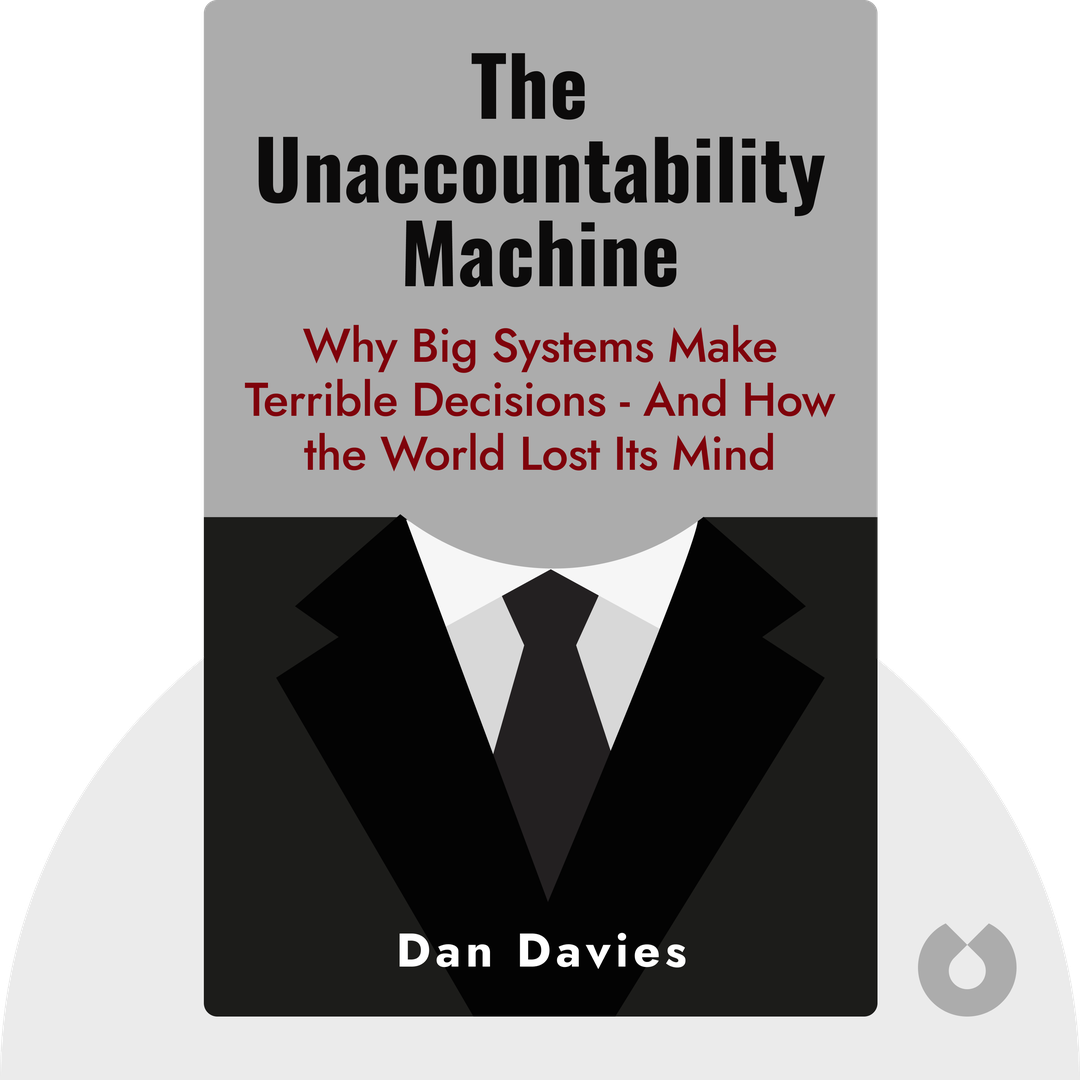
The Unaccountability Machine
Start ListeningDownload Try free on iPhoneScan to start in 5 seconds
Categories:
If You're Curious About These Questions...
You should listen to this audiobook
- Have you ever wondered why massive organizations often make decisions that seem completely illogical to everyone involved?
- Did you know that many modern institutions are actually structured as 'unaccountability machines' where responsibility is designed to disappear?
- What if the secret to fixing a broken bureaucracy lies in a forgotten science that explains how systems—not just people—actually think?
Listen to The Unaccountability Machine — Free Audiobook
Loading player...
Key Takeaways from The Unaccountability Machine
- Discover how 'accountability sinks' emerge in large organizations, using rigid rules and delegation to shield individuals from taking personal responsibility for systemic failures.
- Understand why modern corporations often function like rudimentary artificial intelligences, blindly pursuing narrow metrics to generate harmful results no individual actually intended.
- Learn to manage complex institutions without dissecting their every inner working by treating each department as a 'black box' with defined inputs, outputs, and balanced feedback loops.
- Explore the cybernetic concept of 'variety' to ensure your organizational systems possess enough adaptability to match the unpredictable changes of the outside world.
- Find out how to improve systemic decision-making by filtering out unnecessary noise and installing 'red handle' emergency channels that bypass normal bureaucracy during a crisis.
Learning Tools
Reinforce what you learned from The Unaccountability Machine
Mind Map
The Unaccountability Machine
The Loss of Accountability+
Causes of Systemic Failure+
Cybernetics & System Design+
Restoring Control+
Quiz — Test Your Understanding
Question 1 of 6
What does the term 'accountability sink' refer to in the context of large organizations?
Question 2 of 6
Why do large corporate systems sometimes produce bizarre or harmful outcomes, such as an algorithm recommending frightening videos to children?
Question 3 of 6
According to cybernetics pioneers like Stafford Beer, how should managers handle the immense complexity of large institutions?
Question 4 of 6
How can standardized accounting practices sometimes lead to distorted business decisions?
Question 5 of 6
What was a major consequence of the 'shareholder value revolution' and the relentless pursuit of short-term financial gains?
Question 6 of 6
What is one proposed remedy mentioned in the text to stop corporations from acting like single-minded robots focused only on short-term profits?
The Unaccountability Machine — Full Chapter Overview
- 1Recommendation
- 2Accountability gets lost in complex systems
- 3Why do some systems feel alien
- 4How to handle complex systems without probing their inner workings
- 5Wealth doesn’t mean intelligence
- 6Crises arise when systems cannot adapt
- 7Stop seeing organizations as simple profit machines
The Unaccountability Machine Summary & Overview
The Unaccountability Machine (2024) explores how large institutions and systems often lead to decisions that defy logic and accountability. It examines the role of bureaucracy, misaligned incentives, and structural complexity in creating environments where responsibility is diffused and poor outcomes become inevitable. Drawing on insights from management cybernetics, it also proposes strategies to identify and address these systemic flaws.
Who Should Listen to The Unaccountability Machine?
- Curious professionals navigating large bureaucratic systems
- Strategic policymakers addressing institutional inefficiencies
- Practical problem-solvers tackling complex organizational challenges
Books Similar to The Unaccountability Machine
Readers who enjoyed this also liked these titles.