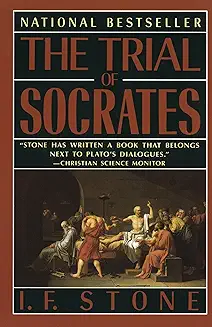
The Trial of Socrates audiobook cover - A legendary muckraking journalist retires, learns enough Greek to challenge the standard story, and reopens history’s most famous courtroom: why did democratic Athens execute Socrates—and what did Plato leave out of the record?

The Trial of Socrates

A legendary muckraking journalist retires, learns enough Greek to challenge the standard story, and reopens history’s most famous courtroom: why did democratic Athens execute Socrates—and what did Plato leave out of the record?

I. F. Stone

4.0 / 5(3 ratings)
Start ListeningDownloadQR code that opens AudiobookHub on the App StoreTry free on iPhoneScan to start in 5 seconds

If You're Curious About These Questions...

You should listen to this audiobook

Listen to The Trial of Socrates — Free Audiobook

Loading player...

Key Takeaways from The Trial of Socrates

Learning Tools

Reinforce what you learned from The Trial of Socrates

Mind Map

Oceanofpdf.Com The Trial Of Socrates If Stone
The Journalistic Investigation+
Methodology and Sources+
Socrates vs. The Polis+
Virtue, Definitions, and Withdrawal+
Historical Context and The Verdict+

Quiz — Test Your Understanding

Question 1 of 10
What is the central paradox that initiates I.F. Stone's investigation into the trial of Socrates?
  • A. Socrates was a poor speaker yet managed to convince many youths to follow him.
  • B. Athens, the most famous city for free speech, executed its most famous talker.
  • C. The prosecution left detailed records, but the defense speeches were entirely lost.
  • D. Socrates praised democracy but was executed by an oligarchic regime.
Question 2 of 10
Why did I.F. Stone feel it was necessary to study ancient Greek to understand the trial?
  • A. He wanted to translate newly discovered legal transcripts from the trial.
  • B. He needed to read Aristotle's lost defense of Socrates in its original dialect.
  • C. He sought to prove that Plato's dialogues were actually written in Latin first.
  • D. He believed Greek terms do not map neatly into English and require grappling with the original language.
Question 3 of 10
What method does Stone use to identify the historical Socrates amidst conflicting accounts?
  • A. He relies exclusively on Plato's writings because Plato was an eyewitness to the trial.
  • B. He accepts the missing prosecution speeches as the only objective truth about Socrates' life.
  • C. He looks for consistent features across the portraits by Plato, Xenophon, Aristophanes, and Aristotle.
  • D. He discards Greek sources and relies solely on archaeological findings from the Athenian Agora.
Question 4 of 10
How did Socrates' view of the human community conflict with the democratic Athenian ideal?
  • A. Socrates argued that only property owners should vote, whereas Aristotle supported universal suffrage.
  • B. Socrates viewed people as a "herd" needing an expert shepherd, rejecting the idea of self-governing citizens.
  • C. Socrates believed citizens should take turns governing, while Aristotle favored rule by a philosopher king.
  • D. Socrates believed the community should be run by military generals, while Athenians preferred merchant leaders.
Question 5 of 10
What clue does Stone find in Xenophon’s account of Socrates praising Homer's works?
  • A. Xenophon leaves out lines that endorse one-man rule, suggesting the defense tried to hide Socrates' anti-democratic sentiments.
  • B. Xenophon emphasizes Socrates' hatred of Agamemnon to prove his democratic loyalties.
  • C. Xenophon proves that Socrates never actually read the Iliad or the Odyssey.
  • D. Xenophon highlights the Thersites episode to show Socrates' deep respect for common soldiers.
Question 6 of 10
What is the political implication of Socrates' argument that "virtue is knowledge"?
  • A. It supports the democratic idea that all citizens inherently share a basic sense of shame and justice.
  • B. It proves that laws can easily foresee every specific case in a society.
  • C. It implies that politics should only deal in probabilities rather than metaphysical certainties.
  • D. It suggests that ordinary people cannot be trusted to rule themselves because they lack absolute knowledge.
Question 7 of 10
How does Stone interpret Socrates' behavior during the moral crises of Mytilene and Melos?
  • A. Socrates actively supported the massacres because he believed the victims were enemies of philosophy.
  • B. Socrates' absence as a civic voice opposing these massacres is seen as a failure of his "gadfly" role.
  • C. Socrates is praised for successfully persuading the assembly to show mercy in both cases.
  • D. Socrates was exiled during these events, making it physically impossible for him to participate.
Question 8 of 10
According to Stone, what recent historical events explain why Athens put Socrates on trial when he was seventy?
  • A. Three civic shocks, including oligarchic coups, which made Athenians deeply fear internal enemies.
  • B. A series of devastating natural disasters that the city blamed on Socrates' impiety.
  • C. The sudden death of Pericles, which left the city vulnerable to Spartan invasion.
  • D. Socrates' publication of a controversial book that openly called for the assassination of democratic leaders.
Question 9 of 10
Stone argues that Socrates might have avoided execution if he had done what during his trial?
  • A. Bribed the leading accuser, Anytus.
  • B. Blamed his controversial teachings entirely on his associate, Critias.
  • C. Framed his defense around the Athenian principle of free speech.
  • D. Fled the city before the jury could deliver a verdict.
Question 10 of 10
What is Stone's final conclusion about why the trial resulted in an execution?
  • A. The trial was a pure misunderstanding caused by a mistranslation of the indictment by Anytus.
  • B. Socrates was entirely innocent of political implications, and the jury convicted him solely for religious heresy.
  • C. The execution was an elaborate suicide pact orchestrated by Plato to turn Socrates into a martyr.
  • D. It was a prosecution of ideas by a frightened democracy, made easier because Socrates refused to invoke democratic principles.

The Trial of Socrates — Full Chapter Overview

The Trial of Socrates Summary & Overview

The Trial of Socrates is I. F. Stone’s investigative reconstruction of how a famously free society put its most famous philosopher to death. Working like a reporter, Stone compares the surviving portraits of Socrates—Plato’s loving drama, Xenophon’s memoir, Aristophanes’ comedy, and Aristotle’s cooler assessments—then asks what the defense accounts omit: the Athenian side.

Stone argues the clash was not just “philosophy vs. ignorance.” It was political and civic: Socrates’ distrust of democracy, his admiration for rule by “the one who knows,” his contempt for popular rhetoric, and the shadow cast by his associates Critias and Alcibiades in the city’s recent traumas. The book tracks the philosophical disputes (virtue, knowledge, definition) and ties them to the instability of Athens after coups and civil violence—showing why the trial erupted late, when Socrates was seventy.

Who Should Listen to The Trial of Socrates?

  • Listeners who love history told like an investigation—sources compared, contradictions exposed, and motives reconstructed.
  • Students of democracy, civil liberties, and political thought who want the Socrates case framed as a crisis of civic order, not a simple morality play.
  • Readers of Plato and Greek tragedy who want context: Athens’ assemblies, courts, coups, and the cultural meaning of “free speech.”

About the Author: I. F. Stone

I. F. Stone (1907–1989) was an American investigative journalist best known for I. F. Stone’s Weekly (1953–1971), his independent one-man newsroom. After retiring from weekly journalism for health reasons, he pursued classical studies and wrote this book as a civil-libertarian inquiry into freedom of thought and speech in history.

🎧
Listen in the AppOffline playback & background play
Get App