If You're Curious About These Questions...
You should listen to this audiobook
- Have you ever wondered why some people can see the hidden patterns of our global chaos while others are left behind?
- Did you know that the same network forces driving your favorite apps are also the primary drivers behind modern economic instability and global conflict?
- What’s the secret to mastering a 'seventh sense' that allows you to navigate and thrive in a world where everything is instantly connected?
Listen to The Seventh Sense — Free Audiobook
Loading player...
Key Takeaways from The Seventh Sense
- Understand the necessity of developing a 'Seventh Sense' to comprehend the complex, interconnected networks that govern our modern digital age.
- Discover why traditional institutions and governments are struggling to combat modern threats because they rely on slow, outdated systems rather than agile networks.
- Learn how global power is shifting away from historical hierarchies, like world leaders and experts, toward modern networks defined by large distribution and high concentration.
- Recognize the crucial distinction between predictable 'complicated' systems and ever-changing 'complex' systems to effectively solve problems and avoid catastrophic failures.
- Find out why constant connectivity leaves society vulnerable to manipulation, and why every major technological innovation inevitably introduces unforeseeable new risks.
Learning Tools
Reinforce what you learned from The Seventh Sense
Mind Map
The Seventh Sense
The Network Age+
Institutional Lag+
Dynamics of Network Power+
Inherent Vulnerabilities+
Gatelands and Exclusion+
Hard Gatekeeping+
Actionable Advice+
Quiz — Test Your Understanding
Question 1 of 7
What does the author mean by the 'Seventh Sense'?
Question 2 of 7
According to the text, why did the US military struggle against terrorist networks despite having advanced resources?
Question 3 of 7
How does the text describe the shift in power from traditional authorities, like doctors, to modern networks, like Google?
Question 4 of 7
What is the crucial difference between a 'complicated' system and a 'complex' system, as outlined in the text?
Question 5 of 7
What lesson did computer scientist Joseph Weizenbaum learn from the public's reaction to his program ELIZA?
Question 6 of 7
According to Metcalfe’s law, what happens to a network as it grows?
Question 7 of 7
How does the author envision the future of digital currencies and 'hard gatekeeping' solving current issues like cybercrime?
The Seventh Sense — Full Chapter Overview
- 1Recommendation
- 2Tech shifts ensure outdated systems get replaced by newer, more capable ones often.
- 3Institutions haven’t progressed and still depend heavily on outdated systems today.
- 4Complex network systems are classified by the extent of their influence.
- 5Constant connectivity means that people are perpetually vulnerable to manipulation today.
- 6Exclusion from a network system can quickly become problematic.
- 7Gatekeeping emerged to safeguard users against online cyber threats.
The Seventh Sense Summary & Overview
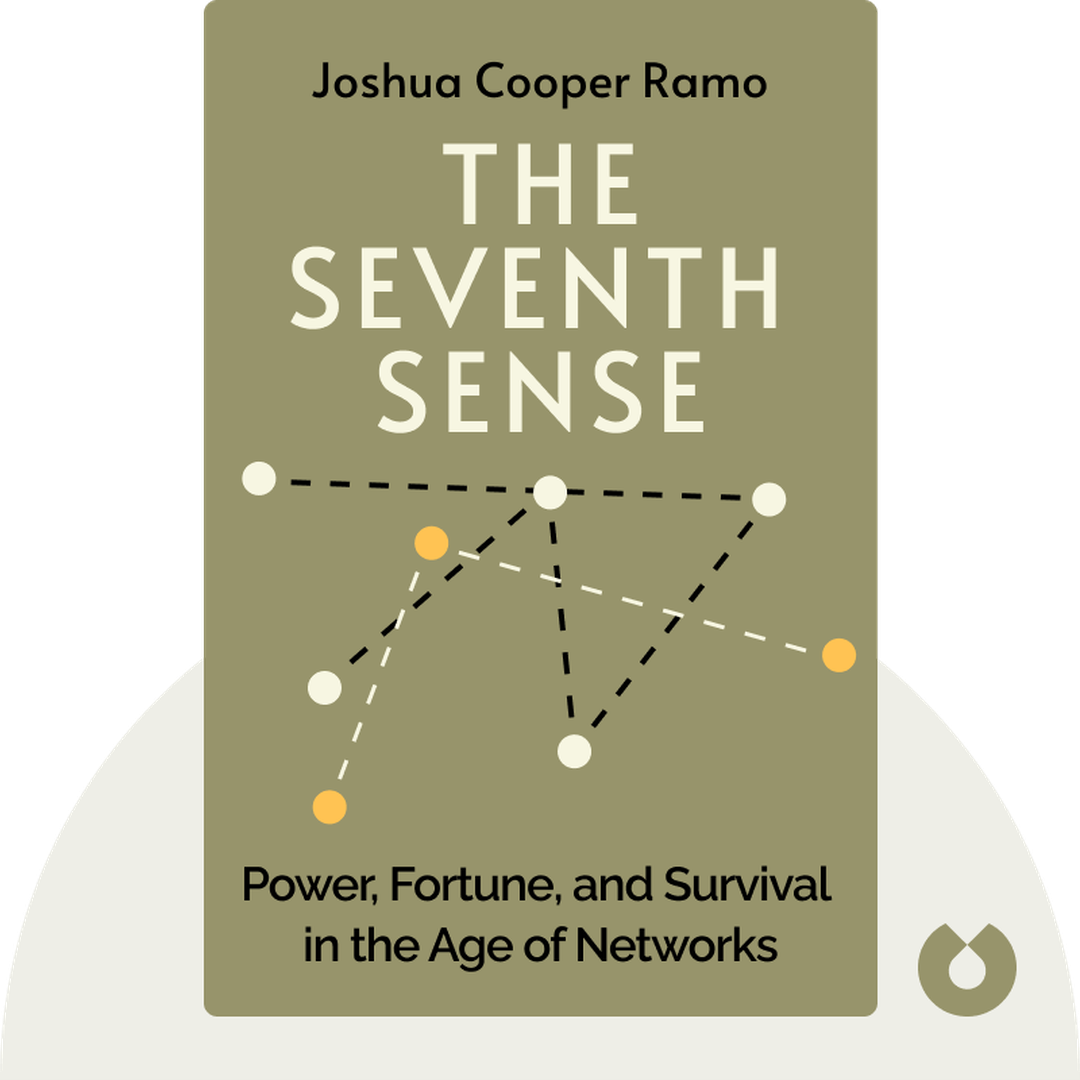
The Seventh Sense (2016) unpacks the positive and negative aspects of today’s interconnected world. Terrorism is on the rise and the global economy is in a questionable state. The Seventh Sense explains how these issues are interrelated, and how society can still prosper in this network-dominated age.
Who Should Listen to The Seventh Sense?
- Anyone addicted to social media
- Managers of a business or corporation
- Anyone curious about the impacts of technology on today’s society
Books Similar to The Seventh Sense
Readers who enjoyed this also liked these titles.