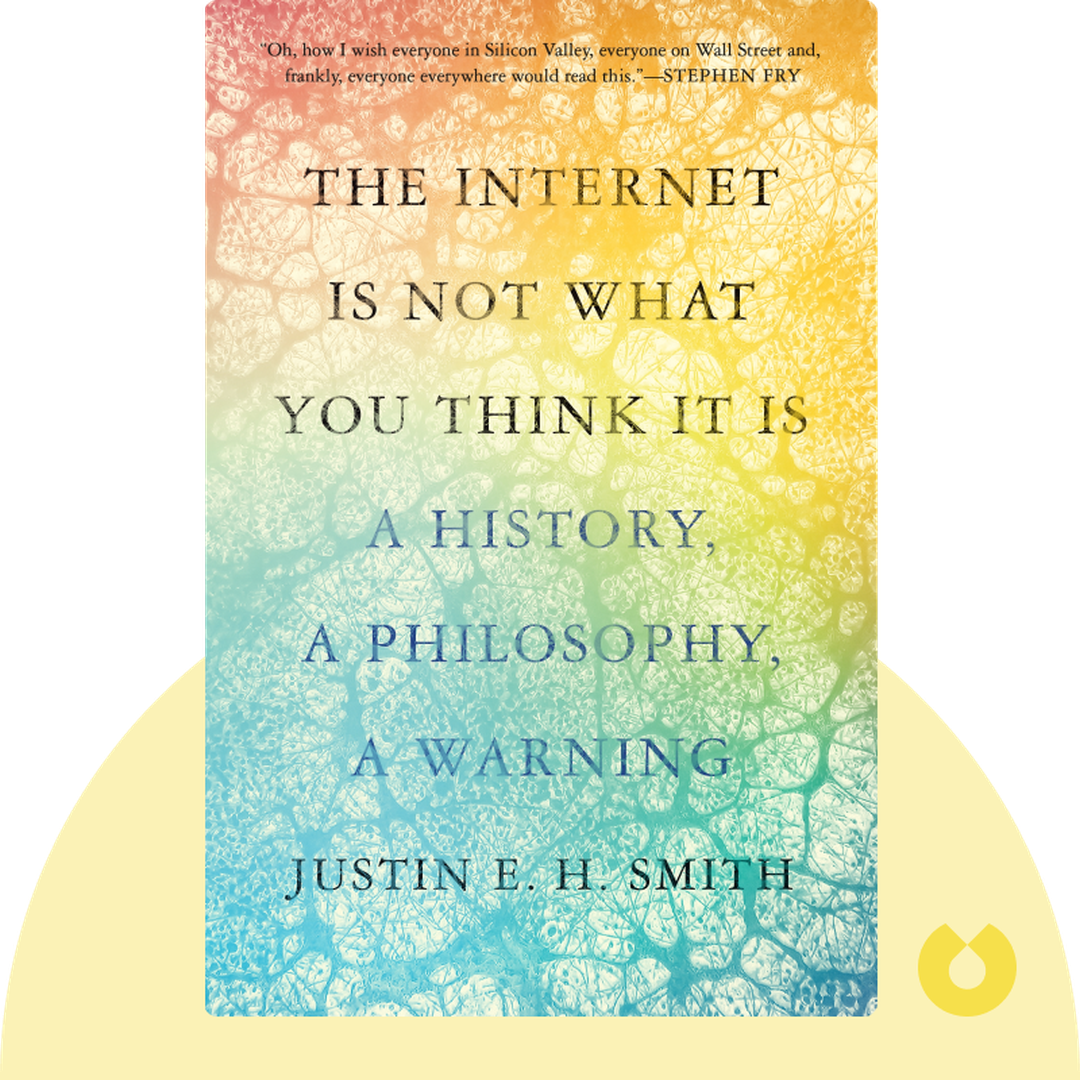
The Internet Is Not What You Think It Is
Start ListeningDownload Try free on iPhoneScan to start in 5 seconds
Categories:
If You're Curious About These Questions...
You should listen to this audiobook
- Did you know that the internet’s true origins might be found in 17th-century philosophy and the hidden patterns of the natural world?
- Have you ever wondered why our digital lives feel so exhausting, and what it reveals about the supposed 'supremacy' of human intelligence?
- What if the world wide web isn't actually a modern invention, but a manifestation of an ancient, biological way of processing information?
Listen to The Internet Is Not What You Think It Is — Free Audiobook
Loading player...
Key Takeaways from The Internet Is Not What You Think It Is
- Discover how social media platforms function as a new form of exploitation by harvesting your personal data to refine addictive algorithms for corporate profit.
- Understand why participating in the modern digital landscape forces you to diminish your complex human personality into a simplified, algorithm-friendly profile.
- Learn how the digital economy extracts your most valuable conscious resource—your attention—by artificially limiting and channeling your brain's natural filtering processes.
- Uncover the centuries-old philosophical roots of artificial intelligence, including why 17th-century thinkers incorrectly assumed that computational machines would guarantee world peace.
- Explore how the concept of a world wide web is not an entirely artificial invention, but rather mirrors the ancient, living communication networks already present throughout nature.
Learning Tools
Reinforce what you learned from The Internet Is Not What You Think It Is
Mind Map
The Internet Is Not What You Think It Is
The Attention Economy+
Human vs. Artificial Attention+
Ancient & Natural Networks+
Evolution of Telecommunication+
Nature, Cities, and Simulation+
Computing and Weaving+
Reclaiming Your Mind+
Quiz — Test Your Understanding
Question 1 of 8
According to the text, how does the business model of social media fundamentally differ from traditional industries?
Question 2 of 8
What is a psychological and social consequence of participating in the modern internet economy, as described in the text?
Question 3 of 8
While artificial intelligence can perform many complex tasks online, what crucial resource of the digital age does it inherently lack?
Question 4 of 8
Why does the author use the example of the slime mould (Physarum polycephalum) mapping Tokyo's train routes?
Question 5 of 8
As human telecommunication evolved from ancient runners to modern digital networks, what was lost when 'speed' became the highest form of progress?
Question 6 of 8
Why does the text argue that the popular theory of the 'universe as a simulation' is biased?
Question 7 of 8
What surprising historical connection does the author reveal about the development of early computers?
Question 8 of 8
What actionable advice does the text offer as a 'radical act of self-reclamation' against the attention-extracting internet economy?
The Internet Is Not What You Think It Is — Full Chapter Overview
- 1Recommendation
- 2You are the product.
- 3Algorithms filter reality, just like brains do.
- 4The idea of a world wide web is ancient and surrounds us.
- 5Humans are long-distance communicators.
- 6The natural world: could it be a simulation?
- 7Why silk-making is linked to the internet.
The Internet Is Not What You Think It Is Summary & Overview
The Internet Is Not What You Think It Is (2022) offers startlingly new ways of understanding the world wide web, and strongly challenges us to examine our long-held beliefs about the supremacy of human cognition. It confronts our most closely-held (and least examined) ideas about the internet and social media, and weaves together observations from centuries of philosophy, mathematics, science and history.
Who Should Listen to The Internet Is Not What You Think It Is?
- Those feeling overwhelmed by the pace of life in the information age
- Anyone worried about the addictive side of social media
- The Zoom-fatigued looking for better ways to connect.
Books Similar to The Internet Is Not What You Think It Is
Readers who enjoyed this also liked these titles.