If You're Curious About These Questions...
You should listen to this audiobook
- Did you know that the very same technologies we use to build a better future could also be weaponized to destabilize entire nations?
- Have you ever wondered why some of the world's most powerful tech leaders are actually calling for more government regulation instead of less?
- What if the secret to navigating the dangers of AI and cyberwarfare lies in a surprising new partnership between Big Tech and global governments?
Listen to Tools and Weapons — Free Audiobook
Loading player...
Key Takeaways from Tools and Weapons
- Understand why intelligent collaboration between governments and big tech corporations is essential to prevent digital catastrophes like hacked hospitals and hijacked elections.
- Explore how the exponential growth of data, from ancient scrolls to Gutenberg's printing press, has fundamentally driven human civilization and democratic progress.
- Discover why the modern data cloud is actually a physical fortress of massive, duplicated server facilities designed to safeguard our digital lives from disaster.
- Learn how Edward Snowden’s 2013 NSA leak echoed the 18th-century legal battles of John Wilkes, highlighting a centuries-old fight against government surveillance.
- Find out how global terrorist events, like the 2015 Charlie Hebdo attack, forced tech companies to rapidly navigate the complex balance between user privacy and national security.
Learning Tools
Reinforce what you learned from Tools and Weapons
Mind Map
Tools and Weapons
The Physical Reality of Data+
Privacy vs. Security+
Global Perspectives on Data+
The Threat of Cyberwarfare+
Social Media and Democracy+
Artificial Intelligence+
The Path Forward+
Quiz — Test Your Understanding
Question 1 of 8
What is the physical reality of the digital 'cloud' as described in the text?
Question 2 of 8
To illustrate the long-standing historical tension between citizens' privacy and government overreach, the text compares Edward Snowden to which historical figure?
Question 3 of 8
Why did Microsoft make the dramatic decision to sue the United States government?
Question 4 of 8
How did a visit to a former Stasi prison in Germany influence Microsoft's approach to data storage?
Question 5 of 8
What alarmed tech corporations like Microsoft the most about the 2017 WannaCry cyberattack?
Question 6 of 8
What historical event does the text use to show that foreign actors attempting to sow discord in modern democracies is not a new phenomenon?
Question 7 of 8
According to the text, what is currently the most pressing and realistic concern regarding Artificial Intelligence?
Question 8 of 8
The authors argue that digital technology is currently too high-risk to go unchecked, and suggest it should be regulated similarly to which other industry?
Tools and Weapons — Full Chapter Overview
- 1Recommendation
- 2Data has always been a vital part of human civilization.
- 3Edward Snowden revived the old privacy question for the twenty-first century.
- 4Terrorist attacks pushed tech companies to clarify their privacy policies.
- 5Cultural and historical differences shape how nations approach data privacy.
- 6The world still hasn’t grasped the true consequences of cyberwar.
- 7Social media has been weaponized to divide democracies in ways that echo the past.
- 8Artificial intelligence has created some difficult new challenges.
- 9New technologies can serve good ends, but they demand joined-up thinking.
Tools and Weapons Summary & Overview
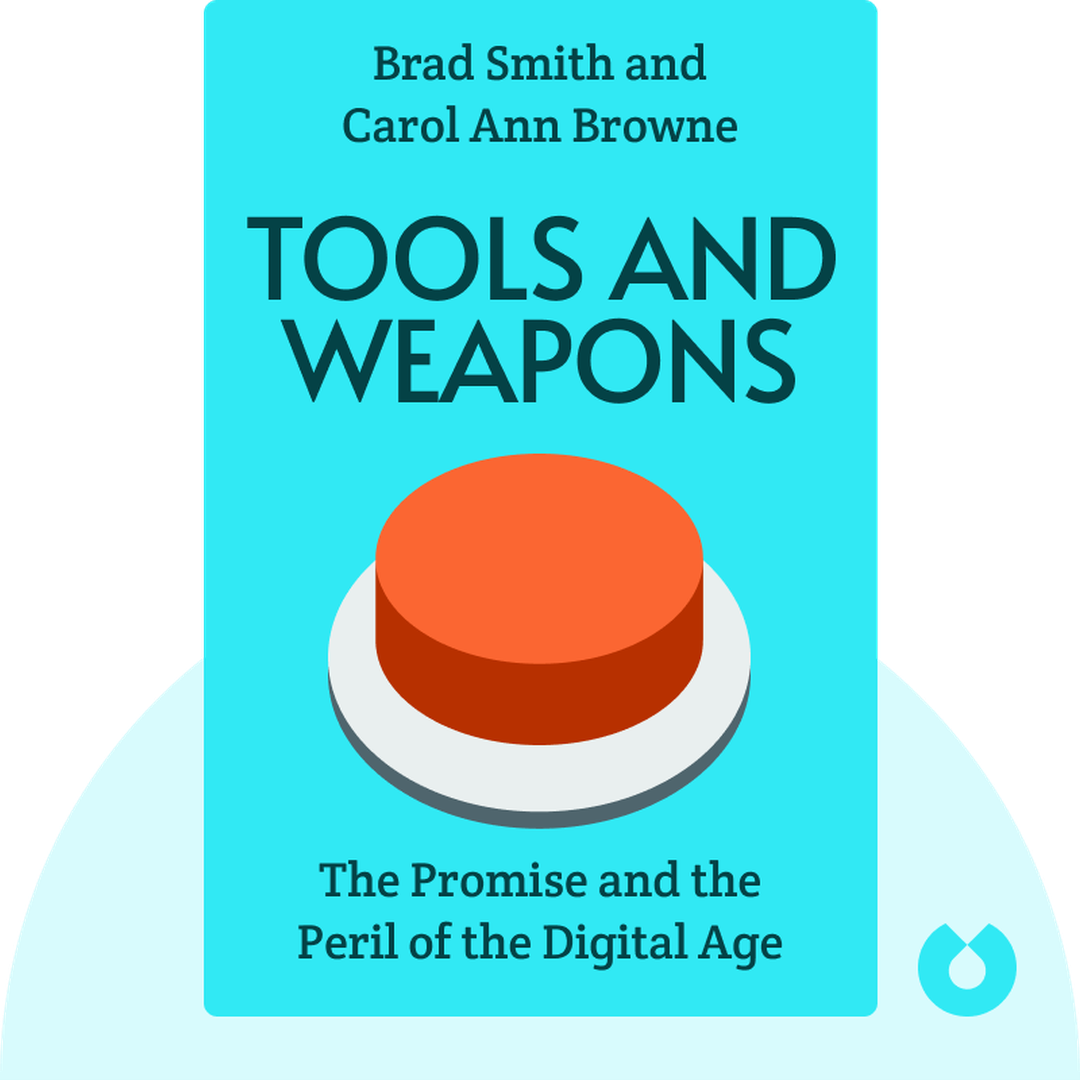
Tools and Weapons (2019) outlines the many different ways in which digital technology can both empower and endanger us. As Microsoft insiders, Brad Smith and Carol Ann Browne offer unique insight into the digital present and the future we face, from advanced AI to devastating cyberwarfare. Here they argue for a world where big tech firms and governments collaborate to ensure that the future is better for all of us.
Who Should Listen to Tools and Weapons?
- Anyone interested in how technology shapes our lives
- Tech-heads and nerds
- Businesspeople getting to grips with a digital future
Books Similar to Tools and Weapons
Readers who enjoyed this also liked these titles.