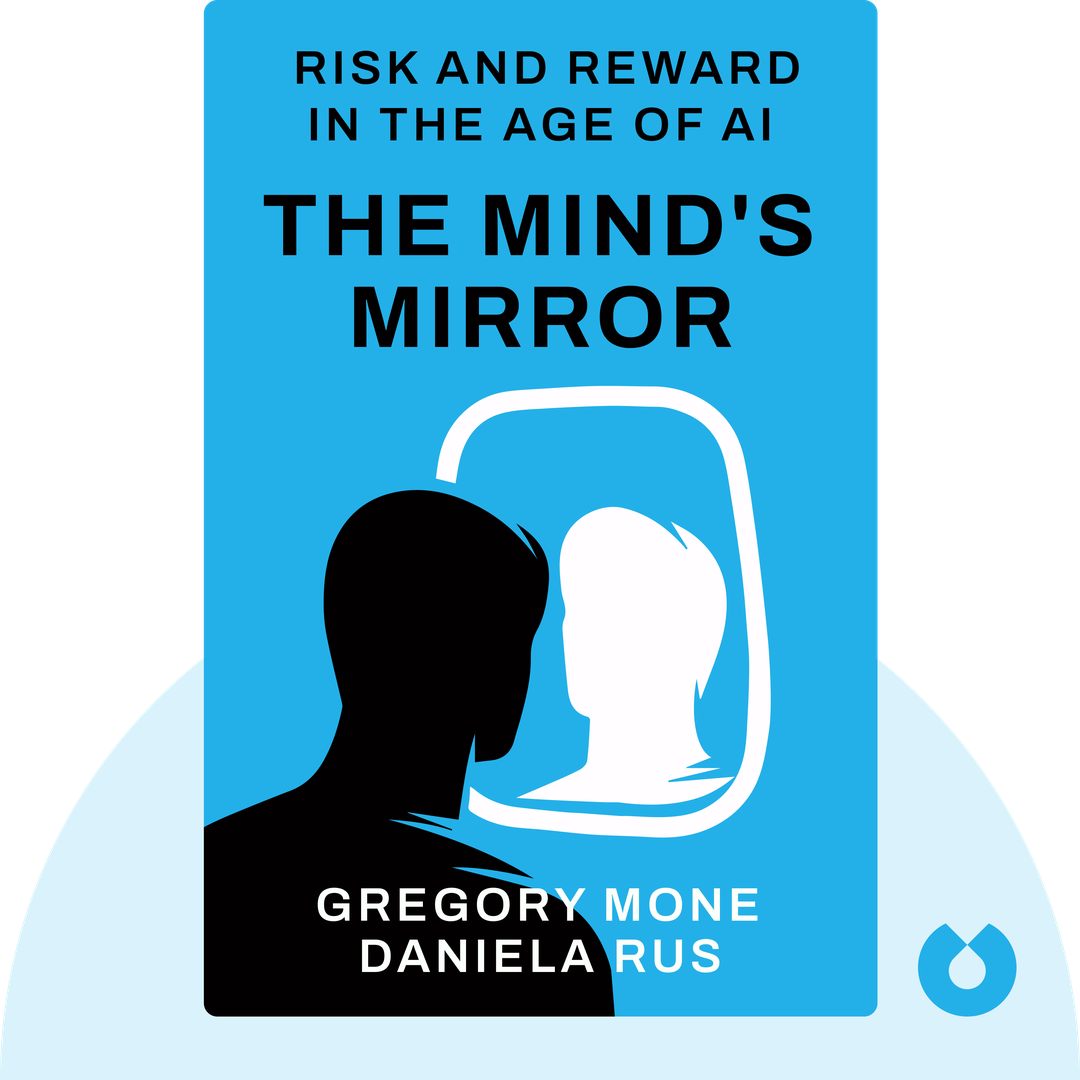
If You're Curious About These Questions...
You should listen to this audiobook
- How did researchers successfully use AI and ambient WiFi signals to detect early stages of Parkinson's disease before major brain damage occurred?
- What is the process known as 'backpropagation,' and why is it considered the unsung hero that allows neural networks to learn from their mistakes?
- Why did patients in a recent medical study consistently rate AI-generated medical advice as more empathetic and caring than responses written by human doctors?
Listen to The Mind's Mirror — Free Audiobook
Loading player...
Key Takeaways from The Mind's Mirror
- Discover how AI acts as a cognitive multiplier, drastically accelerating human productivity to complete complex tasks like drug discovery in a fraction of the usual time.
- Learn how AI models uncover subtle data patterns invisible to the human eye, enabling breakthrough insights and early disease detection.
- Understand why modern AI tools are meant to augment rather than replace human researchers, creating a powerful synergy that pushes the boundaries of knowledge.
- Explore the architecture of neural networks to see how layered, digitally simulated neurons use pattern recognition and iterative learning to mirror biological brains.
- Find out the mechanics of machine learning by seeing how connection 'weights' and activation 'biases' transform raw inputs like image pixels into accurate digital predictions.
Learning Tools
Reinforce what you learned from The Mind's Mirror
Mind Map
The Mind's Mirror
Acceleration & Insight+
Anatomy of Neural Networks+
The Learning Process+
Empathy & Communication+
Quiz — Test Your Understanding
Question 1 of 7
According to the study on professionals using ChatGPT for writing tasks, how did the AI affect writers of different skill levels?
Question 2 of 7
How does the Emerald system developed by MIT Professor Dina Katabi monitor patients to detect early stages of Parkinson’s disease?
Question 3 of 7
In the context of a neural network, what role does a 'bias' play?
Question 4 of 7
What is the primary function of 'backpropagation' in training a neural network?
Question 5 of 7
What demonstrates the true test of a neural network's power and its ability to 'generalize'?
Question 6 of 7
In the study comparing AI-generated responses to human physicians' responses regarding standard medical questions, what was the surprising outcome?
Question 7 of 7
How did the implementation of an AI chatbot affect human-to-human interactions in the customer support study at a software firm?
The Mind's Mirror — Full Chapter Overview
- 1Recommendation
- 2Accelerating with insight
- 3Exploring neural networks
- 4Learning through experience
- 5Empathy in communication
The Mind's Mirror Summary & Overview
The Mind's Mirror (2024) explores the possibilities and risks of artificial intelligence. Aiming to provide readers with an understanding of AI's workings, it explores how AI can enhance human capabilities across various fields, while also addressing the societal challenges it presents.
Who Should Listen to The Mind's Mirror?
- Tech enthusiasts interested in the latest AI developments
- Curious people who want to understand how neural networks function
- Anyone who want to understand how AI is shaping our world
Books Similar to The Mind's Mirror
Readers who enjoyed this also liked these titles.