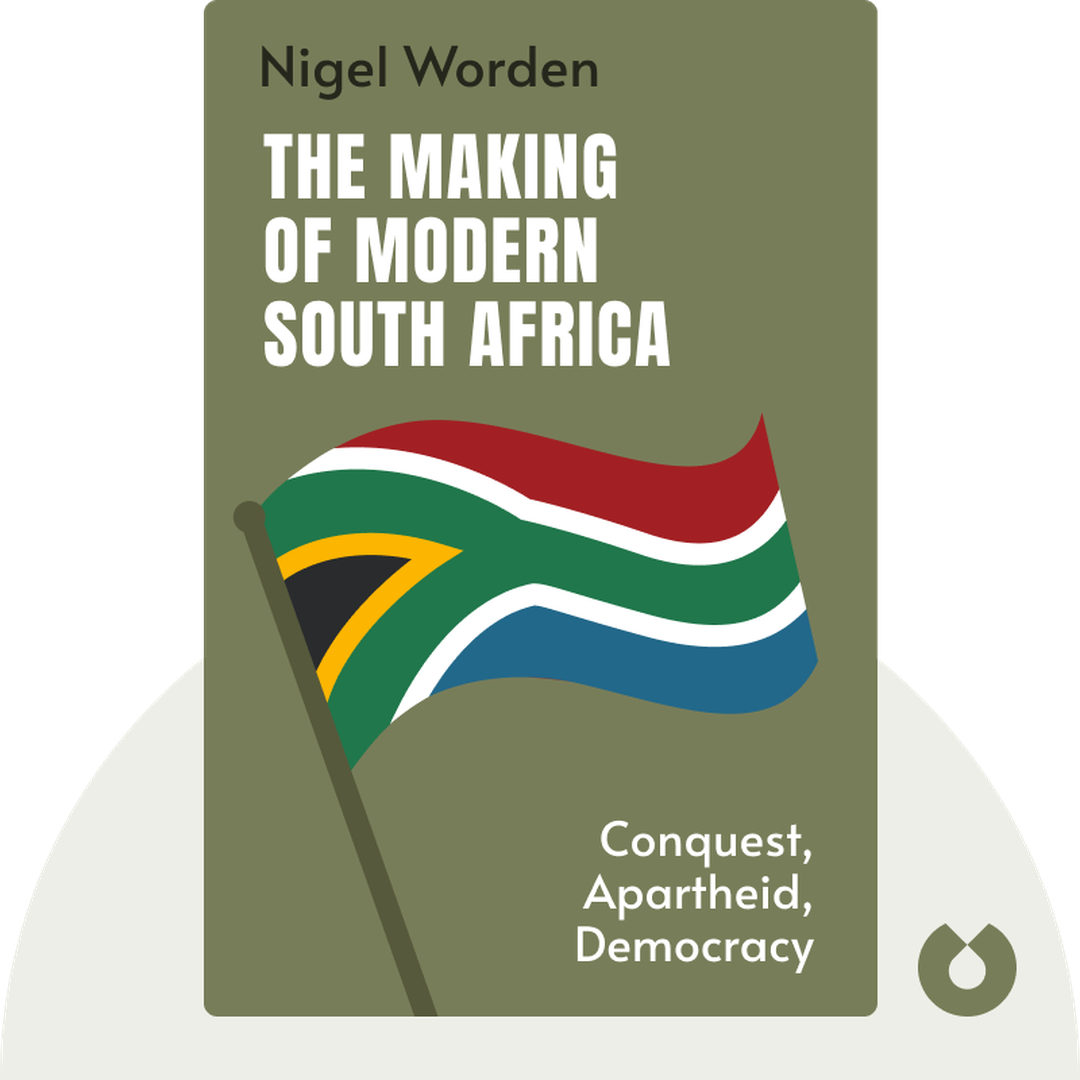
The Making of Modern South Africa
Start ListeningDownload Try free on iPhoneScan to start in 5 seconds
Categories:
If You're Curious About These Questions...
You should listen to this audiobook
- Did you know that the roots of South Africa’s modern identity were planted long before the 20th century in the fierce colonial power struggles of the 1700s?
- Have you ever wondered how the discovery of gold and diamonds served as the ultimate catalyst for reshaping South Africa’s social and political landscape?
- Are you curious about how a country defined by centuries of land disputes and segregation finally navigated the path toward a unified democracy in 1994?
Listen to The Making of Modern South Africa — Free Audiobook
Loading player...
Key Takeaways from The Making of Modern South Africa
- Understand how the roots of South Africa's apartheid system and its 1994 democratic revolution can be traced back to the region's early colonial period.
- Discover how premodern indigenous groups like the San, Khoikhoi, and Bantu-speaking peoples structured their societies around shared land and cattle wealth before European arrival.
- Learn why the Dutch establishment of a 1652 maritime resupply outpost sparked a brutal, decades-long land war that forced the indigenous Khoi population into servitude.
- Explore how British strategic interests in securing a trade route to India led to the seizure of the Cape Colony and violent expansion against the Xhosa and Zulu nations.
- Find out how the 1886 discovery of massive gold deposits completely transformed South Africa's trajectory, kickstarting its industrial revolution and rapid urbanization.
Learning Tools
Reinforce what you learned from The Making of Modern South Africa
Mind Map
The Making of Modern South Africa
Premodern Era & Indigenous Groups+
European Colonization+
British Rule & Industrialization+
War & The Union of South Africa+
Apartheid & Resistance+
Revolt & Economic Decline+
Democratic Transition+
Quiz — Test Your Understanding
Question 1 of 8
What constituted the primary source of wealth and prestige for the early indigenous societies, such as the Khoikhoi and Bantu-linguistic groups, in premodern South Africa?
Question 2 of 8
Why did the Dutch originally establish an outpost at the Cape of Good Hope in 1652?
Question 3 of 8
How did the discovery of gold in 1886 fundamentally transform South Africa's economy and society?
Question 4 of 8
What was the primary effect of the 1913 land laws passed by the newly formed Union of South Africa?
Question 5 of 8
According to the text, what was the primary motivation for the white minority government to implement the system of apartheid in 1948?
Question 6 of 8
What tragic event in 1960 marked a turning point in South African history and led to increased international scrutiny of the apartheid regime?
Question 7 of 8
What major economic factors in the 1980s forced the apartheid government to seriously consider political reform?
Question 8 of 8
What pivotal actions did Frederik Willem de Klerk take shortly after becoming head of state in 1989?
The Making of Modern South Africa — Full Chapter Overview
- 1Recommendation
- 2Before modern times, South Africa housed three distinct indigenous peoples who settled there for generations.
- 3Dutch settlement in South Africa set off a brutal struggle for land.
- 4Mining sparked South Africa’s industrial revolution and urbanization.
- 5Gold, war, and birth of South Africa’s Union
- 6South Africa’s Union, apartheid’s origins, and the emergence of organized political resistance across urban communities
- 7Apartheid and a rising spirit of defiance
- 8Rebellion and a call for reform
- 9Nelson Mandela and Frederik Willem de Klerk’s compromise forged a truly inclusive republic.
The Making of Modern South Africa Summary & Overview
The Making of Modern South Africa (2012) traces the history of South Africa from the colonial conquests of the eighteenth century to the birth of an inclusive democracy in 1994. Along the way, it unpacks how struggles over land, natural resources, and belonging shaped the country’s development.
Who Should Listen to The Making of Modern South Africa?
- Historians
- Politics buffs
- Anyone interested in race and equality
Books Similar to The Making of Modern South Africa
Readers who enjoyed this also liked these titles.