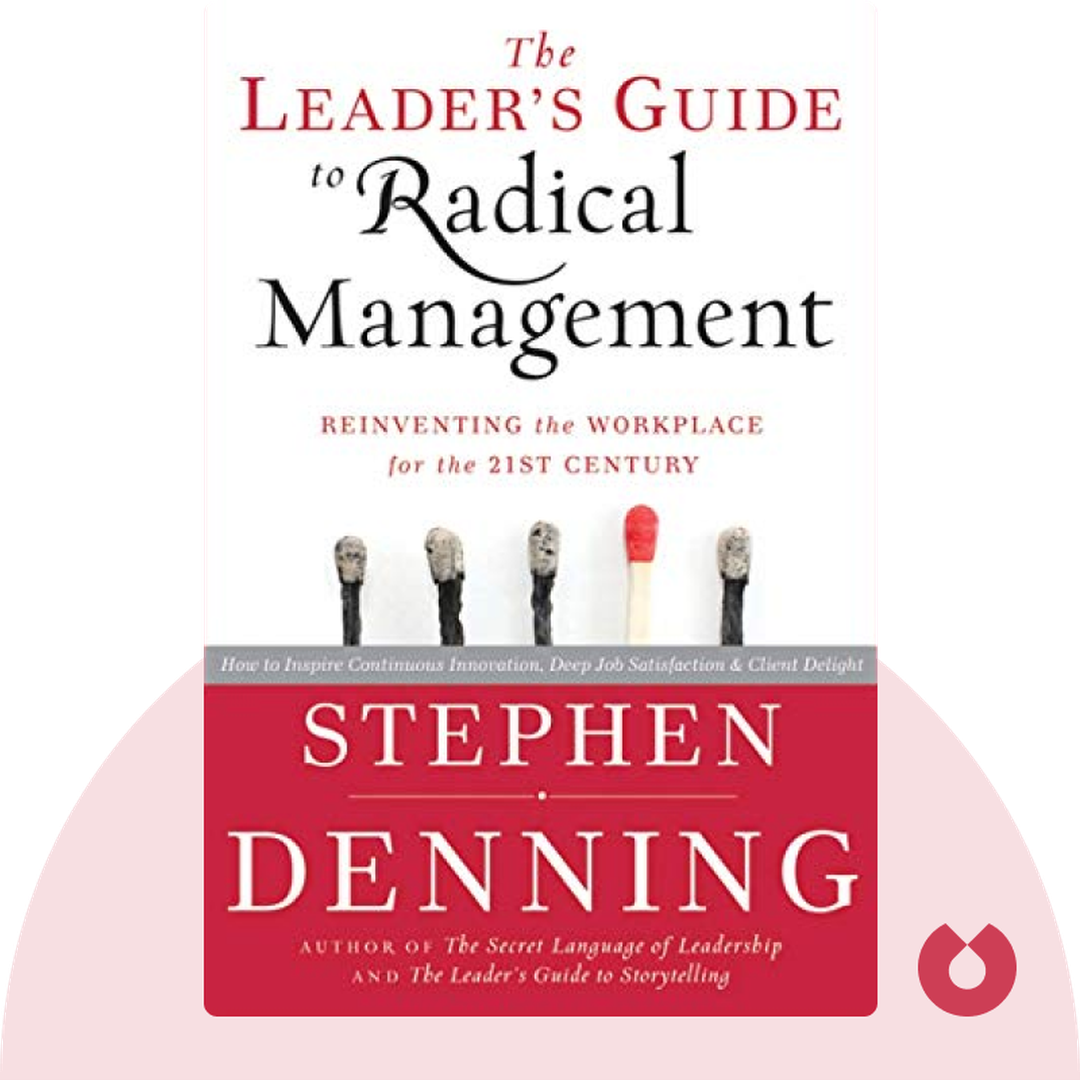
The Leader’s Guide to Radical Management
Start ListeningDownload Try free on iPhoneScan to start in 5 seconds
Categories:
If You're Curious About These Questions...
You should listen to this audiobook
- Did you know that prioritizing shareholder profit over customer delight might actually be the biggest threat to your company’s long-term survival?
- What if you could replace rigid hierarchies with self-organizing teams that drive innovation and productivity without constant supervision?
- Are you curious about the seven radical principles that can transform a stagnant organization into a high-performance engine of continuous value?
Listen to The Leader’s Guide to Radical Management — Free Audiobook
Loading player...
Key Takeaways from The Leader’s Guide to Radical Management
- Discover why client delight should be the ultimate guiding principle of your business, replacing traditional top-down management to motivate employees and drive steady profits.
- Learn how to measure customer satisfaction effectively using the Net Promoter Score (NPS) to target detractors and transform them into loyal promoters.
- Understand why diverse, self-organizing teams without a controlling leader are essential for solving complex business problems and driving true innovation.
- Find out how to eliminate costly waste by adopting client-driven iterations, ensuring you only build what customers actually want while making employees' work more rewarding.
- Master the art of creating a smooth workflow that continuously delivers value at every step, preventing productivity-killing bottlenecks caused by taking on too many simultaneous projects.
Learning Tools
Reinforce what you learned from The Leader’s Guide to Radical Management
Mind Map
The Leader’s Guide to Radical Management
Core Philosophy+
1. Client Delight+
2. Self-Organizing Teams+
3. Client-Driven Iterations+
4. Value in Every Iteration+
5. Radical Transparency+
6. Continuous Self-Improvement+
7. Interactive Communication+
Actionable Advice+
Quiz — Test Your Understanding
Question 1 of 9
What is the primary focus of radical management compared to traditional management?
Question 2 of 9
How does the Net Promoter Score (NPS) measure client delight?
Question 3 of 9
Why are diverse, self-organizing teams better equipped to solve complex problems like client delight?
Question 4 of 9
What is the main benefit of using client-driven iterations, as demonstrated by the Quadrant Homes example?
Question 5 of 9
How does delivering value in every iteration help create a smooth workflow?
Question 6 of 9
According to the book, why do traditional managers often refuse to acknowledge problems?
Question 7 of 9
What was the purpose of the "andon cords" implemented by Taiichi Ohno at Toyota?
Question 8 of 9
Which of the following best describes "interactive communication" for a radical manager?
Question 9 of 9
What is recommended to keep self-organizing teams highly motivated?
The Leader’s Guide to Radical Management — Full Chapter Overview
- 1Recommendation
- 2Every company should aim to delight all customers and turn them into promoters.
- 3To solve the complex challenge of delighting clients, you need diverse, self-organizing teams.
- 4Client-driven iterations will satisfy both customers and your employees.
- 5Build a smooth workflow by delivering value every step of the way.
- 6Identify and fix problems by running a transparent organization.
- 7You must stay on continuous lookout for self-improvement opportunities.
- 8Through interactive communication, you can juggle all tasks and remain an effective manager successfully.
The Leader’s Guide to Radical Management Summary & Overview
The Leader’s Guide to Radical Management (2010) offers seven key principles that will help managers stay focused on making their customers happy. You’ll find that the practical tools presented in these blinks will not only increase your profits; they’ll keep you and your workforce focused on what’s really important.
Who Should Listen to The Leader’s Guide to Radical Management?
- Managers and CEOs
- Entrepreneurs
- Readers interested in good management techniques
Books Similar to The Leader’s Guide to Radical Management
Readers who enjoyed this also liked these titles.