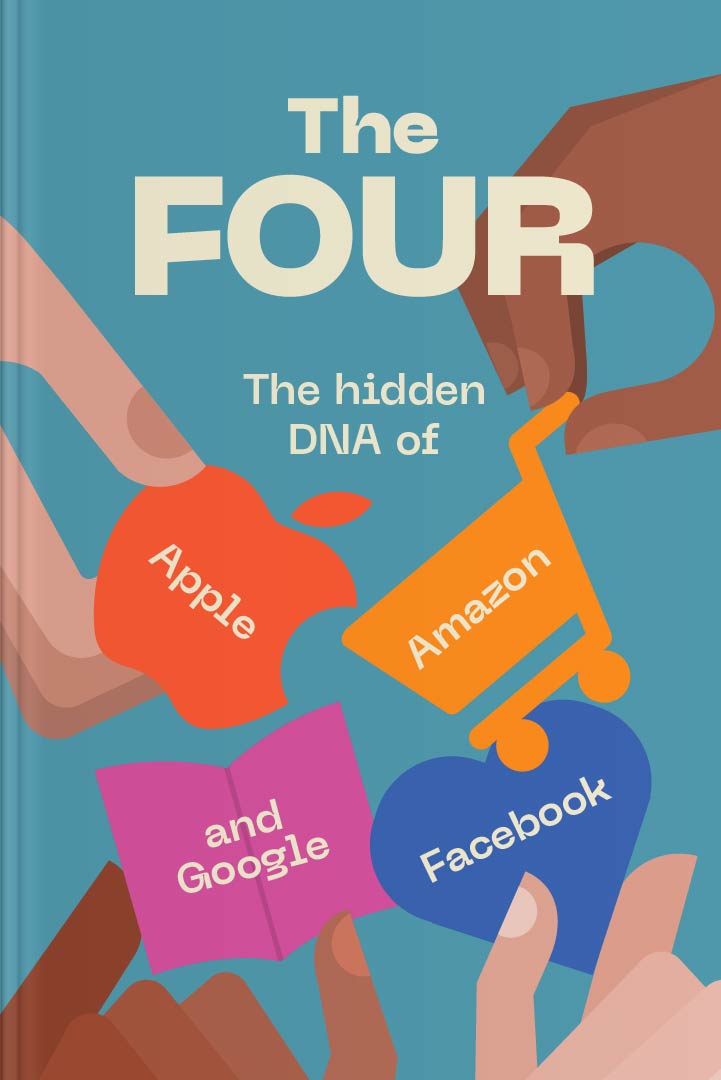
The Four audiobook cover - Four companies quietly reshaped daily life—how people shop, connect, learn, and spend attention—and this warm, practical guide explores how they rose, what fuels their dominance, and what their stories can teach about business and careers in the digital age.

The Four

Four companies quietly reshaped daily life—how people shop, connect, learn, and spend attention—and this warm, practical guide explores how they rose, what fuels their dominance, and what their stories can teach about business and careers in the digital age.

Unknown

4.4 / 5(5 ratings)

If You're Curious About These Questions...

You should listen to this audiobook

Listen to The Four — Free Audiobook

Loading player...

Key Takeaways from The Four

Learning Tools

Reinforce what you learned from The Four

Mind Map

The Four
The Four Horsemen+
The T Algorithm (Trillion-Dollar Traits)+
Potential 5th Horseman+
Career Strategy in the Digital Age+

Quiz — Test Your Understanding

Question 1 of 10
According to the author's body-part metaphor, which human organs do Google and Amazon primarily appeal to?
  • A. The heart, by fostering emotional connections
  • B. The brain, by helping us rationally weigh costs and benefits
  • C. The loins, by promising sex appeal and luxury
  • D. The stomach, by satisfying our basic survival needs
Question 2 of 10
How does Apple achieve unprecedented profitability despite its products not being technically superior to competitors?
  • A. By positioning itself as a luxury brand that appeals to our desire to be special
  • B. By offering the lowest prices in the global smartphone market
  • C. By relying exclusively on government subsidies and tax loopholes
  • D. By monopolizing the business-to-business server industry
Question 3 of 10
What ancient human instinct does Amazon successfully capitalize on to drive its massive growth?
  • A. The instinct to form tribal alliances and communities
  • B. The instinct to seek out a higher, omniscient power
  • C. The hunter-gatherer urge to find and stockpile goods
  • D. The instinct to compete physically for territory
Question 4 of 10
Why does the author compare Google to a modern-day God?
  • A. Because it enforces strict moral guidelines on internet users
  • B. Because it requires financial tithes in the form of subscription fees
  • C. Because it builds massive, temple-like headquarters in major cities
  • D. Because we constantly ask it questions and confide our most closely guarded secrets to it
Question 5 of 10
What negative societal side effect is caused by Facebook's algorithmic curation of news feeds?
  • A. It intentionally promotes competitor platforms to drive up advertising costs
  • B. It polarizes society by reinforcing the political and social views users already hold
  • C. It slows down global internet speeds due to massive data hoarding
  • D. It forces users to pay for premium news content, creating a digital divide
Question 6 of 10
The author refers to the Four as 'cunning thieves.' What famous technological appropriation is attributed to Apple?
  • A. Stealing the search algorithm from Yahoo
  • B. Copying the e-commerce shopping cart design from eBay
  • C. Taking the idea for a mouse-driven graphical user interface from Xerox
  • D. Appropriating social networking algorithms from MySpace
Question 7 of 10
What does the 'T Algorithm' represent in the context of the book?
  • A. The secret code used by Google's search engine to rank websites
  • B. The eight attributes a company needs to reach a one-trillion-dollar valuation
  • C. A psychological tactic used by Facebook to keep users engaged on their platform
  • D. Amazon's logistics formula for guaranteeing same-day delivery
Question 8 of 10
According to the book, what is the primary obstacle preventing Alibaba from becoming the 'fifth horseman'?
  • A. It lacks a profitable e-commerce platform and relies too heavily on physical stores
  • B. It has too few active users compared to its main rival, Walmart
  • C. It lacks global reach and needs to distance itself from the Chinese government
  • D. Its artificial intelligence capabilities are vastly inferior to those of the current Four
Question 9 of 10
How does Amazon 'borrow' from the third-party sellers that use its platform?
  • A. It legally claims copyright over all product images uploaded by sellers
  • B. It uses the sellers' business ideas and data to offer similar products at lower prices
  • C. It forces sellers to invest a percentage of their profits into Amazon's visionary capital funds
  • D. It secretly redirects sellers' customers to Google shopping ads
Question 10 of 10
What counterintuitive career advice does the author offer for achieving success in the digital age?
  • A. Follow your passion above all else, regardless of your skill level
  • B. Avoid large cities where competition for tech jobs is too fierce
  • C. Follow your talent instead of your passion, and commit to becoming great at it
  • D. Avoid using social media so you can maintain a mysterious, highly sought-after professional profile

The Four — Full Chapter Overview

The Four Summary & Overview

For more than two decades, Apple, Amazon, Facebook, and Google have influenced how the world moves: what people buy, how they communicate, where they seek answers, and how advertising reaches them. This summary explores how each company rose by making a few unusually clear choices—about customers, design, data, and scale—and how those choices gradually pushed earlier leaders into the background.

Along the way, listeners will find grounded business lessons about vision, differentiation, risk, and building trust. The closing chapter shifts from companies to people, offering gentle career guidance for thriving in a tech-shaped economy—whether someone chooses to grow as an employee or build something of their own.

Who Should Listen to The Four?

  • Business leaders, founders, and aspiring entrepreneurs who want clear lessons from the strategies behind modern tech dominance
  • Professionals and students planning their careers in a digital world shaped by platforms, data, and rapid change
  • Curious listeners who want a big-picture, easy-to-follow explanation of why these four companies became so influential

About the Author: Unknown

This summary is based on provided source content. The original author of the text was not specified.

🎧
Listen in the AppOffline playback & background play
Get App