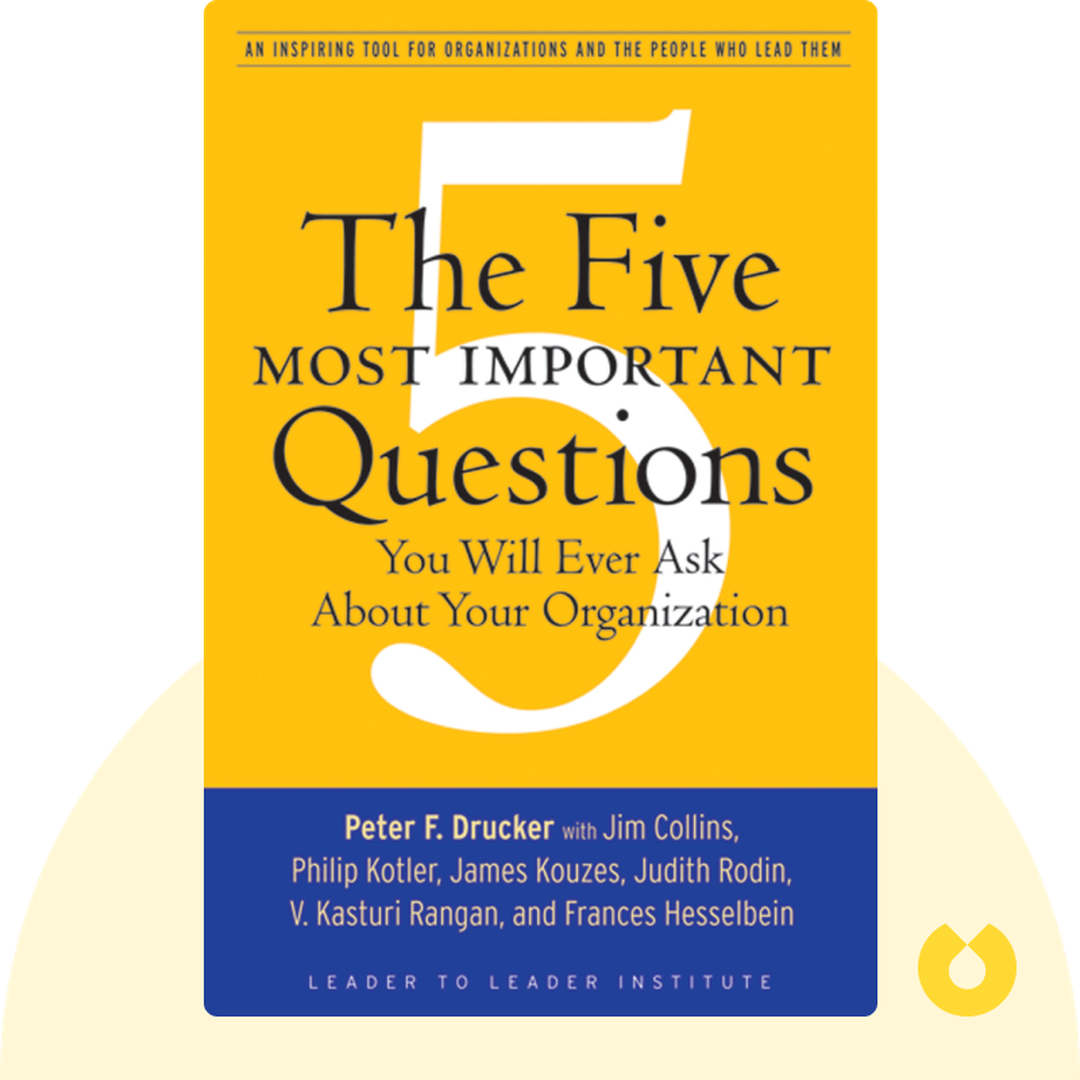
The Five Most Important Questions You Will Ever Ask About Your Organization
Start ListeningDownload Try free on iPhoneScan to start in 5 seconds
Categories:
If You're Curious About These Questions...
You should listen to this audiobook
- What if you could transform your organization's performance by answering just five simple, yet profound questions that most leaders overlook?
- Are you curious about why defining who your 'customer' is—and what they truly value—remains the most difficult challenge for even the most experienced managers?
- What’s the secret to moving beyond mere survival and creating a results-driven plan that actually achieves your organization’s long-term mission?
Listen to The Five Most Important Questions You Will Ever Ask About Your Organization — Free Audiobook
Loading player...
Key Takeaways from The Five Most Important Questions You Will Ever Ask About Your Organization
- Learn how to craft a concise mission statement that fits on a t-shirt and serves as the ultimate guiding force for your organization's goals.
- Discover how a clearly defined mission helps you separate non-negotiable core values from flexible elements so you can confidently adapt to a changing world.
- Understand the critical distinction between primary customers whose lives you directly change and supporting customers who help you achieve your mission.
- Find out how closely monitoring your audience allows you to recognize unexpected demographic shifts and successfully evolve your business strategies.
- Uncover the power of directly asking what your customers truly value, avoiding the trap of false assumptions and profoundly improving your service delivery.
Learning Tools
Reinforce what you learned from The Five Most Important Questions You Will Ever Ask About Your Organization
Mind Map
The Five Most Important Questions You Will Ever Ask About Your Organization
Core Premise+
Q1: What is our mission?+
Q2: Who is our customer?+
Q3: What does our customer value?+
Q4: What are our results?+
Q5: What is our plan?+
Quiz — Test Your Understanding
Question 1 of 7
How did changing the emergency room's mission statement to 'To give assurance to the afflicted' improve their operations?
Question 2 of 7
Why did the Girl Scouts of the USA decline a lucrative deal to canvas for a charity organization?
Question 3 of 7
According to Drucker, what is the defining characteristic of a 'primary customer'?
Question 4 of 7
What crucial lesson did the homeless shelter learn by asking 'What does our customer value?'
Question 5 of 7
In the context of a school, why is it essential for a principal to understand and satisfy 'supporting customers' like teachers and the school board?
Question 6 of 7
When evaluating an organization's results, how does the book distinguish between qualitative and quantitative data?
Question 7 of 7
When creating a plan of action, what is the maximum number of overarching goals Drucker recommends setting?
The Five Most Important Questions You Will Ever Ask About Your Organization — Full Chapter Overview
- 1Recommendation
- 2A well-defined mission helps you stay truly focused on your objectives.
- 3Recognizing your primary and secondary customers will help you better navigate a shifting marketplace.
- 4Successful organizations understand what their customers truly value.
- 5Recognizing which results your organization ought to be judged on is the true key to ultimate success.
- 6A well-crafted action plan keeps you focused on your objectives and clearly outlines how best to achieve them successfully.
The Five Most Important Questions You Will Ever Ask About Your Organization Summary & Overview
The Five Most Important Questions You Will Ever Ask About Your Organization (2008) presents readers with five simple yet highly effective questions that any manager, owner or stakeholder should ask in order to increase their organization’s chances of success. While these questions are focused on non-profit organizations, the lessons are applicable to any organization seeking to make a difference.
Who Should Listen to The Five Most Important Questions You Will Ever Ask About Your Organization?
- Business owners, managers and other stakeholders
- Students of business and management
- Readers interested in improving leadership skills
Books Similar to The Five Most Important Questions You Will Ever Ask About Your Organization
Readers who enjoyed this also liked these titles.