If You're Curious About These Questions...
You should listen to this audiobook
- Did you know that organizational health is actually a more powerful driver of success than strategy, finance, or even your industry's best technology?
- Have you ever wondered why even the most brilliant leadership teams often fail to get their employees pulling in the same direction?
- What if you could eliminate the internal politics and confusion that are quietly draining your organization’s most valuable resources?
Listen to The Advantage — Cinematic Audio Edition
Loading player...
Key Takeaways from The Advantage
- Discover why prioritizing organizational health over fast, flashy strategies creates a sustainable competitive advantage by eliminating draining internal competition.
- Learn how to build a highly effective leadership team of three to ten people grounded in vulnerability, where leaders openly admit mistakes and share personal truths.
- Understand how establishing real trust enables healthy conflict, allowing your team to honestly challenge ideas and secure genuine buy-in without damaging respect.
- Find out how to transition from a single-leader enforcer model to a culture of shared accountability, where peers naturally keep one another on track.
- Master the practice of prioritizing collective results over individual ambitions to ensure true cohesion, where success and failure are fully shared by the entire team.
Learning Tools
Reinforce what you learned from The Advantage
Mind Map
The Advantage
Smart vs. Healthy Organizations+
Why Leaders Neglect Health+
Discipline 1: Build a Cohesive Leadership Team+
Discipline 2: Create Clarity+
Discipline 3: Overcommunicate Clarity+
Discipline 4: Reinforce Clarity+
Effective Meetings+
The Leader's Role+
Quiz — Test Your Understanding
Question 1 of 12
Why does the author argue that a healthy organization can eventually become smart, but an unhealthy organization cannot?
Question 2 of 12
Which of the following describes the 'adrenaline bias' that prevents leaders from focusing on organizational health?
Question 3 of 12
According to the text, what is the optimal size for a leadership team to ensure efficient sharing of ideas and collective responsibility?
Question 4 of 12
What specific type of trust is foundational for a cohesive leadership team to function effectively?
Question 5 of 12
How should cohesive leadership teams view conflict during the decision-making process?
Question 6 of 12
When a leadership team asks the critical question, 'How do we behave?', what are they primarily trying to clarify?
Question 7 of 12
Why must leaders act as 'Chief Reminding Officers' and repeatedly overcommunicate their core messages?
Question 8 of 12
What is the recommended approach if an employee fits the company's behavioral values but is not performing well?
Question 9 of 12
What does the author identify as the single best indicator of a company's organizational health?
Question 10 of 12
Which type of meeting is described as the most valuable activity in an organization and should ideally be run without a pre-set agenda?
Question 11 of 12
What is the likely outcome when leaders try to discuss all organizational issues in a single, comprehensive staff meeting?
Question 12 of 12
The text suggests that the leadership team should create a 'playbook.' What should this playbook contain?
The Advantage — Full Chapter Overview
- 1Recommendation
- 2For lasting success, organizations must be both smart and healthy.
- 3Leaders often ignore organizational health, thinking they’re too sophisticated, busy, or analytical to bother with it all.
- 4Form a cohesive leadership team to build a healthy, cohesive organization overall.
- 5From trust to results focus, five behavioral principles must guide teams to build cohesive unity and shared accountability.
- 6Leadership teams must build cohesion by asking simple questions about who they are and what they will do together.
- 7Employees must be continually reminded of the company’s purpose, core values, strategy, and top priorities consistently.
- 8Human systems across the company must be simple and based on answers to the six key questions outlined.
- 9No action, activity, or process is more vital to a healthy organization than how it holds meetings overall.
- 10Leaders employ four types of meetings—daily, weekly, monthly, and quarterly—for different levels of detail and focus needed.
- 11Leaders and their teams are the crucial core of building healthy organizations over time.
The Advantage Summary & Overview
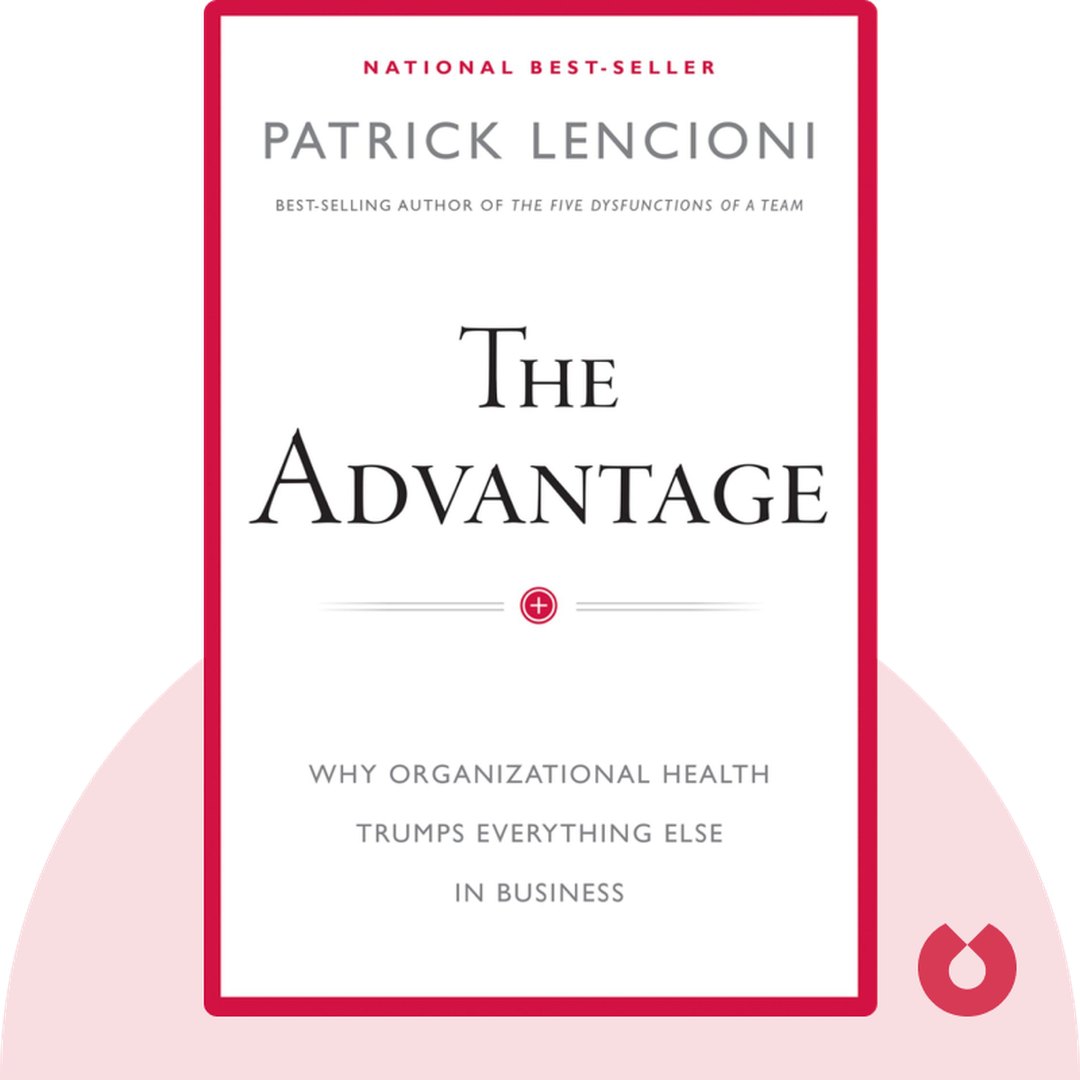
These blinks outline the key principles for building a healthy organization where all the employees pull together in the same direction following the same objectives. This enables organizations to achieve their full potential, while unhealthy competitors waste resources in internal squabbles.
Who Should Listen to The Advantage?
- Leadership team members in any type of organization
- Anyone working in human resources
- Consultants in the fields of leadership, organizational learning and team building
Books Similar to The Advantage
Readers who enjoyed this also liked these titles.