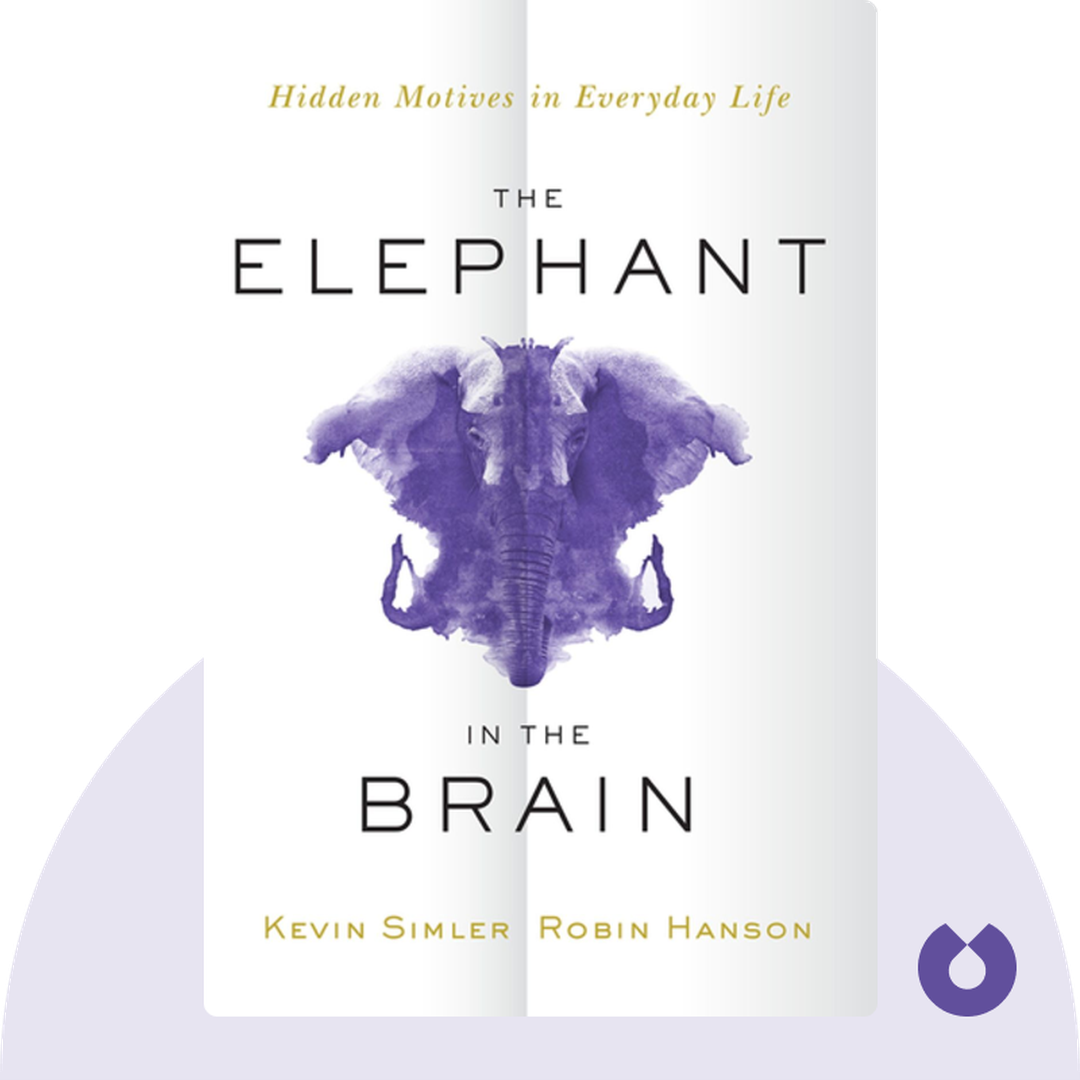
The Elephant in the Brain
Start ListeningDownload Try free on iPhoneScan to start in 5 seconds
Categories:
If You're Curious About These Questions...
You should listen to this audiobook
- Have you ever wondered why your brain hides your true motives from you, making you believe you’re more selfless than you actually are?
- Did you know that many of our most noble actions—like giving to charity or pursuing an education—are often driven by hidden social signals we aren't even aware of?
- What’s the secret 'elephant' in your brain that quietly controls your behavior while keeping your conscious mind completely in the dark?
Listen to The Elephant in the Brain — Cinematic Audio Edition
Loading player...
Key Takeaways from The Elephant in the Brain
- Discover why the human brain is hardwired for selfishness and how it hides these dark motives deep within the subconscious to protect your self-image.
- Understand how self-deception acts as a strategic evolutionary tool to protect you from outside judgment and help form vital social alliances.
- Learn to read the rapid, subconscious cues of body language to uncover people's true intentions and gain the upper hand in social interactions.
- Recognize how complex advertising techniques, such as lifestyle association and psychological color cues, subtly deceive your brain into purchasing products.
- Uncover the hidden social motives behind religious practices and discover whether everyday actions are driven by genuine intent or a subconscious desire for social approval.
Learning Tools
Reinforce what you learned from The Elephant in the Brain
Mind Map
The Elephant in the Brain
Core Concept+
Evolution & Competition+
Managing Competition+
Hidden Motives in Daily Life+
Quiz — Test Your Understanding
Question 1 of 7
What does the term 'the elephant in the brain' refer to according to the authors?
Question 2 of 7
According to primatologist Robin Dunbar, what is the deeper significance of social grooming among chimpanzees?
Question 3 of 7
Why do humans frequently hide their true, often selfish motives from themselves?
Question 4 of 7
How does the 'social brain hypothesis' explain the evolution of human intelligence?
Question 5 of 7
What role do social norms and mechanisms like gossip play in human society?
Question 6 of 7
What did psychologist Vladas Griskevicius’s 2010 study reveal about people's purchasing habits regarding eco-friendly products?
Question 7 of 7
According to evolutionary psychologist Geoffrey Miller, why do humans spend time and energy creating art even though it doesn't aid basic ecological survival?
The Elephant in the Brain — Full Chapter Overview
- 1Recommendation
- 2Animals act from deep, complex, often selfish motives, yet they aren’t always fully conscious of them all.
- 3Humans often prefer to keep unpleasant motives concealed from themselves, too.
- 4Humans are intelligent because competition shaped us to be so.
- 5Social norms curb needless competition, yet they require a community to enforce them.
- 6We rarely notice body language, which often leaves us pleasantly, even blissfully, quite unaware.
- 7We purchase goods to flaunt personal status – and our idealized personality traits – to others too.
- 8Although art isn’t vital for survival, it can confer a competitive edge in sexual selection.
The Elephant in the Brain Summary & Overview
The Elephant in the Brain (2018) explores the selfish motives that drive much of human behavior but which we’d much rather remain unaware of.
Who Should Listen to The Elephant in the Brain?
- Students of psychology and anthropology
- People interested in evolutionary theory
- Anyone curious about the dynamics of human behavior
Books Similar to The Elephant in the Brain
Readers who enjoyed this also liked these titles.