If You're Curious About These Questions...
You should listen to this audiobook
- Did you know that modern biology and ancient Buddhist philosophy might actually be pointing toward the exact same conclusion about what it means to be human?
- Have you ever wondered if the building blocks of your DNA contain the secret to understanding the deep spiritual truths of the Dharma?
- Are you curious about how an empirical scientist and a spiritual seeker could look at the same microscopic cell and see the same profound mysteries of life?
Listen to The Dharma in DNA — Free Audiobook
Loading player...
Key Takeaways from The Dharma in DNA
- Discover how Buddhist philosophy and modern biology unexpectedly converge to offer a unified understanding of what it actually means to be human.
- Understand why the traditional clash between science and religion isn't universal, particularly when viewed through a Buddhist lens that rejects the concept of an eternal soul.
- Learn how the fundamental Buddhist concept of anatman, or nonself, reframes human identity as a dynamic process rather than a fixed, stable essence.
- Explore the ancient chariot analogy to realize that the 'self' is simply a convenient label for a complex, ever-changing bundle of mind and matter.
- Find out how spiritual concepts like impermanence can actually enhance scientific thought, bridging the gap between hard-nosed empiricism and religious philosophy.
Learning Tools
Reinforce what you learned from The Dharma in DNA
Mind Map
The Dharma in DNA
Science and Religion Relationship+
Buddhist View of Self (Anatman)+
Biological View of Self+
Convergence of Biology and Buddhism+
Quiz — Test Your Understanding
Question 1 of 6
What realization did molecular biologist Dee Denver have after hearing the Dalai Lama speak?
Question 2 of 6
How did paleontologist Stephen Jay Gould attempt to resolve the traditional clash between science and religion?
Question 3 of 6
In the story of the monk Nagasena and King Menander, what does the analogy of the chariot illustrate about Buddhist philosophy?
Question 4 of 6
According to the Buddhist perspective described in the text, what is a primary cause of human suffering?
Question 5 of 6
How do modern biologists, as described in the text, view the relationship between genes and the environment?
Question 6 of 6
What shared conclusion do both Buddhist philosophy and modern biology reach regarding the concept of the self?
The Dharma in DNA — Full Chapter Overview
- 1Recommendation
- 2The clash between science and religion isn’t inevitable.
- 3Buddhists understand the self as a dynamic process, not a fixed identity.
- 4The self is invisible under the microscope as well.
The Dharma in DNA Summary & Overview
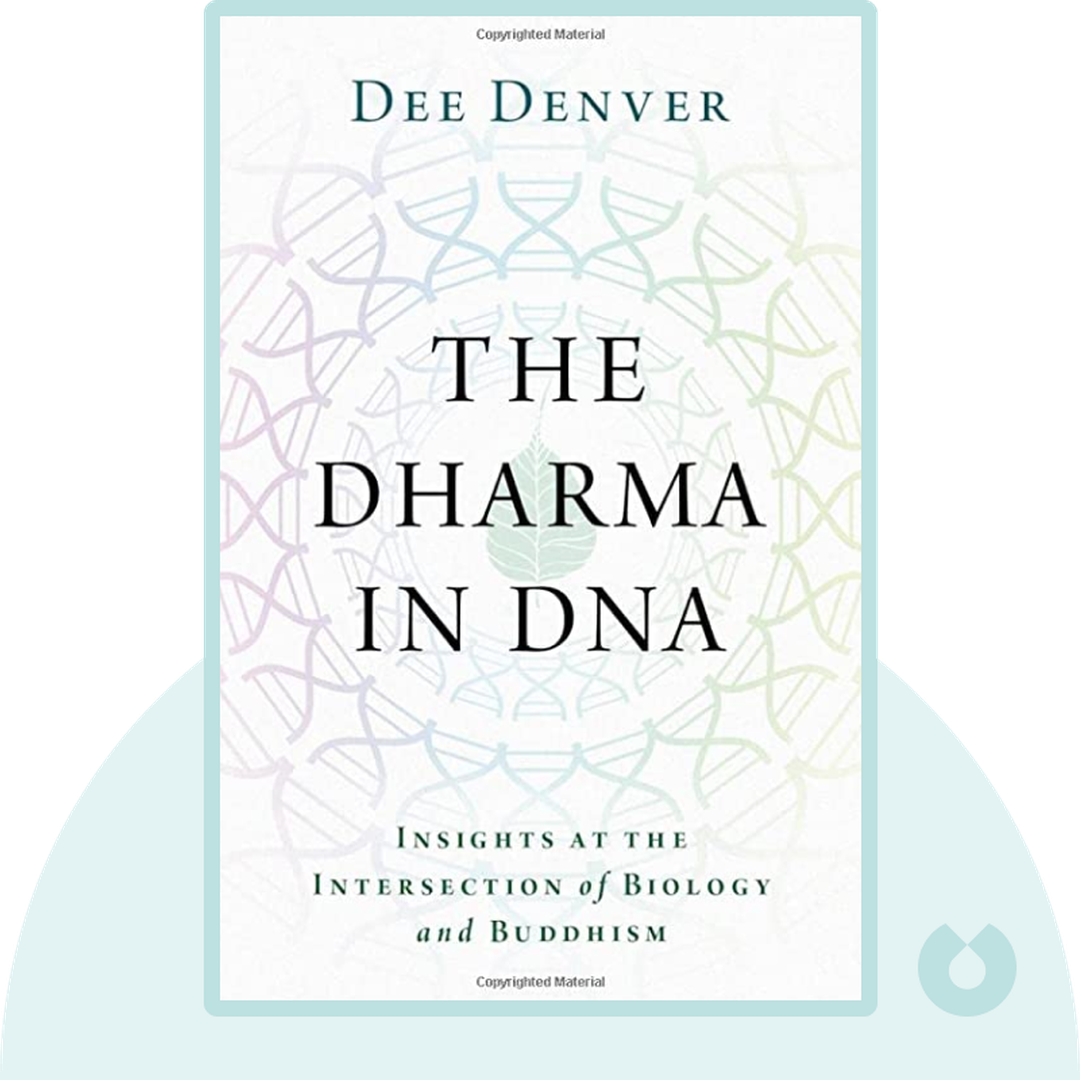
The Dharma in DNA (2022) explores the intersections between Buddhist philosophy and biology. At first glance, these two traditions couldn’t be more different. One is spiritual; the other empirical. But there are overlaps. Both traditions are attempts to discover meaning, for one. But there’s more to it than that: both the teachings of the Buddha and the findings of biologists appear to converge on a similar understanding of what it means to be human.
Who Should Listen to The Dharma in DNA?
- Open-minded rationalists and skeptics
- Thinkers who love big ideas
- Spiritualists interested in science
Books Similar to The Dharma in DNA
Readers who enjoyed this also liked these titles.