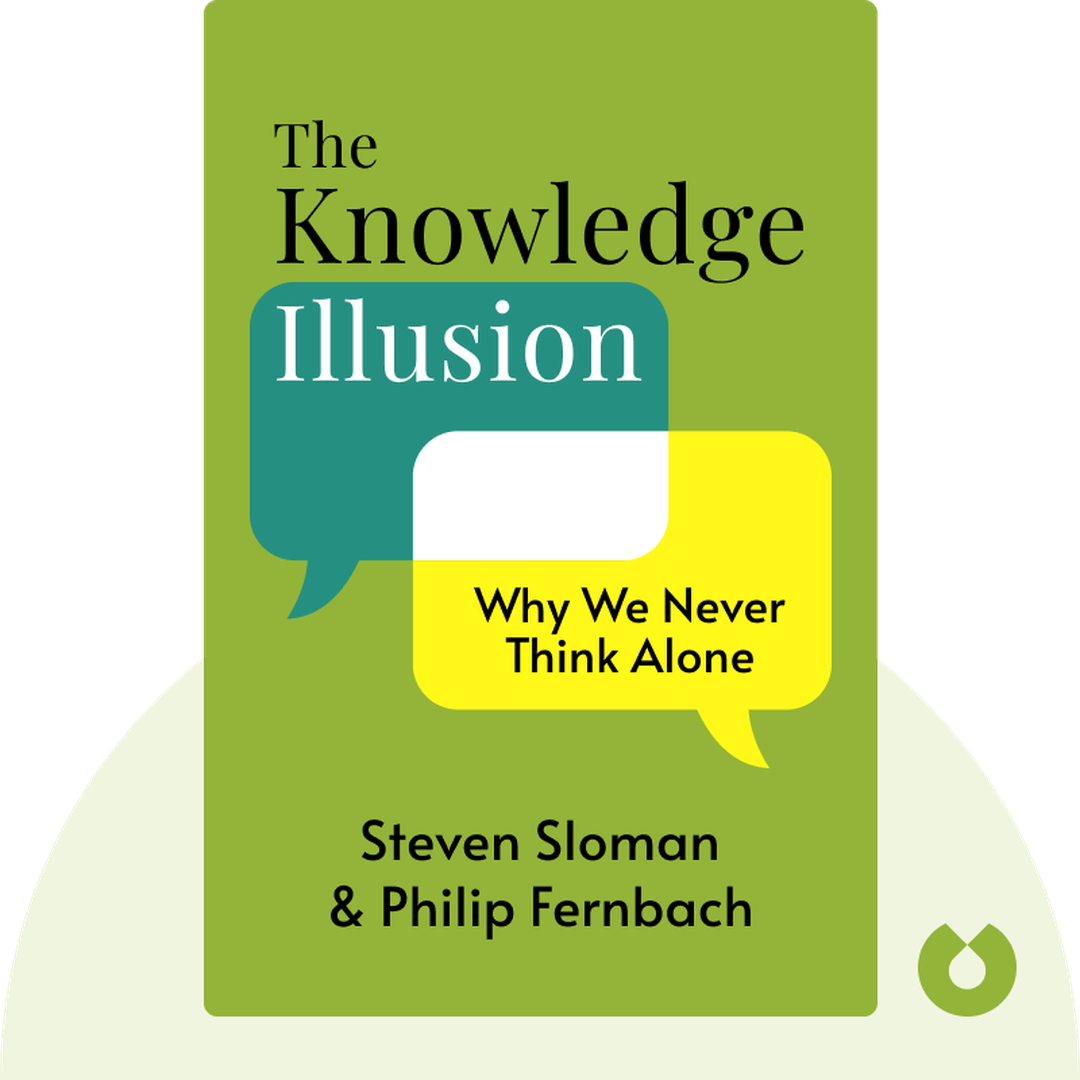
The Knowledge Illusion
Start ListeningDownload Try free on iPhoneScan to start in 5 seconds
Categories:
If You're Curious About These Questions...
You should listen to this audiobook
- Have you ever wondered why you feel like you understand how a simple zipper works, until you’re actually asked to explain it?
- Did you know that the vast majority of your knowledge doesn’t actually live in your brain, but in the world around you?
- What if the secret to human intelligence isn't how much you know individually, but how well you tap into a collective mind?
Listen to The Knowledge Illusion — Cinematic Audio Edition
Loading player...
Key Takeaways from The Knowledge Illusion
- Discover why the 'lone genius' is a myth and learn how human intelligence relies on a communal effort rather than individual brainpower.
- Understand the 'illusion of explanatory depth' to see why we consistently overestimate our knowledge of how everyday objects actually work.
- Learn why the human brain didn't evolve to function as a data-storing computer, holding surprisingly little information in an infinitely complex world.
- Find out how our brains evolved primarily to facilitate action, and why our unique capacity for diagnostic reasoning sets us apart from other animals.
- Explore why reasoning backward from effect to cause is difficult, and how we naturally rely on storytelling to make causal sense of our surroundings.
Learning Tools
Reinforce what you learned from The Knowledge Illusion
Mind Map
The Knowledge Illusion
The Nature of Human Knowledge+
How We Actually Think+
Collective Intelligence+
Technology & AI+
Society, Politics, and Beliefs+
Rethinking Intelligence & Education+
Quiz — Test Your Understanding
Question 1 of 10
What is the 'Illusion of Explanatory Depth' (IoED)?
Question 2 of 10
According to the text, why is the metaphor of the human brain as a computer fundamentally flawed?
Question 3 of 10
What specific cognitive ability is argued to set humans apart from other animals?
Question 4 of 10
When solving the 'bat and ball' math problem, why do most people initially guess the incorrect answer of 'ten cents'?
Question 5 of 10
Which of the following is an example of 'embodiment' as described in the book?
Question 6 of 10
The 'social brain hypothesis' suggests that human brains grew exceptionally large primarily to:
Question 7 of 10
Why do the authors argue that the fear of a machine 'superintelligence' wiping out humanity is likely unfounded?
Question 8 of 10
What does the failure of the 'deficit model' reveal about people's fear of technologies like genetically modified organisms (GMOs)?
Question 9 of 10
In the authors' experiment, what happened when participants with radical political views were asked to causally explain the effects of the policies they supported?
Question 10 of 10
Based on the book's conclusions, how should society redefine what it means to be 'smart'?
The Knowledge Illusion — Full Chapter Overview
- 1Recommendation
- 2The illusion of explanatory depth makes us believe we know more than we truly do.
- 3The human brain didn’t evolve to store data, and the world is unimaginably complex.
- 4The human brain evolved for action, and diagnostic reasoning may set us apart from animals.
- 5Because reasoning from effect to cause is hard, we rely on stories to make causal sense.
- 6We use both intuitive and deliberate modes of reasoning.
- 7Our thinking depends on our bodies and on the external world.
- 8Our species’ success rests on shared intelligence and our power to work together.
- 9Machines can’t share intentions, so a true superintelligence is unlikely.
- 10Fear of innovation can breed anti-science attitudes that resist correction.
- 11Thinking in causal terms can fight groupthink, while politicians use sacred values.
- 12We must rethink what it means to be smart and reimagine education.
The Knowledge Illusion Summary & Overview
The Knowledge Illusion (2017) is an in-depth exploration of the human mind. It argues against the view that intelligence is solely an individual attribute, offering compelling arguments for how our success as a species would have been impossible without a community of knowledge.
Who Should Listen to The Knowledge Illusion?
- Students of cognitive science
- Know-it-alls
- Aspiring intellectuals worried that they know too little
Books Similar to The Knowledge Illusion
Readers who enjoyed this also liked these titles.