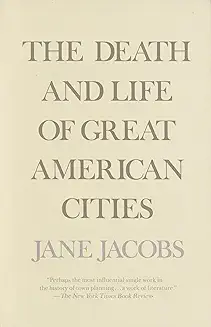
The Death and Life of Great American Cities audiobook cover - Jane Jacobs dismantles the comforting myths of “good planning” and shows how real city neighborhoods actually stay safe, grow prosperous, and regenerate—through sidewalks, mixed uses, small blocks, old buildings, and dense human life that planners keep trying to erase.

The Death and Life of Great American Cities

Jane Jacobs dismantles the comforting myths of “good planning” and shows how real city neighborhoods actually stay safe, grow prosperous, and regenerate—through sidewalks, mixed uses, small blocks, old buildings, and dense human life that planners keep trying to erase.

Jane Jacobs

4.2 / 5(6 ratings)
Start ListeningDownloadQR code that opens AudiobookHub on the App StoreTry free on iPhoneScan to start in 5 seconds

If You're Curious About These Questions...

You should listen to this audiobook

Listen to The Death and Life of Great American Cities — Free Audiobook

Loading player...

Key Takeaways from The Death and Life of Great American Cities

Learning Tools

Reinforce what you learned from The Death and Life of Great American Cities

Mind Map

The Death And Life Of Great American Cities Jane Jacobs
The Failure of Orthodox City Planning+
Sidewalks as the City's Foundation+
Children, Parks, and Neighborhoods+
The Four Conditions of Diversity+
Forces of Decay and Vacuums+
Systems, Money, and Transit+

Quiz — Test Your Understanding

Question 1 of 10
How does Jacobs describe modern urban renewal and orthodox city planning?
  • A. A necessary step to modernize aging infrastructure
  • B. A form of civic looting that fractures communities
  • C. An underfunded effort that needs more government intervention
  • D. A successful strategy that creates balanced neighborhoods
Question 2 of 10
Why did official planners condemn Boston's North End as a slum, despite its real-world success?
  • A. It lacked adequate funding for public schools and libraries.
  • B. It was suffering from a high rate of violent crime and disease.
  • C. It was dense, mixed, and did not fit the planners' ideological fantasies of a good city.
  • D. Its residents were rapidly moving out to the suburbs.
Question 3 of 10
According to Jacobs, what is the primary requirement for making city streets safe?
  • A. Increasing the presence of armed police patrols.
  • B. Creating 'eyes on the street' through continuous sidewalk use and active storefronts.
  • C. Building inward-facing residential complexes with private security.
  • D. Removing commercial businesses from residential blocks to reduce stranger traffic.
Question 4 of 10
What vital function do 'public characters', such as storekeepers, serve in a city neighborhood?
  • A. They act as information hubs that link strangers into local knowledge networks.
  • B. They provide organized, formal surveillance to report minor crimes to the police.
  • C. They organize political protests to fight against city hall.
  • D. They enforce strict social conformity and intimacy among all neighborhood residents.
Question 5 of 10
Why does Jacobs flip the traditional planning view and argue that lively sidewalks are often safer for children than parks?
  • A. Parks are usually located near high-speed border highways.
  • B. Sidewalks provide steady adult surveillance and quick help, whereas adult oversight in parks is often thin.
  • C. Children are less likely to encounter strangers on sidewalks than in public parks.
  • D. Sidewalks are privately owned, giving parents legal control over the space.
Question 6 of 10
Jacobs rejects the idea of the inward, self-contained 'neighborhood unit.' Instead, she argues that real self-government depends on which three neighborhood scales?
  • A. The household, the apartment building, and the local school district.
  • B. The city block, the commercial zone, and the residential zone.
  • C. The city as a whole, the street neighborhood, and large subcity districts.
  • D. The private park, the gated community, and the downtown center.
Question 7 of 10
Which of the following is NOT one of the four conditions Jacobs outlines as necessary to generate city diversity?
  • A. Mixed primary uses
  • B. Large, unbroken city blocks
  • C. A mix of aged and new buildings
  • D. A high concentration of people
Question 8 of 10
According to the four conditions of city diversity, why is a presence of 'aged buildings' essential for a vibrant neighborhood?
  • A. They provide historic tourist attractions that fund local government.
  • B. They ensure the neighborhood retains a specific, uniform architectural aesthetic.
  • C. They allow for low-overhead experiments and small enterprises to exist.
  • D. They force the city to invest in continuous infrastructure renewal.
Question 9 of 10
How can a highly successful, diverse city district end up destroying its own vitality?
  • A. By attracting too many public parks, which create dangerous vacuums.
  • B. By drawing the attention of orthodox planners who bulldoze it for urban renewal.
  • C. By becoming so popular that the most profitable use multiplies and crowds out the original mix of uses.
  • D. By raising residential taxes so high that only large families can afford to live there.
Question 10 of 10
Fundamentally, Jacobs believes planners must view cities not as simple machines or statistics, but as what?
  • A. Standardized economic zones
  • B. Problems of organized complexity, similar to living biological systems
  • C. Utopian art projects
  • D. Temporary structures meant for continuous cyclical rebuilding

The Death and Life of Great American Cities — Full Chapter Overview

The Death and Life of Great American Cities Summary & Overview

In The Death and Life of Great American Cities, Jane Jacobs launches a direct attack on mid-20th-century urban renewal and orthodox planning. She argues that the biggest failures of modern rebuilding—tower-in-the-park projects, single-use districts, superblocks, and highway slicing—come from misunderstanding what cities are: not tidy machines, but living systems whose strength comes from everyday diversity and constant street-level interaction.

Jacobs builds her case by observing ordinary scenes: sidewalks that stay safe because of “eyes on the street,” parks that thrive only when surrounded by active mixed uses, and “slums” that improve themselves when residents can stay put and reinvest. She then identifies four conditions that generate city vitality—mixed primary uses, small blocks, aged buildings, and high concentration—and shows how cities decline when planning and financing destroy those conditions. The book concludes with practical tactics for housing, traffic, design, and governance, grounded in the idea that a city is a problem of organized complexity.

Who Should Listen to The Death and Life of Great American Cities?

  • Urban planners, architects, and transportation professionals who want a street-level, reality-based framework for city vitality.
  • Civic leaders, neighborhood advocates, and policy makers working on housing, safety, zoning, or downtown revitalization.
  • Readers who love cities and want to understand why some neighborhoods thrive while others hollow out.

About the Author: Jane Jacobs

Jane Jacobs (1916–2006) was a writer and urban thinker born in Scranton, Pennsylvania, who later lived in Toronto. She became one of the most influential critics of urban renewal and modern planning orthodoxy, also authoring The Economy of Cities, Cities and the Wealth of Nations, The Question of Separatism, and Systems of Survival.

🎧
Listen in the AppOffline playback & background play
Get App