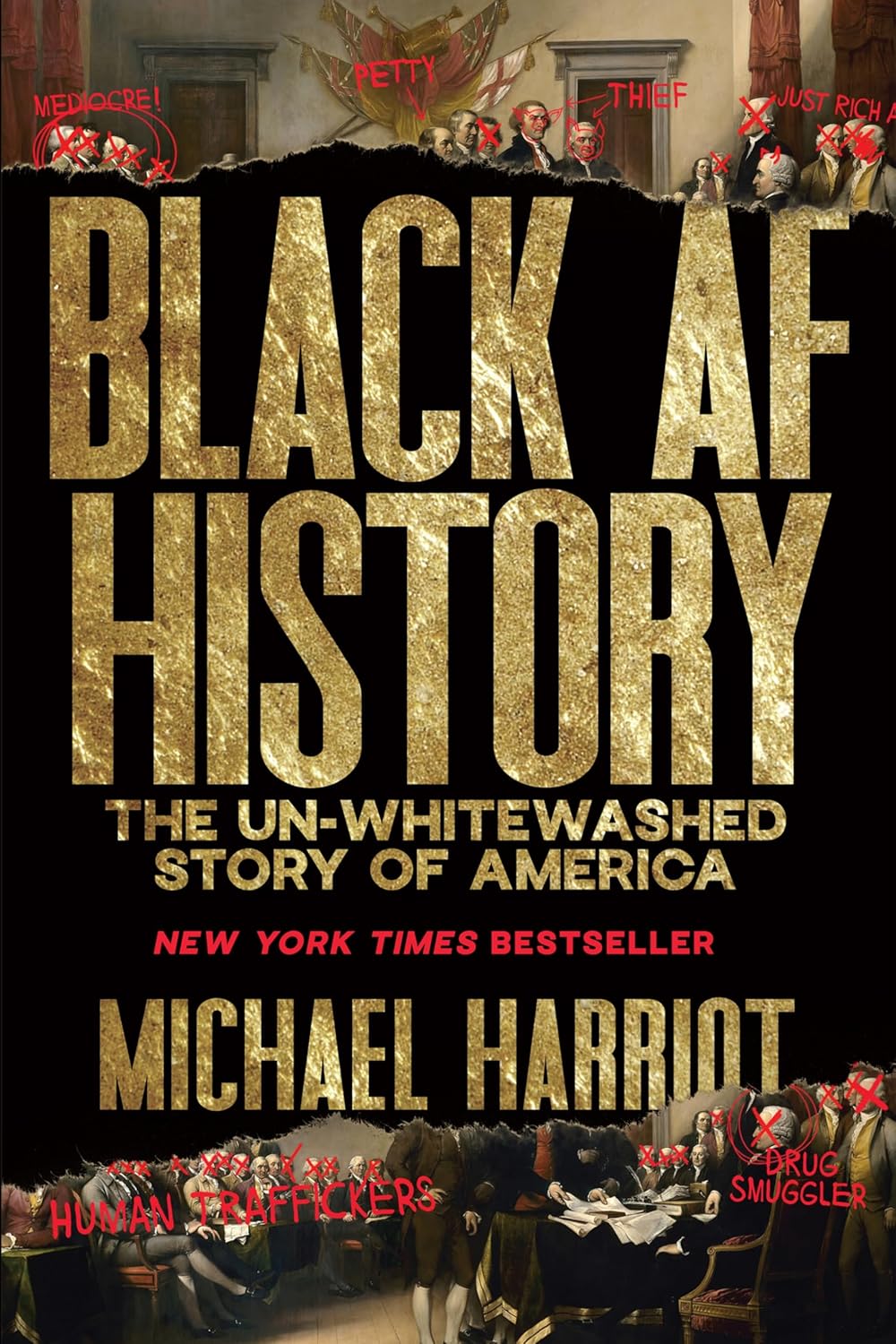
Black AF History: The Un-Whitewashed Story of America audiobook cover - A sharp, funny, furious retelling of U.S. history that recenters Black life as the engine of America—showing how enslavement, resistance, culture, politics, and wealth built the nation, and how the myth of “America” survives by erasing that truth.

Black AF History: The Un-Whitewashed Story of America

A sharp, funny, furious retelling of U.S. history that recenters Black life as the engine of America—showing how enslavement, resistance, culture, politics, and wealth built the nation, and how the myth of “America” survives by erasing that truth.

Michael Harriot

4.3 / 5(4 ratings)
Start ListeningDownloadQR code that opens AudiobookHub on the App StoreTry free on iPhoneScan to start in 5 seconds

If You're Curious About These Questions...

You should listen to this audiobook

Listen to Black AF History: The Un-Whitewashed Story of America — Free Audiobook

Loading player...

Key Takeaways from Black AF History: The Un-Whitewashed Story of America

Learning Tools

Reinforce what you learned from Black AF History: The Un-Whitewashed Story of America

Mind Map

Black Af History
Framing and The Myth+
Pre-1619 and Jamestown+
Empire, Slavery, and Culture+
Revolutions and Choices+
Resistance and Sanctuary+
Civil War to Systemic Cycles+

Quiz — Test Your Understanding

Question 1 of 9
In the book's opening, what does the metaphor of 'the sleeves' of a stolen coat represent?
  • A. The personal memories of the author's childhood
  • B. The curriculum of Black history books in the author's family home
  • C. Evidence that exposes a historical theft and contradicts national myths
  • D. The escape route to Canada that the author planned as a child
Question 2 of 9
According to Harriot, what was the 'structural turning point' that made the failing Jamestown colony profitable?
  • A. The colonists finally learning successful farming techniques from the Powhatan people.
  • B. A peace treaty brokered by the English crown that stabilized the region.
  • C. The discovery of gold and other precious metals near the settlement.
  • D. The arrival of '20 and odd' kidnapped Africans, establishing human trafficking as the economic foundation.
Question 3 of 9
Harriot argues that the transatlantic slave trade was not inevitable. What key institutions does he say enabled its birth and legalization?
  • A. European church authority and imperial competition between Portugal and Spain.
  • B. The pre-existing slave trading networks that existed within Africa.
  • C. The scientific racism theories that emerged during the Enlightenment.
  • D. The democratic assemblies of the early American colonies demanding labor.
Question 4 of 9
Why does Harriot push back against the '1619 begins everything' framing by telling stories of figures like Esteban and the Ayllón colony revolt?
  • A. To prove that all early Africans in the Americas were enslaved.
  • B. To celebrate the role of Black conquistadors in European conquest.
  • C. To show that Black presence, agency, and resistance existed in the Americas before English colonization.
  • D. To argue that slavery was a minor and insignificant part of early American history.
Question 5 of 9
What is the crucial connection Harriot draws between the South Carolina rice empire and the Gullah-Geechee people?
  • A. The unique geography and task system allowed space for a distinct culture and language to form.
  • B. The Gullah-Geechee people were specifically brought to teach English to other enslaved groups.
  • C. The planters intentionally mixed people from different regions to prevent a common language.
  • D. The Gullah-Geechee were the first to successfully revolt and establish their own colony.
Question 6 of 9
During the American Revolution, what does Harriot identify as the primary motivation for Black people's actions?
  • A. Fierce loyalty to the American cause of independence.
  • B. A deep-seated allegiance to the British Crown.
  • C. The pursuit of their own freedom, regardless of which side offered it.
  • D. A desire to remain neutral and avoid the conflict entirely.
Question 7 of 9
What point does Harriot make by discussing the 'disease' of 'drapetomania'?
  • A. It was a legitimate medical diagnosis that explains the actions of many enslaved people.
  • B. It proves that enslavers were concerned for the mental health of the enslaved.
  • C. It exposes the absurd logic of white supremacy, which treated the natural desire for freedom as a pathology.
  • D. It was an effective propaganda tool that stopped people from trying to escape.
Question 8 of 9
How does Harriot characterize the formation of the Black church?
  • A. As a 'remix' that blended African traditions, Islam, and Christianity into a unique institution for survival.
  • B. As a simple adoption of the religious practices forced upon them by white enslavers.
  • C. As a secular institution that primarily focused on political organizing and rejected spirituality.
  • D. As a secret society that existed entirely underground, separate from all public life.
Question 9 of 9
What does Harriot mean by the 'constant “something else”' that appears after Reconstruction?
  • A. The promise of future economic aid that never materializes.
  • B. The pattern of white power inventing new systems of oppression whenever Black people make progress.
  • C. The need for Black people to always have an alternative plan for escape.
  • D. The unexpected technological changes that disrupt Black communities.

Black AF History: The Un-Whitewashed Story of America — Full Chapter Overview

Black AF History: The Un-Whitewashed Story of America Summary & Overview

Black AF History reframes American history by flipping the default viewpoint: instead of treating Black life as a sidebar, Michael Harriot makes it the sun that everything else orbits. Through personal stories, satire, and deeply researched historical scenes—from Jamestown’s collapse to South Carolina’s rice empire, from the Haitian Revolution to Reconstruction’s promise and betrayal—Harriot argues that the nation’s most celebrated myths were built by omission.

Across sixteen chapters, the book tracks how race-based slavery became law, how Black resistance shaped every major era (Revolutionary War, Civil War, civil rights), how the Black church and Black women built institutions and strategy, and how modern systems—segregation, surveillance, and mass incarceration—evolved as “something else” whenever Black people gained ground.

Who Should Listen to Black AF History: The Un-Whitewashed Story of America?

  • Listeners who want U.S. history told from a Black-centered perspective with humor and urgency.
  • Anyone studying slavery, Reconstruction, Jim Crow, civil rights, surveillance, and the racial wealth gap.
  • Readers who enjoy social commentary and memoir-driven storytelling alongside historical synthesis.

About the Author: Michael Harriot

Michael Harriot is a journalist and columnist (TheGrio) whose work focuses on race, politics, and culture. He has written for outlets including The Washington Post and The Atlantic, appears as a political commentator, and has been recognized by the National Association of Black Journalists.

🎧
Listen in the AppOffline playback & background play
Get App