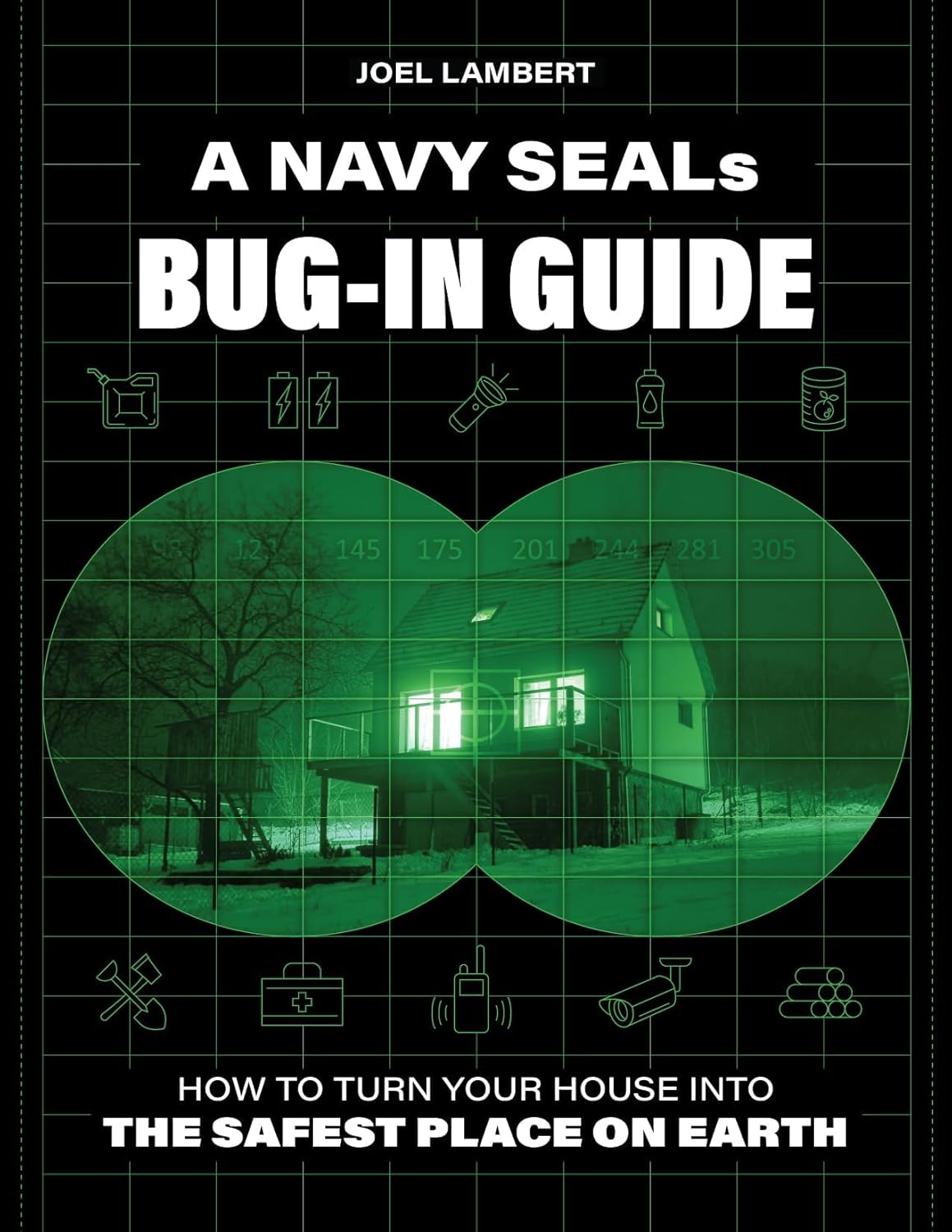
NAVY SEALS BUG IN GUIDE: How to Transform Your Home into the Safest Place on Earth audiobook cover - When the world breaks—power grids fail, roads clog, and panic spreads—the smartest move often isn’t to run. This guide lays out a practical, room-by-room, system-by-system plan to make your home a self-sufficient stronghold.

NAVY SEALS BUG IN GUIDE: How to Transform Your Home into the Safest Place on Earth

When the world breaks—power grids fail, roads clog, and panic spreads—the smartest move often isn’t to run. This guide lays out a practical, room-by-room, system-by-system plan to make your home a self-sufficient stronghold.

JAMES LANDERS

4.0 / 5(3 ratings)
Start ListeningDownloadQR code that opens AudiobookHub on the App StoreTry free on iPhoneScan to start in 5 seconds

If You're Curious About These Questions...

You should listen to this audiobook

Listen to NAVY SEALS BUG IN GUIDE: How to Transform Your Home into the Safest Place on Earth — Free Audiobook

Loading player...

Key Takeaways from NAVY SEALS BUG IN GUIDE: How to Transform Your Home into the Safest Place on Earth

Learning Tools

Reinforce what you learned from NAVY SEALS BUG IN GUIDE: How to Transform Your Home into the Safest Place on Earth

Mind Map

Navy Seal Bug In Guide Joel Lambert
The Bug-In Philosophy & Mindset+
Risk Assessment & The Home System+
Food Stockpiling & Protocols+
Water Security & Purification+
Utilities, Defense, & Communications+
Health, Hygiene, & Sanitation+
Skills, Community, & Advanced Hardening+

Quiz — Test Your Understanding

Question 1 of 9
According to the book, why is 'bugging in' (staying home) often a more realistic survival strategy than evacuating?
  • A. Public shelters are always well-equipped and safe.
  • B. Evacuating trades a known, prepared environment for uncertainty and risk.
  • C. Wilderness survival skills are easy for most people to learn quickly.
  • D. Emergency services guarantee clear roads and safe passage during a crisis.
Question 2 of 9
What are the three key inputs the book recommends for building a personalized risk profile to guide your preparations?
  • A. News reports, social media trends, and government alerts.
  • B. Your budget, the size of your house, and your family's preferences.
  • C. Regional hazards, specific home vulnerabilities, and historical patterns.
  • D. The availability of survival gear, proximity to military bases, and population density.
Question 3 of 9
Even within a 'bug-in' plan, why does the book emphasize the importance of having clear and multiple evacuation routes?
  • A. To have a way to get to a neighbor's house for supplies.
  • B. Because a bug-in plan might fail, and a safe exit is a critical backup.
  • C. To impress upon family members the seriousness of the situation.
  • D. To allow emergency responders easy access to the home.
Question 4 of 9
What is the 'First-In, First-Out' (FIFO) method recommended for managing a food stockpile?
  • A. Eating the most calorie-dense foods first to ensure high energy.
  • B. Using the oldest items first by incorporating them into regular meals and replacing them with new stock.
  • C. Storing food with the longest shelf-life at the front for emergencies.
  • D. Organizing the stockpile by food group, with proteins first and carbohydrates last.
Question 5 of 9
What is a primary limitation of using boiling as a water purification method, according to the guide?
  • A. It is ineffective against bacteria and protozoa.
  • B. It adds a bad taste that makes water undrinkable.
  • C. It does not remove chemical contaminants.
  • D. It requires specific equipment that is hard to find.
Question 6 of 9
When the grid fails, what is the concept of 'load shedding' that the book advises as a core practice?
  • A. Using a generator powerful enough to run the entire house at once.
  • B. Only running essential devices to conserve backup power.
  • C. Shutting down power completely at night to save fuel.
  • D. Shedding excess power from solar panels back into the grid.
Question 7 of 9
How does the book conceptualize the role of hygiene and sanitation in a long-term bug-in scenario?
  • A. As a matter of personal comfort that is secondary to security.
  • B. As an essential security system to protect against disease and microbes.
  • C. As a task that should be postponed until the initial crisis has passed.
  • D. As something only necessary if a member of the household is already sick.
Question 8 of 9
Beyond hardening your own home, what does the book identify as a crucial element for creating 'defense-in-depth'?
  • A. Building an alliance with local law enforcement.
  • B. Stockpiling more ammunition than anyone else in the area.
  • C. Creating a community-level defense through neighborhood watch and mutual aid networks.
  • D. Setting up complex and hidden traps around your property.
Question 9 of 9
What is the book's concluding message about the nature of a preparedness plan?
  • A. A plan, once made, should be followed rigidly without change.
  • B. Preparedness is a one-time effort of buying supplies and hardening the home.
  • C. The most expensive gear is the most important part of any plan.
  • D. A plan must be a 'living system' that is continuously reassessed, practiced, and adapted.

NAVY SEALS BUG IN GUIDE: How to Transform Your Home into the Safest Place on Earth — Full Chapter Overview

NAVY SEALS BUG IN GUIDE: How to Transform Your Home into the Safest Place on Earth Summary & Overview

This book argues that in most real emergencies, staying home—“bugging in”—beats fleeing into uncertainty. It frames the house as the one place you understand best, where your supplies, tools, routines, and neighbors can become force multipliers rather than liabilities. From that premise, it builds a layered preparedness plan: assess likely threats, harden weak points, and stock the essentials that keep life functioning when outside systems collapse.

Chapter by chapter, the guide covers home risk assessment, food and water planning, backup power, defensive hardening, communications when internet and cell service fail, medical readiness, sanitation for long disruptions, core survival skills, and the psychological side of enduring isolation and stress. It closes by expanding preparedness beyond one household—security tech, neighborhood watch, mutual aid, and safe resource sharing—then emphasizes constant review and adaptation as conditions change.

Who Should Listen to NAVY SEALS BUG IN GUIDE: How to Transform Your Home into the Safest Place on Earth?

  • Homeowners or renters who want a structured “bug-in” plan for outages, storms, supply disruptions, or unrest
  • Families building practical stockpiles (food, water, meds) and household procedures without relying on fantasy survival scenarios
  • Community-minded preppers interested in neighborhood coordination, watch networks, and mutual aid

About the Author: JAMES LANDERS

James Landers is listed as the author of NAVY SEALS BUG IN GUIDE. No additional verified biographical details are provided in the supplied excerpt.

🎧
Listen in the AppOffline playback & background play
Get App