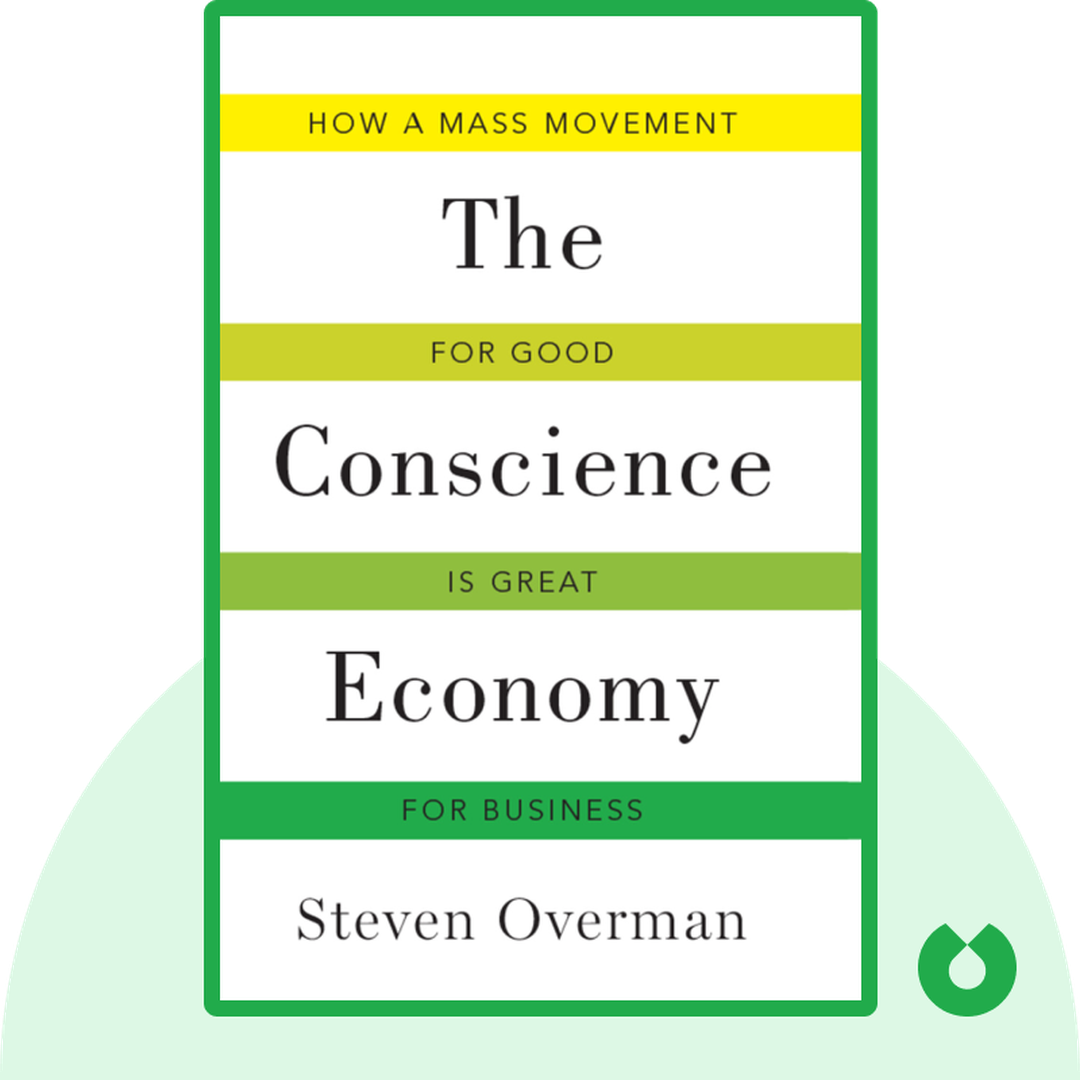
The Conscience Economy
Start ListeningDownload Try free on iPhoneScan to start in 5 seconds
Categories:
If You're Curious About These Questions...
You should listen to this audiobook
- Have you ever wondered why eco-friendly and fair-trade products have suddenly transformed from niche interests into the driving force of the global market?
- What’s the secret to winning over the new generation of hyperconnected consumers who value a company's ethics as much as its products?
- Are you curious about how the world’s most successful brands are rewriting their playbooks to survive in an era where every business decision is under a public microscope?
Listen to The Conscience Economy — Free Audiobook
Loading player...
Key Takeaways from The Conscience Economy
- Understand why the era of the ruthless, profit-driven businessman is over, and discover how absolute transparency is now required to win the loyalty of modern consumers.
- Discover how the hyperconnected nature of the internet is doing more than just spreading information—it is actively cultivating a powerful, global culture of empathy.
- Learn how to survive in the new 'conscience economy' by ensuring your corporate culture prioritizes strong ethical values and global problem-solving over bottom-line profits.
- Find out why unethical practices will quickly lead to a brand's downfall at the hands of highly informed young consumers who expose corporate wrongdoings on social media.
- Recognize the profound societal shift toward a new 'conscience culture' that radically redefines self-actualization and demands authentic social responsibility from businesses.
Learning Tools
Reinforce what you learned from The Conscience Economy
Mind Map
The Conscience Economy
The New Consumer Generation+
Conscience Culture+
Brand Strategy & Survival+
Corporate Social Responsibility (CSR)+
The New Marketing: Matchmaking+
Internal Implementation+
Quiz — Test Your Understanding
Question 1 of 7
Why are modern consumers demanding more ethical behavior from companies compared to those in the twentieth century?
Question 2 of 7
How does the book describe the relationship between technological connectedness and human conscience?
Question 3 of 7
How does 'conscience culture' view the concept of self-actualization differently than established global culture?
Question 4 of 7
According to the text, what drives the vast majority of consumer decision-making when choosing between brands?
Question 5 of 7
What is the predicted future for Corporate Social Responsibility (CSR) in the conscience economy?
Question 6 of 7
In the conscience economy, marketers must shift away from manipulation and instead act as 'matchmakers.' Which of the following is NOT one of the new '5 Cs' of marketing?
Question 7 of 7
What actionable advice does the author give for companies wanting to implement fairer or more sustainable corporate policies?
The Conscience Economy — Full Chapter Overview
- 1Recommendation
- 2Naughtiness has gone out of style – today, good is sexy!
- 3Technological advances make us more connected, and more empathetic too.
- 4Consumers’ rising awareness of global challenges dramatically increases the pressure on companies to provide real, effective solutions.
- 5Conscience culture is replacing the culture we once knew well.
- 6Today, brands must communicate the values of the conscience economy – or simply fade away.
- 7In the conscience economy, a corporation’s social engagement sits at the heart of its business.
- 8Marketers need to become matchmakers to thrive in the conscience economy today.
The Conscience Economy Summary & Overview
The Conscience Economy (2014) reveals the implications that our changing, hyperconnected world has for businesses and brands. These blinks guide you through the principles and strategies that are vital for any company hoping to win over the outspoken, discerning consumers at the heart of today’s conscience culture.
Who Should Listen to The Conscience Economy?
- Readers curious as to why eco-friendly and fair-trade products are suddenly so trendy
- Marketers who closely follow the changing nature of branding
- Managers and leaders who want to learn more about the new generation of critical, inquisitive customers
Books Similar to The Conscience Economy
Readers who enjoyed this also liked these titles.